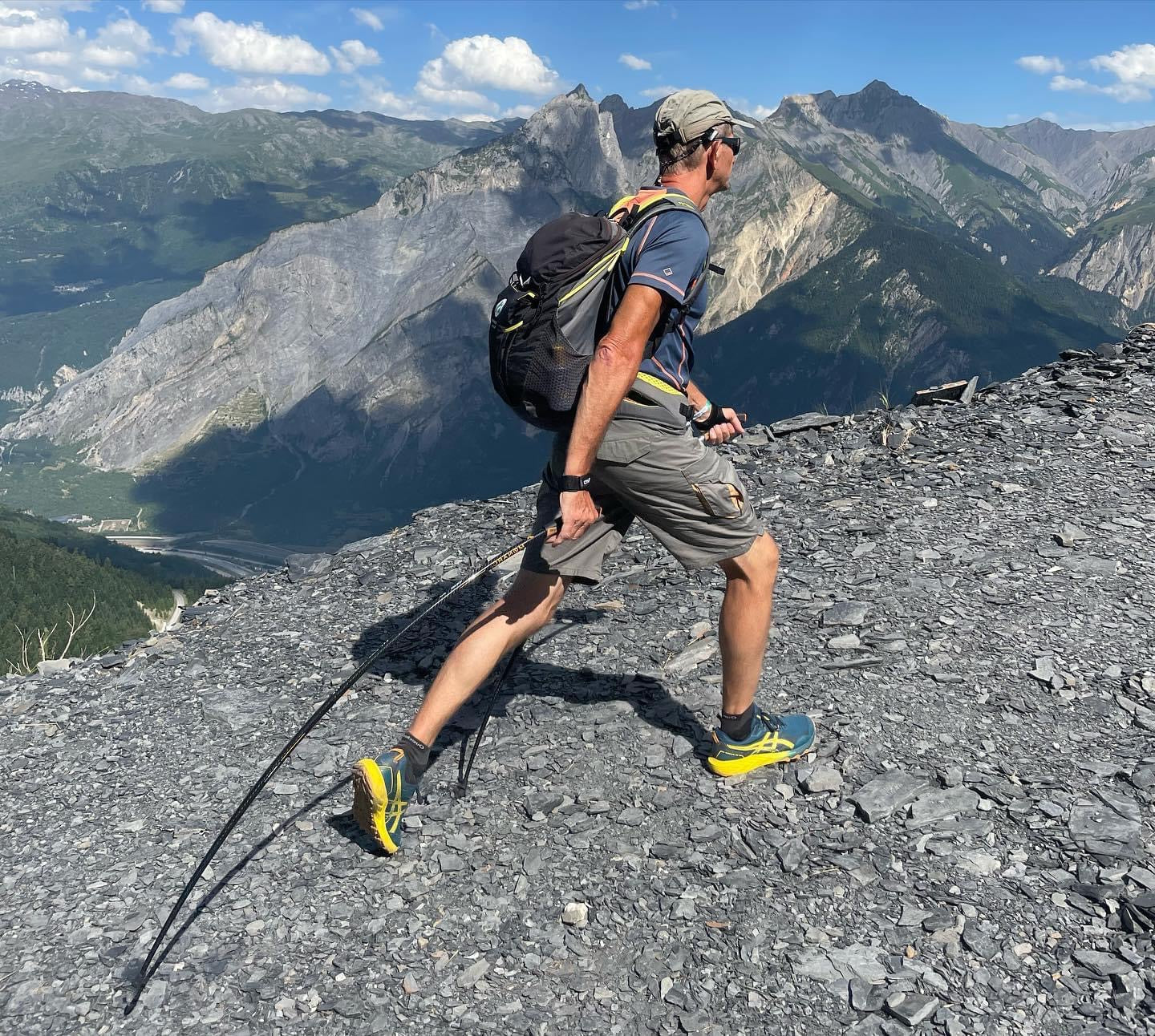
An 8-Week Nordic Walking Training Programme
To make progress in Nordic walking in 8 weeks, three sessions a week are enough: an endurance walk, an interval session and a long walk, with the duration built up little by little. The programme below takes you from 95 to 150 minutes of walking a week if you are a beginner, and from 150 to over 200 minutes if you already walk, spending most of the time in zone 2, at a pace at which you can still talk. Warm-up, cool-down and strength work are included.
In short
- 3 sessions a week: you alternate endurance, intervals and a long walk, with a rest day between two sessions.
- Duration: beginners go from 95 to 150 minutes a week, intermediates from 150 to 205 minutes. The WHO recommends 150 to 300 minutes of moderate activity a week.
- Intensity: you walk mostly in zone 2 (60 to 70% of maximum heart rate), where you can speak in full sentences, and do the intervals in zone 3, where you can only manage short sentences.
- Structure: each session starts with a 10-minute warm-up and ends with a 5-minute cool-down. Two 15-minute strength sessions are added each week.
- Milestones: week 4 is lighter, and a 2 km test in weeks 2 and 8 measures your progress.
- Before week 1: choose poles of the right length, i.e. your height multiplied by 0.68.
Three checks before week 1
Your health
Nordic walking suits almost everyone, but ask your doctor before starting if you have a heart or lung condition or diabetes, persistent joint pain, or if you have not exercised for years. The French Club des cardiologues du sport also advises a medical check-up before taking up intense activity again over the age of 35 for men and 45 for women. During the programme, stop and see a doctor if you have chest pain, unusual breathlessness, palpitations or feel faint.
Your poles
A pole that is too long pushes your shoulder up; one that is too short cuts your push short. To find the right length, multiply your height by 0.68 and, between two lengths, take the shorter one (a very sporty walker can take the one above). For example, for a height of 1.65 m, the calculation gives 1.12 m (1.65 × 0.68), so you would take 110 cm poles. For the straps, measure around your hand: S under 18 cm, M from 18 to 20 cm, L over 20 cm. Everything is explained in our size guide.
Your shoes
Flexible walking or trail shoes with a lugged sole are all you need. Avoid town shoes, which slip on paths. Our advice is in Choosing shoes for Nordic walking.

Three sessions a week, each with its own role
Each week has three different sessions. Put them on non-consecutive days, for example Tuesday, Thursday and Saturday.
- Endurance (zone 2) builds your base. It is a continuous walk at a steady pace, during which you can hold a conversation.
- Intervals (zones 2 and 3) teach you to walk faster. You alternate harder blocks with blocks of active recovery. In week 1, this session is used to work on technique.
- The long walk (zone 2) gets your body used to duration. It is the session that grows most from one week to the next; a hilly route is welcome from week 5.
Progress stays gentle. You add 10 to 15 minutes a week at most, and week 4 is lighter to let your body absorb the work. The WHO advises the same approach for people taking up activity again, starting small and then gradually increasing frequency, intensity and duration (Bull et al., 2020).
Judging the effort with heart-rate zones and how it feels
The programme is set in heart-rate zones, expressed as a percentage of your maximum heart rate (max HR). Without a heart-rate monitor, how it feels and the talk test are enough. If you can talk but not sing, the effort is moderate. If you can only say a few words without pausing for breath, it is vigorous (CDC).
| Zone | % of max HR | Perceived effort out of 10 | Talk test | In the programme |
|---|---|---|---|---|
| Zone 1 | 50 to 60% | 2 to 3 | You could sing | Warm-up, cool-down |
| Zone 2 | 60 to 70% | 4 to 5 | Full sentences | Endurance, long walk, recoveries |
| Zone 3 | 70 to 80% | 6 to 7 | Short sentences | Interval blocks |
| Zone 4 | 80 to 90% | 8 | A few words | Hills, for intermediates only |
To estimate your max HR, the Tanaka formula (208 − 0.7 × age) is more accurate than the classic “220 minus age”, which underestimates it after 40 (Tanaka et al., 2001). At 60, it gives 166 beats per minute; zone 2 is then between 100 and 116 beats, zone 3 between 116 and 133. It is only an estimate, give or take about ten beats. If the figure and the feeling do not match, trust the feeling.
Nordic walking calls for two clarifications. First, at the same speed, the poles make your body work harder. In a field study, oxygen uptake rose by about 20% and heart rate by 5 to 8 beats per minute, without the walkers finding the effort harder (Church et al., 2002). Second, a wrist watch measures your heart less accurately when you hold poles, and a chest strap is more reliable (Baek et al., 2021). Our article on apps and smartwatches will help you choose. For pace and zones in detail, read What speed in Nordic walking? Pace, heart-rate zones and progression.
The programme week by week
Choose your level. You are a beginner if you walk little or are new to Nordic walking, and an intermediate if you already walk at least twice 45 minutes a week without difficulty. In the calendar, the large figure is the duration for a beginner and the small one for an intermediate, including warm-up and cool-down.

| Week | Beginner (endurance · intervals · long walk) | Intermediate (endurance · intervals · long walk) |
|---|---|---|
| 1 | 30 · 30 (technique) · 35 = 95 min | 45 · 45 (6 × 2 min) · 60 = 150 min |
| 2 | 30 · 35 (5 × 1 min) · 40 with test = 105 min | 45 · 50 (5 × 3 min) · 65 with test = 160 min |
| 3 | 35 · 35 (6 × 1 min 30) · 45 = 115 min | 50 · 50 (4 × 5 min) · 75 = 175 min |
| 4 (lighter) | 30 · 30 (5 × 1 min) · 40 = 100 min | 40 · 45 (6 × 2 min) · 60 = 145 min |
| 5 | 40 · 40 (5 × 2 min) · 50 = 130 min | 50 · 55 (hills 8 × 1 min) · 80 = 185 min |
| 6 | 40 · 45 (4 × 3 min) · 55 = 140 min | 50 · 55 (3 × 8 min) · 90 = 195 min |
| 7 | 45 · 45 (4 × 4 min) · 60 = 150 min | 55 · 60 (hills 10 × 1 min) · 90 = 205 min |
| 8 | 45 · 45 (2 km test) · 60 = 150 min | 45 · 50 (2 km test) · 90 = 185 min |
Getting started in weeks 1 and 2
These two weeks are for learning the movement and getting your body used to the poles. Everything happens in zone 2, apart from short blocks in week 2. The interval session in week 1 is a technique session with 15 minutes of drills. You walk trailing the poles, plant each pole behind your front foot and open your hand at the end of the push. Our 7 exercises to improve your technique give you the details. In week 2, you do your first intervals, 5 × 1 minute in zone 3 with 2 minutes in zone 2 in between. With Arcs de Marche®, the movement stays that of Nordic walking, and these two weeks also give you time to find your rhythm with the curve.
The benchmark test takes place during the week 2 long walk. After the warm-up, time 2 km on a flat, familiar route, at the briskest pace you can hold steadily without going into the red, then finish the walk in zone 2. Note your time and your perceived effort out of 10.
Building up in weeks 3 and 4
Now the aim is to walk for longer and hold the intervals. In week 3, the beginner moves up to 6 × 1 minute 30 in zone 3, with 1 minute 30 of recovery, and the long walk reaches 45 minutes. The intermediate moves up to 4 × 5 minutes. Week 4 is deliberately lighter, with fewer minutes but the same regularity. It gives your body time to absorb the work; do not skip it, even if you feel fit.
Consolidation in weeks 5 and 6
You now learn to hold longer blocks and you tackle hills. The interval blocks go up to 2 and then 3 minutes for the beginner, and the long walk passes 50 minutes, on a slightly hilly route if you can. The intermediate starts hill work with 8 brisk one-minute climbs in zone 4, walking back down easily, then moves on to 3 × 8 minutes in zone 3 the following week. Uphill, shorten your stride a little and push firmly on the poles.
Autonomy in weeks 7 and 8
The aim is now to walk for an hour without difficulty and to measure your progress. The beginner reaches 150 minutes a week, the minimum the WHO recommends for adults (Bull et al., 2020), with 4-minute blocks in zone 3 and a one-hour long walk. The intermediate takes on 10 one-minute hill climbs and 90-minute long walks.
In week 8, repeat the 2 km test in the same conditions as in week 2. Compare the time, but also how it feels, because at the same pace the effort should feel easier. Eight weeks can be enough to make a difference. In an 8-week trial with 3 sessions a week, untrained people aged 60 to 80 improved their self-selected walking speed and their balance (Gomeñuka et al., 2019).
The typical session, from warm-up to cool-down
Every session follows the same structure. The Club des cardiologues du sport recommends always including a warm-up and a recovery of around ten minutes. The programme therefore has a 10-minute warm-up, then 5 minutes of cool-down followed by a few minutes of gentle stretching.

- Warm-up, 10 minutes in zone 1. Walk slowly for 5 minutes with the poles trailing, loosen your joints for 3 minutes (shoulder, hip and ankle circles), then gradually speed up for 2 minutes to the pace of the session.
- Main set. In the endurance session, keep a steady pace in zone 2. In the interval session, do the blocks shown in the calendar and recover in zone 2. On the long walk, stay in zone 2 without chasing speed.
- Cool-down, 5 minutes in zone 1. Walk slowly with your shoulders relaxed. Then gently stretch, without forcing and for 20 to 30 seconds each, your calves, the front and back of your thighs, your chest and your shoulders.
Drink 3 to 4 sips of water every 30 minutes of exercise, as the Club des cardiologues du sport also advises, and more when it is hot.
Two 15-minute strength sessions a week
The WHO recommends that adults do muscle-strengthening activities involving all major muscle groups on at least 2 days a week (Bull et al., 2020). Do this circuit after the endurance session and after the long walk, or at home on another day, in 2 to 3 rounds of 10 to 15 repetitions per exercise.
- Sit-to-stands: stand up from a chair without using your hands to work your thighs and glutes.
- Forward lunges: do them leaning on your poles to strengthen your thighs and balance.
- Press-ups against a wall or a table: they work your arms, chest and triceps, which are the pushing muscles.
- Front plank: hold for 20 to 30 seconds, on your knees at first, to strengthen your abdominals and back.
- Calf raises: they strengthen your calves.
Over 65, the WHO advises varied activities that combine balance and strength on at least 3 days a week. At the end of each session, add 30 seconds standing on one foot, on each side, next to a wall.
What the Arcs de Marche® change over 8 weeks
As the programme goes on, your sessions grow from 30 to 60 minutes, and up to 90 for intermediates. The number of pole plants rises with them. With one plant per step and about 100 steps a minute, a 150-minute week adds up to some 15,000, and the shape of the pole plays a part in every one of them.

The Arcs de Marche® are the first poles whose shape has been scientifically compared with that of straight poles. In the Université Grenoble Alpes study, carried out with 8 regular walkers at 5 and 6 km/h, the curve lowers the push angle from 46° to 33°. The push thus becomes more horizontal and propulsion 22% more efficient, while the vibration transmitted to the arms falls by 22 to 26%. Heart rate and oxygen uptake stay the same at equal speed, so this mechanical gain requires no extra effort. This is what our walkers call the “booster effect”. The study is small and its authors call for larger studies; the details are on the Université Grenoble Alpes study page (in French).
Designed for the Nordic walking movement, not adapted from a hiking pole, the Arcs are also accepted in competition on all circuits in Europe. They can therefore take you well beyond week 8.
Following the programme with a club
A programme is easier to stick to with others. A coach corrects your technique from the first sessions, the group helps you hold the intervals, and a fixed meeting time stops you skipping a week. In a MØNARC® Partner Club, members get €30 off each pair of Arcs de Marche®. To find a club near you, read our article on Nordic walking in a group.
Do you run a club? This programme can serve as the outline for an 8-week cycle for your new members. The Partner Club label gives them the discount on the Arcs and gives the club preferential terms on our certified training courses for coaches.
And after the 8 weeks?
Keep three sessions a week and the strength work. You can then lengthen the long walk, add a fourth easy session or look for hills, staying between 150 and 300 minutes a week, the range recommended by the WHO. Repeat the 2 km test every 8 weeks. In the long term, a review of 16 randomised trials concluded that Nordic walking improves resting heart rate, blood pressure, exercise capacity and maximum oxygen uptake (Tschentscher et al., 2013).
If your goal is to lose weight, follow on with our 12-week weight-loss programme.
Frequently asked questions
How many Nordic walking sessions a week to make progress?
Three sessions a week, separated by a rest day, are enough to make progress. Aim for at least 150 minutes of walking a week in total, the minimum recommended by the WHO for moderate activity.
Can you Nordic walk every day?
You can walk every day at an easy pace if you have no pain. Keep at least one rest day a week and do not do two interval sessions in a row.
Do you need a heart-rate watch for the programme?
No, the talk test is enough. In zone 2 you speak in full sentences; in zone 3 you can only manage short sentences. If you want to track your zones to the beat, choose a chest strap over wrist measurement, which is less accurate with poles.
What if I miss a session or a week?
If you miss a session, move on to the next one without catching up the next day. If you miss a whole week, repeat the previous week before carrying on. If you are ill, rest. The Club des cardiologues du sport points out that you should not do intense exercise with a fever, nor in the 8 days after a bout of flu.
Sources
- Bull F.C. et al., “World Health Organization 2020 guidelines on physical activity and sedentary behaviour”, British Journal of Sports Medicine, 2020, 54(24): 1451-1462.
- Tanaka H., Monahan K.D., Seals D.R., “Age-predicted maximal heart rate revisited”, Journal of the American College of Cardiology, 2001, 37(1): 153-156.
- Church T.S., Earnest C.P., Morss G.M., “Field testing of physiological responses associated with Nordic Walking”, Research Quarterly for Exercise and Sport, 2002, 73(3): 296-300.
- Baek S., Ha Y., Park H.W., PM&R, 2021, 13(4): 379-386.
- Gomeñuka N.A. et al., “Effects of Nordic walking training on quality of life, balance and functional mobility in elderly: a randomized clinical trial”, PLoS One, 2019, 14(1): e0211472.
- Tschentscher M., Niederseer D., Niebauer J., “Health benefits of Nordic walking: a systematic review”, American Journal of Preventive Medicine, 2013, 44(1): 76-84.
- Centers for Disease Control and Prevention (CDC), “Measuring Physical Activity Intensity”, accessed October 2026.
- Club des cardiologues du sport, “Les 10 règles d’or” (the 10 golden rules), accessed October 2026.
- Termoz N., Depery E., Lorenzi G., Université Grenoble Alpes: study of straight poles versus MØNARC® curved poles, 8 participants.

The MØNARC® Arcs de Marche®
These curved 100% carbon Nordic walking poles weigh 140 g each and are designed and assembled in France. They are delivered ready to walk with straps, tungsten carbide tips and a made-to-measure bag.
Disclaimer. This article provides general information. It does not replace the advice of a doctor or health professional, nor supervision by a qualified instructor. Before starting or stepping up physical activity, especially if you have a health condition, pain or ongoing treatment, consult your doctor. Exercise according to your fitness, on suitable ground and with equipment in good condition. Each reader remains solely responsible for their own practice and for the decisions they make based on this information, and MONARC SAS cannot be held liable for their consequences.