Ultra-Walking 100 km and Beyond: What Equipment to Go Really Far?
There is an invisible frontier in the world of sporting walking. It lies somewhere around the 60th kilometre, where the legs start to weigh, where the blisters wake up, where the mind negotiates with the body. The ultra-walkers who regularly cross that frontier (100, 120, 160, 200 km) share one thing: they have learned to make equipment choices that forgive no approximation.
Ultra-walking: definition and formats
We speak of ultra-walking as soon as the distance exceeds the marathon (42.195 km). In practice, the community considers events from 60-80 km as "ultra". The most emblematic formats start at 100 km, the Oxfam Trailwalker being the best-known example in France, and rise to multi-day Alpine crossings exceeding 200 km. The specificity of these events: they are walked, sometimes coupled with phases of light running. Rhythm is fundamental, economy of movement is queen.
Poles: indispensable beyond 60 km
In trail ultras, poles are often optional on short formats. Beyond 60-80 km, they become almost universal in the field. The reason is simple: they redistribute the muscular work between the upper and lower body, delaying the exhaustion of the lower limbs and preserving the joints over the repetition of thousands of steps.
For ultra-walkers specifically, those who maintain a sustained walking rhythm without running, the poles' role is even more central. They are active at every step, for the whole duration of the event. Their quality, weight and geometry directly influence effort management over 24, 36 or 48 hours.
The pole-choice criteria for ultra-walking
- Weight: over 100 km, every gram is carried tens of thousands of times. Poles of 140 g each represent 280 g in total. Poles of 280 g represent 560 g. The difference seems minimal; over 20 hours, it is physically significant.
- Stiffness: a pole that flexes or vibrates absorbs part of the push energy and dissipates it. In an ultra, you want every push transmitted to the ground in full. High-grade carbon (T700 and above) guarantees that stiffness without compromise.
- Detachable straps: on an ultra, you refuel, you dress, you manage your things. Straps that release in seconds are indispensable to avoid losing time or hurting your wrists trying to free your hands quickly.
- Versatile tips: the surfaces change constantly. Tungsten carbide tips with interchangeable rubber pads let you adapt without stopping.
- The carry bag: at a refreshment point, if your poles are no longer useful on a section, you must be able to stow them quickly in your bag or around the pack.
The specific ultra-walking technique
In long-distance ultra-walking, the technique must above all be economical. This is not the time for grand spectacular movements. On the flat, the pole is planted slightly behind the front foot, the push is long and relaxed, the arm opens fully backwards. Uphill, you shorten the step, increase the pole frequency, alternate or double-push depending on the steepness. Downhill, you release the straps and use the poles as shock absorbers and balance guides.
Regularity of movement is the key. Degraded technique after 60 km (arms that no longer open, a push that stops too early) creates muscular compensations that exhaust secondary muscle groups and hasten the arrival of cramps.
The MØNARC® Arcs de Marche in ultra-walking
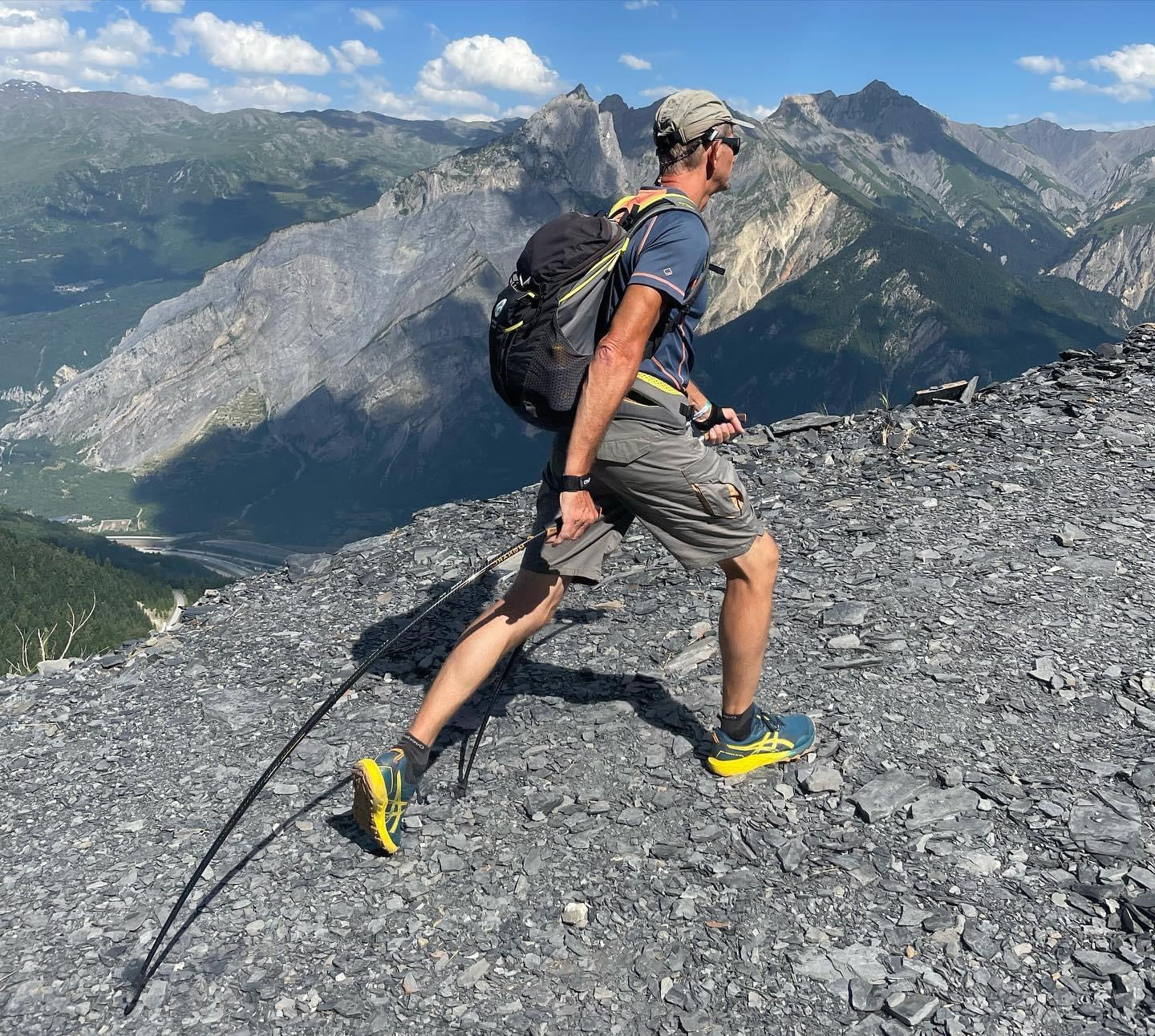
Marie-Élisabeth Charre reports with the Arcs de Marche®: "a better push that lets you lengthen the step and go faster. The MØNARC let you go further without waking the aches", notably her ankle arthrodesis and shoulder problems. That is exactly what every ultra-walker seeks: to go further, for longer, while protecting the weak points.
Alain Gestin, an ultra-walker used to long distances, regularly practises with the MØNARC® Arcs de Marche. For him, these poles are an integral part of his effort strategy on events beyond 100 km.

The MØNARC® Arcs de Marche®
Curved 100% carbon Nordic walking poles, 140 g per pole, designed in France and assembled in France. 140 g per pole and a forward-directed push: they are designed for distance.
Disclaimer. This article provides general information. It does not replace the advice of a doctor or health professional, nor supervision by a qualified instructor. Before starting or stepping up physical activity, especially if you have a health condition, pain or ongoing treatment, consult your doctor. Exercise according to your fitness, on suitable ground and with equipment in good condition. Each reader remains solely responsible for their own practice and for the decisions they make based on this information, and MONARC SAS cannot be held liable for their consequences.