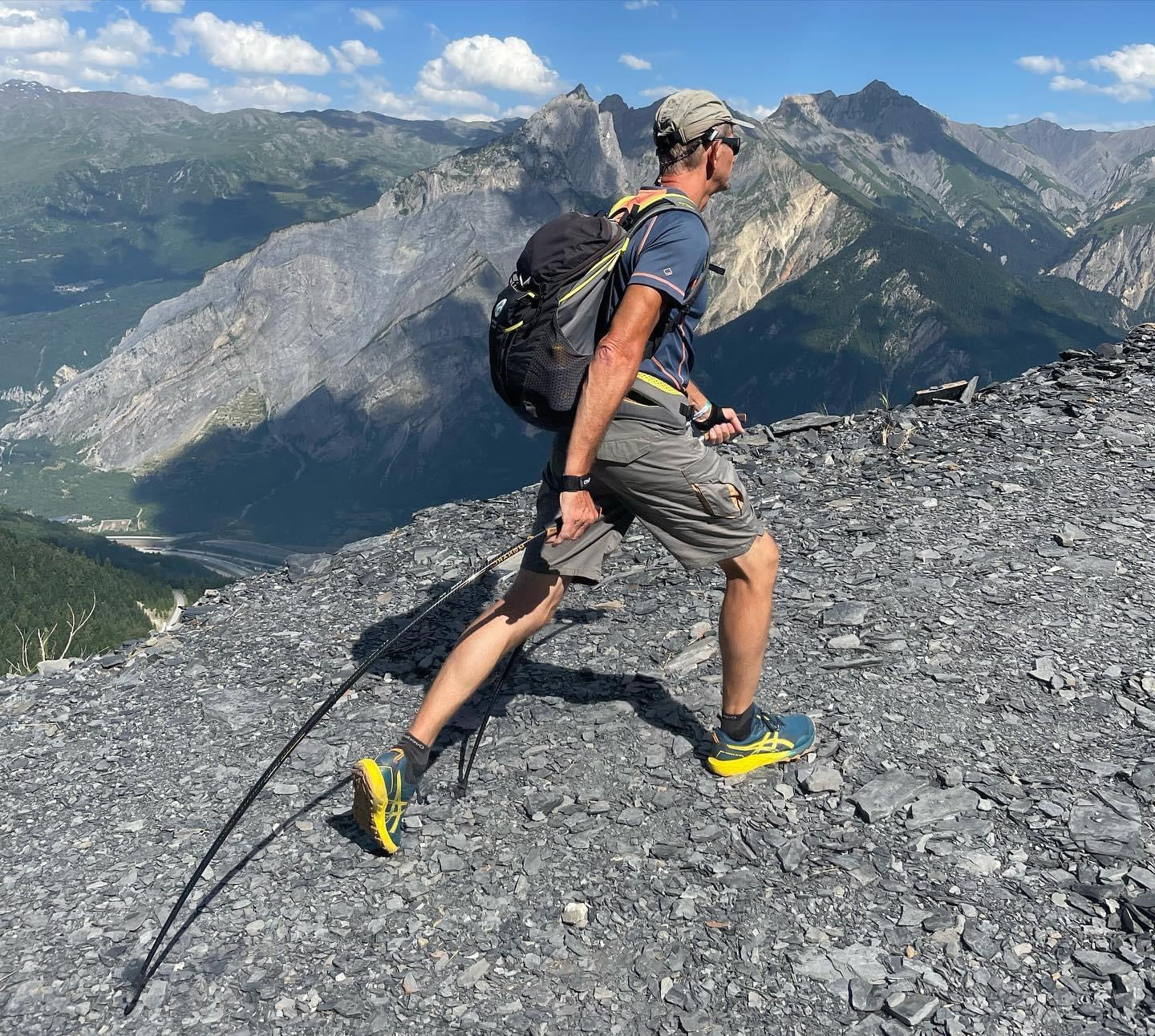
Nordic Walking and Obesity: A Particularly Suitable Activity
Obesity is one of the most complex public-health challenges of our time. While diet plays a central role, regular physical activity is an essential pillar of any sustainable weight-management approach. Among the recommended disciplines, Nordic walking has a profile particularly suited to people who are overweight or obese, provided you understand why and how to practise it.
Why Nordic walking is particularly recommended for obesity
People who are overweight or obese face specific constraints that make many sports difficult or injurious: joint overload, rapid breathlessness, knee and hip pain, lack of self-confidence in sporting environments. Nordic walking answers these constraints remarkably well:
- Low joint impact: the poles absorb up to 30% of the body's weight, relieving the knees and hips at every step, a decisive advantage for people whose joints already carry a heavy load
- High calorie burn for a moderate perceived effort: at the same pace, Nordic walking burns between 20% and 40% more calories than ordinary walking, by engaging the arms, shoulders, back and abdominals
- Accessible from day one: no intimidating sports equipment, no competition, no imposed speed. You start at your own pace.
- Progressive and scalable: you start on the flat, increase the distances, gradually add elevation. Nordic walking naturally adapts to physical progress
What the studies say about Nordic walking and weight loss
A systematic review of Nordic walking programmes in overweight or obese people shows that after 4 to 10 weeks of regular practice, participants observe:
- Weight loss of between 0.7% and 6.4% of initial weight
- A reduction in body mass index (BMI)
- A decrease in fat mass and waist circumference
- Improved glucose tolerance
These results are obtained with programmes of 4 to 5 sessions per week of 60 minutes. A study by the University of Verona followed 38 adults over 6 months of regular Nordic walking and observed a significant reduction in body fat and waist circumference.
Calories burned: concrete figures
Nordic walking burns about 400 kcal per hour for a 60 kg person at a sustained pace, against 280 kcal for ordinary walking. For an 80 kg person, that expenditure can reach 600 kcal/hour. The activity sits between 6 and 8 MET (Metabolic Equivalent of Task) depending on pace and terrain, making it a moderate- to high-intensity activity.
The psychological benefit: walking without being judged
Nordic walking has a psychological advantage often underestimated in the context of obesity: it is practised in natural environments, without a gym, without others' gazes, at your own pace. It restores a positive relationship with the body in motion. Several studies note a significant improvement in quality of life and self-esteem in regular practitioners, independently of weight loss.
Suitable poles for more comfort and safety
For people who are overweight, solid, well-calibrated poles are essential. Poles that are too light or too thin can feel insufficient as a support; poles that are too heavy tire the arms quickly. The MØNARC® Arcs de Marche, in T700 carbon, offer the optimal combination: a lightness of 140 grams per pole and maximum stiffness for reliable support, whatever the pressure applied.
This article is for information purposes. A physical-activity programme adapted to overweight or obesity should ideally be followed with the support of a doctor or specialised coach.

The MØNARC® Arcs de Marche®
Curved 100% carbon Nordic walking poles, 140 g per pole, designed in France and assembled in France. Their curve directs the push more forwards and reduces the vibrations transmitted to the arms, two effects measured by Université Grenoble Alpes.
Disclaimer. This article provides general information. It does not replace the advice of a doctor or health professional, nor supervision by a qualified instructor. Before starting or stepping up physical activity, especially if you have a health condition, pain or ongoing treatment, consult your doctor. Exercise according to your fitness, on suitable ground and with equipment in good condition. Each reader remains solely responsible for their own practice and for the decisions they make based on this information, and MONARC SAS cannot be held liable for their consequences.