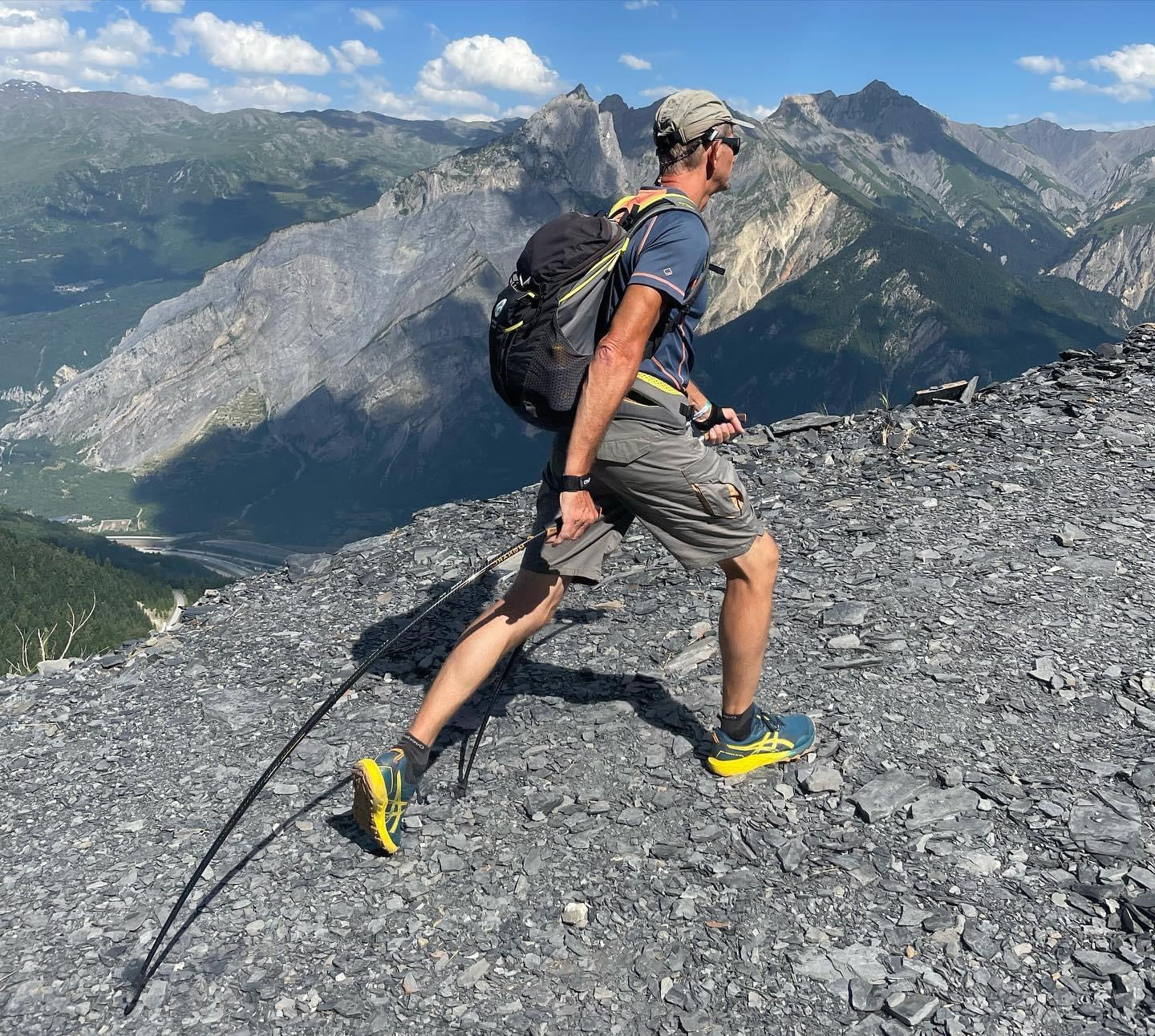
Nordic Walking Poles: Carbon, Aluminium or Fibreglass, Which Material to Choose?
When choosing your first Nordic walking poles, one question always comes up: carbon or aluminium? Behind this choice of material lie very different sensations in the field, and direct consequences for your joints, your speed and your walking pleasure.
Aluminium: solid entry level, but limited
Aluminium poles dominate the entry level. They have one merit: they are robust, take impacts well and come at an attractive price. This is what some manufacturers still recommend for complete beginners or very occasional walkers, at one outing per week at most.
But aluminium has a major flaw for Nordic walking: it does not absorb vibrations. Every impact with the ground travels up into the wrists, elbows, then shoulders. On a 30-minute outing, it is bearable. Over 1.5, 2 or 3 hours, these repeated micro-shocks can encourage tendinitis and joint pain, particularly in people who are already fragile.
Fibreglass: a damper, but a compromise
Fibreglass naturally absorbs part of the vibrations at impact, which protects the joints better than aluminium. However, a pure fibreglass pole is noticeably heavier and clearly less dynamic: part of the push is lost in the material's softness instead of serving forward motion. It is an entry-level material, not a performance one.
Carbon: fewer vibrations, more lightness
Carbon is a composite material. The higher the carbon percentage, the lighter, stiffer and more filtering the pole. Major retailers recommend at least 50% carbon for regular practice, and 70% or more for intensive practice, precisely to limit vibrations in the arms and gain dynamism.
Concretely, what does that change?
- You can walk longer without pain in the shoulders or elbows.
- Every push is more efficient: the pole twists less and better transmits your movement.
- You gain precision of support on technical terrain (climbs, descents, side slopes).
This is why all competition Nordic walking poles are carbon, and why aluminium remains confined to occasional use.
Stiff, but not "brittle": the case of T700 carbon
You sometimes read that 100% carbon poles are "too stiff" or fragile. In reality, everything depends on the carbon grade and the design of the shaft. T700 carbon, used on the MØNARC® Arcs de Marche®, is a high-end carbon widely used in industry for its mechanical strength and durability. It sits just below the most exclusive aerospace carbons.
This technical choice produces a pole that is both very stiff (no push lost in flexing) and very light (around 140 grams per pole), while remaining robust enough to withstand the demands of an ultra-trail, a vertical kilometre or an ultra-walk of more than 100 km.
Vibrations and joints: what the studies say
The technical sheets of the leading Nordic walking players are clear: the higher the carbon content, the more vibrations are filtered, which protects the joints and improves comfort. Conversely, aluminium lets the shock wave travel up to the shoulders. Over thousands of steps, the difference translates into less fatigue, less tension and faster recovery.
In a study carried out with Université Grenoble Alpes, the MØNARC® Arcs de Marche® also show a particularity: their curve changes the push angle (33° versus 46° for a straight pole) and directs the force more towards the front. Result: at equal speed, perceived effort is significantly lower than with classic straight poles.
The comparison at a glance
| Material | Vibrations | Weight | Push transmission | Verdict |
|---|---|---|---|---|
| Aluminium | High | Heavy | Low | ❌ Avoid |
| Fibreglass | Low | Medium | Medium | ⚠️ Entry level |
| Carbon 50–70% | Low | Light | Good | ✅ Decent |
| Carbon 100% | Minimal | Ultra light | Maximum | ⭐ MØNARC® reference |
Curved carbon: the MØNARC® option
The MØNARC® Arcs de Marche® go further than a classic straight carbon shaft:
- High-strength T700 carbon for maximum stiffness and a weight of around 140 g per pole.
- An exclusive full curve that naturally directs the push forwards rather than downwards.
- Tungsten carbide tip, detachable straps (S/M/L) and a made-to-measure carry bag.
So it is not just a "carbon pole", but a complete system designed for propulsion, precision of movement and lasting comfort, whether in cardiac rehabilitation, sporty Nordic walking, ultra-walking or ultra-trail.

The MØNARC® Arcs de Marche®
Curved 100% carbon Nordic walking poles, 140 g per pole, designed in France and assembled in France. Delivered ready to walk with straps, tungsten carbide tips and a made-to-measure bag.
So, carbon or aluminium?
If you walk once a month, for 30 minutes, an entry-level aluminium pole may be enough to discover the discipline. But as soon as you aim for regular practice, outings of an hour or more, progress in speed or hilly terrain, carbon clearly wins.
And if you are looking for performance, comfort and committed French design (assembly in an ESAT) all at once, the MØNARC® Arcs de Marche® offer one of the most accomplished propositions on today's market.
👉 Discover the MØNARC Arcs de Marche® on monarc-nordic.com
Going further
- What size Nordic walking poles should you choose? The complete guide
- The different types of Nordic walking pole tips: how to choose?
- One-piece or telescopic Nordic walking poles: which to choose?
- Nordic walking: the 7 criteria for choosing your poles well
Disclaimer. This article provides general information. It does not replace the advice of a doctor or health professional, nor supervision by a qualified instructor. Before starting or stepping up physical activity, especially if you have a health condition, pain or ongoing treatment, consult your doctor. Exercise according to your fitness, on suitable ground and with equipment in good condition. Each reader remains solely responsible for their own practice and for the decisions they make based on this information, and MONARC SAS cannot be held liable for their consequences.