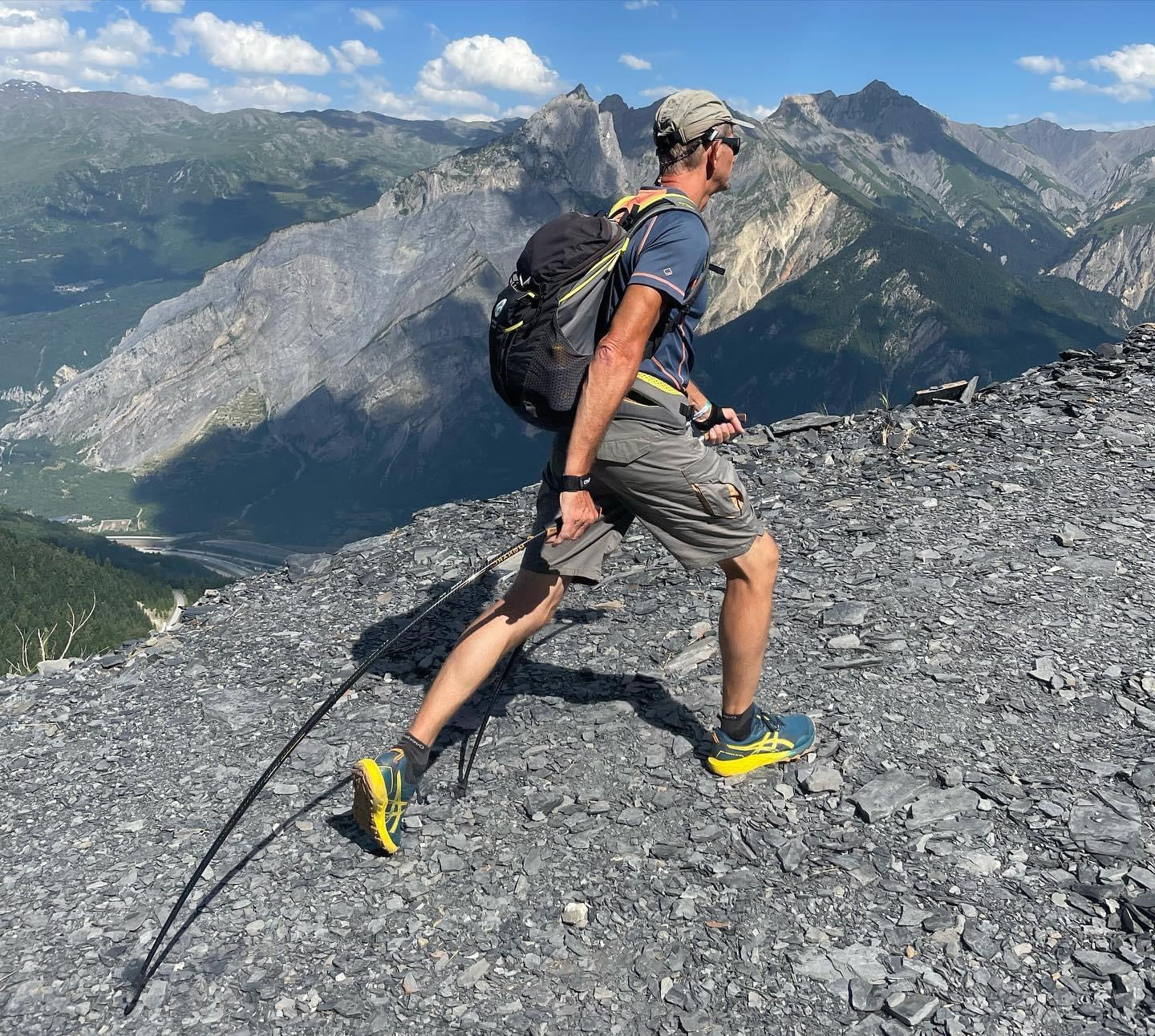
Poles in Ultra-Trail: Why Curved Ones Really Change the Game
On a UTMB, a TCC, a Grand Raid or any mountain ultra, poles are not an accessory. They are survival allies. When the legs stop responding at kilometre 80, when night falls on a technical single track, when the final climb seems endless: that is when the pole reveals what it is really worth.
Why use poles in ultra-trail?
The answer fits in one word: economy. Over long distances, every joule counts. Poles make it possible to spread the effort over all four limbs instead of concentrating everything on the legs. On steep climbs, poles transfer part of the effort from the legs to the upper body, reinforcing the forward push along the slope, not downwards. With the curve of the MØNARC® Arcs de Marche®, the push angle stays oriented in the direction of travel, which improves the efficiency of the movement over thousands of strides.
Downhill, they absorb the shocks, protect the knees and stabilise the upper body on technical sections. On flat ground, they maintain the rhythm and delay overall muscular fatigue.
Ultra-endurance studies confirm that using poles uphill reduces perceived fatigue and the electromyographic activity of the lower limbs, which translates, at the end of the race, into less burned-out legs and a more stable stride over the final kilometres.
The specificity of ultra terrain: what the straight pole does not see
An ultra-trail is not a flat, regular surface. It is 40,000 metres of positive and negative elevation, wet ground, technical trails, stretches of asphalt in between. At every change of terrain, the pole's support angle changes. With a classic straight pole, the push angle therefore varies constantly, creating irregularities in the energy transmission.
This is where the geometry of the MØNARC® Arcs de Marche® comes in. Measured by Université Grenoble Alpes, the curve maintains a push angle of 33° to the ground (against 46° for a straight pole), which naturally directs the force forwards at every support. Over 100 km, that is thousands of better-oriented pushes. The energy saving is not spectacular at each step: it is cumulative, and that is precisely where it changes everything.
Uphill: getting the most from the arms
On steep climbs, the technique evolves: the torso leans forward, the poles are planted closer to the body, the supports become alternating or simultaneous depending on the slope. In double-push technique (both poles at once), the arms and shoulders become real engines. The curve of the MØNARC® offers a natural attack angle in this configuration, without deliberately changing the movement.
On sections of 40-60% gradient, typical of the Vertical Kilometre events built into some ultras, the vertical push takes precedence over everything. Rigid, light, well-anchored poles then make all the difference. The MØNARC® in T700 carbon at 140 grams per pole answer exactly these demands.
Downhill: stability and joint protection
Downhill, the poles' role switches. They no longer propel, they stabilise and absorb. The recommended technique: poles planted alternately to keep permanent ground contact, knees bent, torso slightly inclined forward, weight on the ball and front of the foot. The poles are planted slightly further ahead on steep descents to create a braking, reassuring support.
On the long, repeated descents that characterise Alpine ultras, this passive damping work by the poles preserves the quadriceps and knees, delaying or avoiding the "concrete descent" that all trail runners dread at the end of a race.
Weight and reliability: the two imperatives of the ultra
In ultra-trail, every gram carried all night turns into fatigue. Poles at 300 g each represent 600 g of permanent load on the arms. Poles at 140 g, like the MØNARC®, represent 280 g. The difference seems minimal at the start. At the finish, it may have prevented shoulder tendinitis or preserved movement quality over the final kilometres.
Reliability is the other imperative: a pole that breaks at kilometre 70, at night, in the mountains, is a catastrophe. The T700 carbon of the MØNARC® is the same grade used in high-stress industrial applications. It shrugs off impacts on rocks, energetic plants on climbs, involuntary twists on technical terrain.
The verdict of a tester over 93 km
Sergi Garcia i Gisbert, an experienced Spanish practitioner, tested the MØNARC® Arcs de Marche over a 93 km course mixing asphalt, trails and forest track. His verdict: poles "intended for experienced Nordic walkers, ideal for competition", with a sensation of propulsion perceptible from the first hours.

The MØNARC® Arcs de Marche®
Curved 100% carbon Nordic walking poles, 140 g per pole, designed in France and assembled in France. 140 g per pole and a forward-directed push: they are designed for distance.
Disclaimer. This article provides general information. It does not replace the advice of a doctor or health professional, nor supervision by a qualified instructor. Before starting or stepping up physical activity, especially if you have a health condition, pain or ongoing treatment, consult your doctor. Exercise according to your fitness, on suitable ground and with equipment in good condition. Each reader remains solely responsible for their own practice and for the decisions they make based on this information, and MONARC SAS cannot be held liable for their consequences.