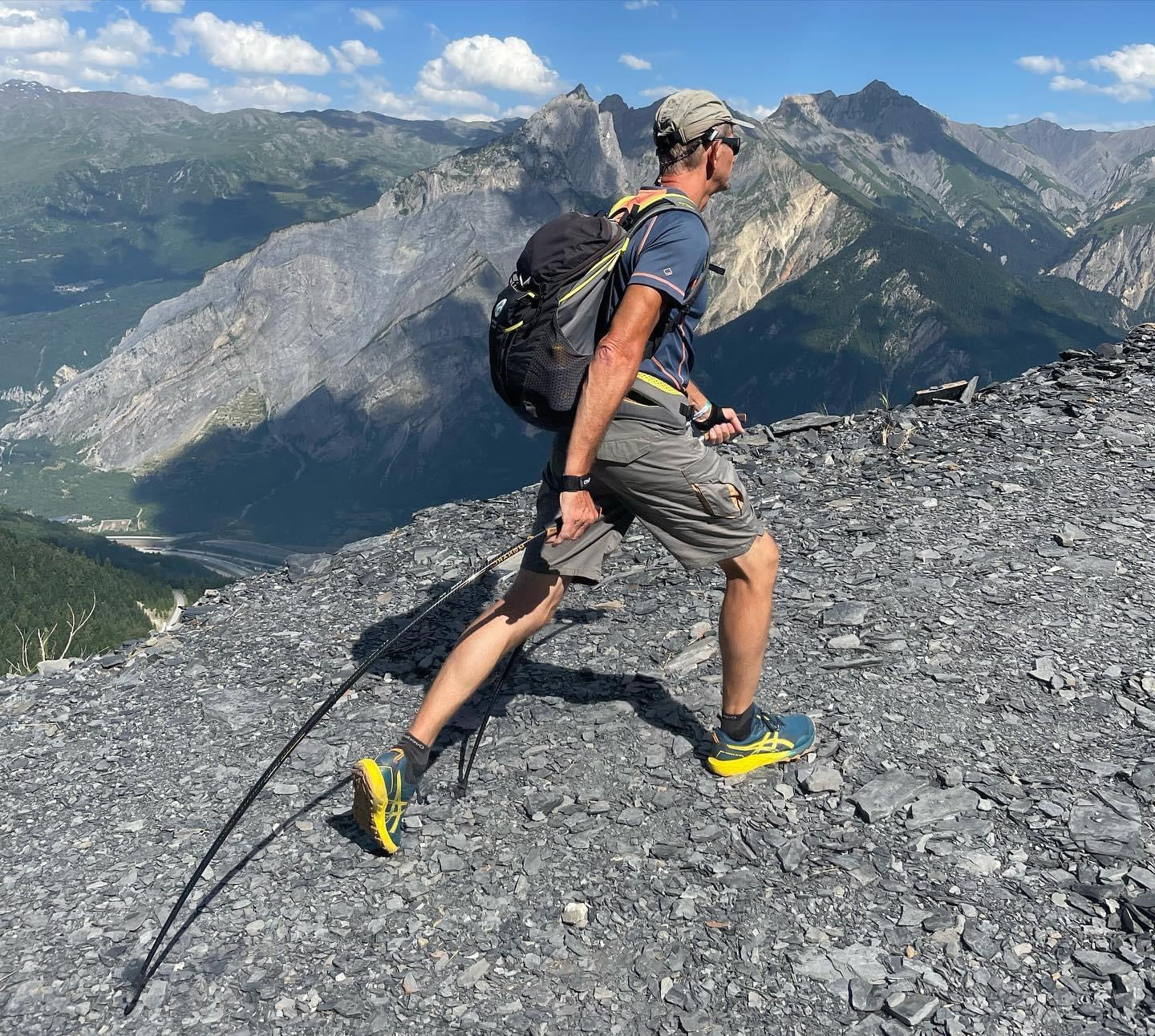
The Curve of Nordic Walking Poles: What Does It Really Change?
For decades, all Nordic walking poles shared one thing: they are straight. Linear. Designed to plant and push in line with the arm. This straight-pole orthodoxy seemed untouchable, until a surveying engineer from the Drôme noticed something at once obvious and new, on a forest walk with his grandchildren.
The origin of an idea: branches in the woods
Christian Pelèse, a lifelong hiker and topographical engineer, watched his grandchildren walking with naturally curved branches. Picking them up to put them away, he felt an unusually fluid sensation: the push seemed more efficient, more directed forwards. Those branches were not straight. They were arched, slightly curved, like a bow.
From that observation came the idea that would become MØNARC® and its Arcs de Marche®: the world's first fully curved Nordic walking pole, designed in France and assembled in France.
What the curve changes: the biomechanics simply explained
The difference between a straight pole and an Arc de Marche does not lie in an elastic effect or an energy return. This point is fundamental and often misunderstood. The curve does not store energy to release it later, like a spring. MØNARC® poles are in fact deliberately very stiff, in high-strength T700 carbon.
What changes is the angle of the push force. A study by Université Grenoble Alpes (UGA), on experienced Nordic walkers, measured this difference precisely:
- Classic straight pole: average angle of 46° to the ground
- MØNARC® Arc de Marche: average angle of 33° to the ground
Those 13° of difference may seem trivial. They are not. A more horizontal angle means that the force exerted on the pole is directed more forwards, and less upwards or downwards. Propulsion is mechanically more efficient with every plant.
A significantly lower perceived effort
The UGA study also shows that at 5 km/h, perceived effort is significantly lower with the Arcs de Marche than with classic straight poles. At 6 km/h, walkers report higher perceived comfort and pleasure. And this at identical physiological intensity: heart and lungs work just as hard, but the sensation of fatigue is lower.
Over long distances, trail or ultra-walks of 120 to 200 km, this perceived difference becomes a decisive advantage. Less perceived fatigue means better management of effort over time.
The always-vertical tip: an often overlooked advantage
The curve of the Arcs de Marche generates a second mechanical benefit: the tip plants always vertically in the ground, whatever the phase of the stride. With a straight pole, the angle of attack varies with the movement, which creates irregularities in the support and can load the wrist at unfavourable angles. With the MØNARC®, the grip is constant, the wrist stays in its natural axis.
T700 carbon: the reasonable choice
To keep this angular advantage without making the pole heavier, the choice of material is decisive. The MØNARC® Arcs de Marche are made of T700 carbon, a high-performance grade just below aerospace-grade carbons. This choice keeps the weight at 140 grams per pole, remarkable given the greater effective length due to the curve.
Final assembly is carried out in France, in an ESAT (a sheltered workshop employing people with disabilities) in the north-east of the country. An approach both technical and human.

The MØNARC® Arcs de Marche®
Curved 100% carbon Nordic walking poles, 140 g per pole, designed in France and assembled in France. Delivered ready to walk with straps, tungsten carbide tips and a made-to-measure bag.
To try them is to adopt them
Jean-Pierre Guilloteau, state-qualified mountain leader, Nordic walking instructor and author of the reference book La marche nordique, techniques et bienfaits, was the first to test the prototypes in February 2023. His verdict, since shared by dozens of walkers of all levels: the sensation is immediate, the propulsion perceptible from the very first kilometres.
Because a curve cannot be explained. It has to be felt.
👉 Discover the MØNARC® Arcs de Marche on monarc-nordic.com
Disclaimer. This article provides general information. It does not replace the advice of a doctor or health professional, nor supervision by a qualified instructor. Before starting or stepping up physical activity, especially if you have a health condition, pain or ongoing treatment, consult your doctor. Exercise according to your fitness, on suitable ground and with equipment in good condition. Each reader remains solely responsible for their own practice and for the decisions they make based on this information, and MONARC SAS cannot be held liable for their consequences.