

Competitive Nordic Walking: What If We Talked Again About the Push on the Poles?
By the side of the course, many have already noticed it, sometimes without quite daring to say it. In Nordic walking competitions, you see walkers going very fast… without the arms' push on the poles always appearing fully engaged. The movement exists, of course, but it sometimes seems shortened, less powerful than what the manuals and training courses describe.
This observation mostly remains implicit. The press does not make it a subject, blogs mention it in half-words, the discussions happen mainly “among insiders”. At MØNARC®, we do not claim to hold the truth, nor to judge anyone. We are simply a brand attached to Nordic walking, to its history and its technique, and we want to open this debate with respect.
A widely shared feeling… rarely put into words
What many observe in the field is a kind of gap between the movement taught in clubs and the movement sometimes adopted in high-speed competition. The arms swing, the poles accompany the stride, but the full push backwards, the one that really engages the triceps, the shoulders and the back, sometimes seems reduced.
This is not to say that “nobody pushes any more”. There are very fine technical movements in competition, exemplary athletes, coaches highly attentive to these questions. But it would be an exaggeration to claim the subject does not exist. Many practitioners, coaches or judges talk about it among themselves, informally, wondering about the discipline's evolution.
When speed takes over from the movement 🚀
Competitive Nordic walking has brought a lot to the discipline: visibility, structure, a calendar of events, motivation to progress. But as in many sports, the pursuit of the clock can sometimes push towards simplifying the movement. At very high speed, it is tempting to reduce the arms' amplitude, to let the poles “accompany” rather than propel.
This drift is understandable: the athlete seeks efficiency above all, the judge must arbitrate in real time, the organiser wants a fluid race. Little by little, with no intention of cheating, the ideal technique described in the teaching sheets can drift away from the reality on the ground. It is this grey zone that we propose to examine, without dramatising.

Back to fundamentals: why the push matters so much
In all the reference documents, Nordic walking is distinguished from brisk walking by one central point: the active push on the poles. The pole is not a mere balance accessory, nor a metronome. It is a genuine point of support, which transfers part of the legs' work to the upper body.
A complete movement is an arm that moves forward, a pole that plants slightly behind the body, then a frank push backwards, up to near-full extension, a hand that opens to let the strap catch the pole. This movement engages the upper-body muscles, distributes the loads, protects the joints and improves the efficiency of the displacement. When the push shrinks to a symbolic contact, you keep the scenery of Nordic walking, but you lose part of its substance.
What if we also talked about technique in competition?
In other sports, technique is regularly questioned in the light of video, movement analysis, feedback. In Nordic walking, this work already exists in many clubs, during training courses and workshops. The movement is dissected, filmed, corrected; the best way of engaging the arms is discussed.

[Note: This image is not taken from the latest 2026 rules, but it nonetheless illustrates the push issue in question here.]
✅ What we propose is to broaden this reflection to competition itself. Not to multiply sanctions, but to ask: how do we encourage and reward the athletes who keep a real push, even at high speed? How do we help those who, under the pressure of the clock, have gradually shortened their movement, to recover a more complete technique?
The place of a brand like MØNARC® in this reflection 🧐
As a pole manufacturer, we are neither referees, nor scientists, nor guardians of the temple. We are committed observers: we talk with coaches, walkers, cardiac-rehabilitation specialists, ultra-walking and ultra-trail practitioners. What we often hear is the desire to preserve a Nordic walking that really works the whole body, including in a competitive context.
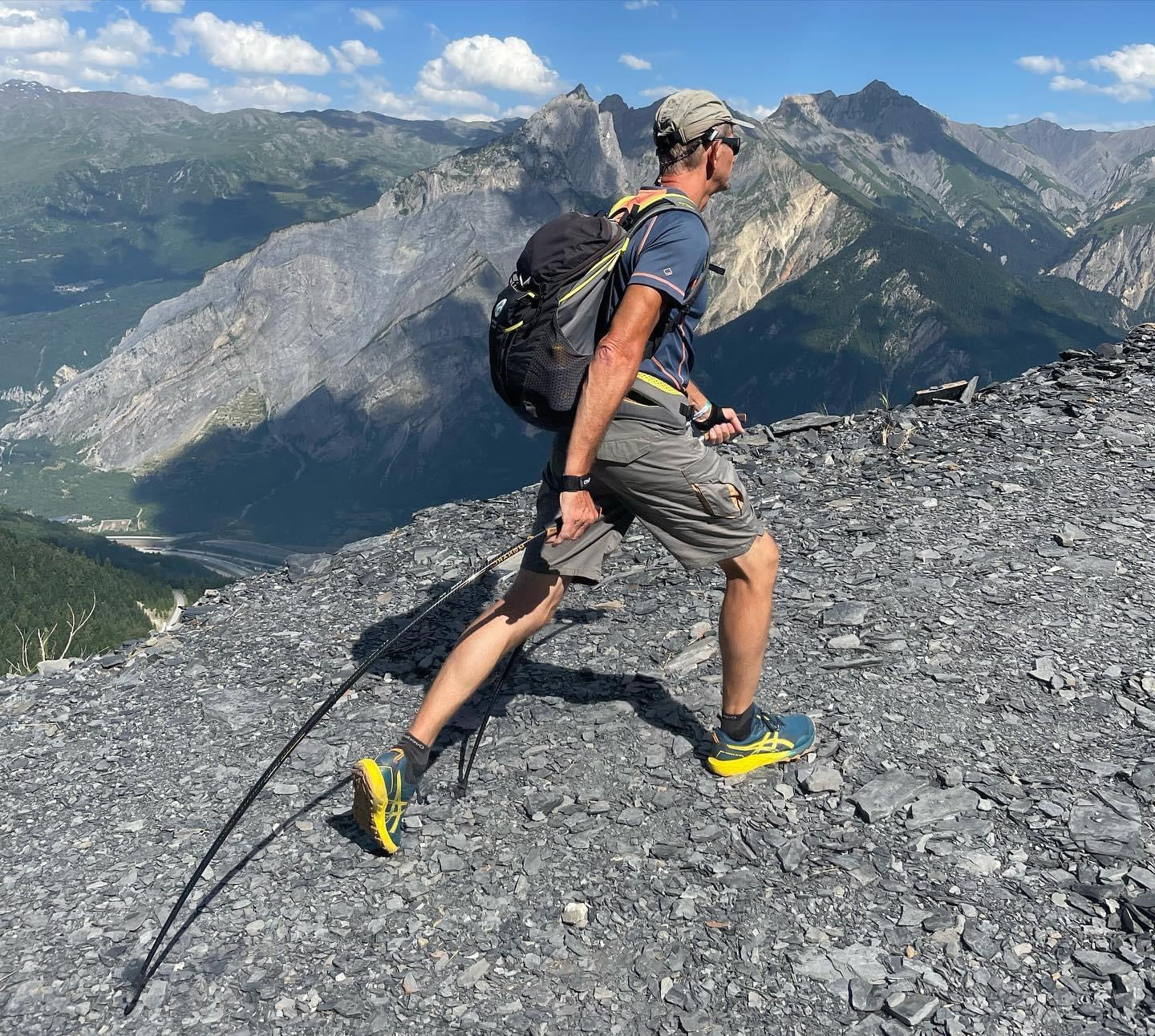
It is this vision that guided the design of our MØNARC® Arcs de Marche®: curved poles in T700 carbon, rigid, light, designed to favour a forward-directed push and to offer comfort over time. But we gladly repeat it: no pole, however accomplished, can replace the walker's technique. Without real engagement of the arms, the equipment remains under-used.
Opening the debate
In asking these questions, we point at no culprits, no “good” or “bad” pupils. We know that judges do their best in often complex conditions, that organisers carry demanding projects, that athletes train hard and love their discipline deeply.
Our wish is simpler: to contribute, in our place, to a substantive discussion on the future of competitive Nordic walking. How do we reconcile the clock, the spectacle, the conviviality… and respect for a technique that stays true to the spirit of Nordic walking? How do we make sure that the push on the poles does not become a mere option, but remains the heart of the movement, including on the start line?
At MØNARC®, we make no claim to settle this debate. We have observations, convictions, and the sincere desire to take part in the reflection with all those who share this attachment to the discipline.
If these lines can open a calm exchange between practitioners, coaches, organisers and enthusiasts, then our stone in the pond will have been thrown in the finest possible way: without splashing, but making circles that keep widening.

The MØNARC® Arcs de Marche®
Curved 100% carbon Nordic walking poles, 140 g per pole, designed in France and assembled in France. 140 g per pole and a forward-directed push: they are designed to help you gain pace without additional effort.
2 comments
C’est vrai en compétition à cause de la vitesse il n’y a pas de planter de batons beaucoup de marcheurs l’oubli.
Maintenant pour sanctionné comment fait on.
Oui je serais intéressé par les btts monarc