Nordic Walking: The 7 Criteria for Choosing Your Poles Well
Choosing your Nordic walking poles is no small matter. These two objects sit at the heart of the discipline's entire biomechanics: a poor choice can reduce the benefits of practice, create shoulder or wrist pain, or simply discourage you after a few outings. Here are the 7 criteria that really make the difference.
1. One-piece or telescopic?
This is the first choice to make. One-piece poles (a single shaft, non-adjustable) are favoured by regular practitioners and competitors for their lightness, stiffness and optimal energy transmission. Telescopic or folding poles offer adjustability and easier transport (on planes in particular). They are practical for beginners who do not yet know their ideal length, or for walkers who travel often.
For regular, committed practice, the one-piece pole stands out as the best choice.
2. Length: how to calculate it?
Length is one of the most critical factors. A pole that is too short will make you lean forward; too long, it will work against you. The reference method: multiply your height (in cm) by 0.68. So for a person of 170 cm, the ideal length is about 115 cm. Between two lengths, you generally take the shorter one.
But the measurement is not enough: always try your poles before buying. Plant the pole vertically in front of you, tip on the ground. The angle between your forearm and your upper arm should be slightly more than 90°. Very sporty walkers and competitors can take the next length up to gain propulsion.
3. Material: carbon or aluminium?
Aluminium is cheaper, but it has a major problem: it transmits vibrations instead of absorbing them, which can cause shoulder and arm tendinitis over long distances. Carbon is the reference material for serious practice.
The carbon content indicates the level of practice:
- 50% carbon: good entry level for occasional use
- 70-80% carbon: excellent compromise for regular practice
- 100% T700 carbon or higher: for intensive practitioners, trail and ultra-walking
The MØNARC® Arcs de Marche are made of T700 carbon, the highest grade on the consumer market, just below aerospace-grade carbons. Weight: 140 grams per pole.
4. Pole shape: straight or curved?
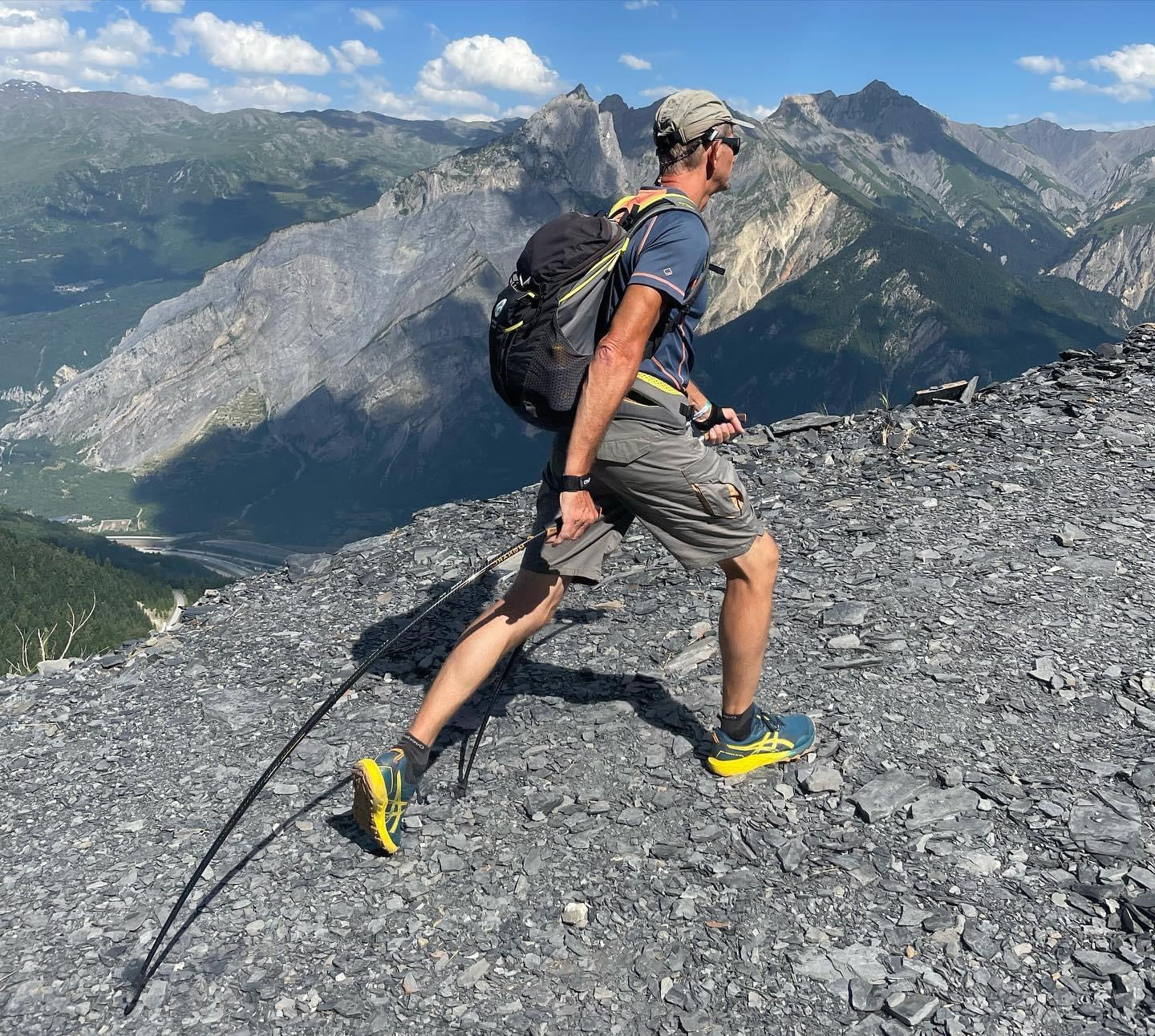
Until recently, all poles on the market were straight. The MØNARC® Arcs de Marche introduced an unprecedented alternative: the full curve. A study by Université Grenoble Alpes measured that this curve directs the push force 13° more horizontally, optimising forward propulsion. A decisive criterion for long distances and performance seekers.

The MØNARC® Arcs de Marche®
Curved 100% carbon Nordic walking poles, 140 g per pole, designed in France and assembled in France. Delivered ready to walk with straps, tungsten carbide tips and a made-to-measure bag.
5. Grip and strap
The grip must be ergonomic and comfortable to the touch. Cork absorbs perspiration and adapts to the shape of the hand over time. Technical rubber grips offer good adhesion in all conditions.
The strap is just as important: it should be available in several sizes (S, M, L), preferably detachable to make refreshment stops easier, and allow the hand to open fully in the rear push phase. A strap unsuited to your hand is the leading cause of wrist pain.
6. The tip: which type to choose?
Tungsten carbide tips are the quality standard: hard and durable, they wear slowly even on asphalt. Bevelled tips penetrate natural ground better and offer better grip. Double-bevelled tips are ideal for mixed and technical terrain.
On hard surfaces (asphalt, concrete), use the rubber pads supplied with your pole, or you will quickly wear out your tungsten tips.
7. Brand and after-sales service
A Nordic walking pole is an investment. Check that the brand offers accessible spare parts: replacement tips, straps in several sizes, pads. Ask about guarantees.
MØNARC® offers its Arcs de Marche® as a complete pack: poles, straps (S/M/L), tungsten carbide tips and a made-to-measure carry bag. Assembled in France in an ESAT, with direct customer support and spare parts available.
Disclaimer. This article provides general information. It does not replace the advice of a doctor or health professional, nor supervision by a qualified instructor. Before starting or stepping up physical activity, especially if you have a health condition, pain or ongoing treatment, consult your doctor. Exercise according to your fitness, on suitable ground and with equipment in good condition. Each reader remains solely responsible for their own practice and for the decisions they make based on this information, and MONARC SAS cannot be held liable for their consequences.