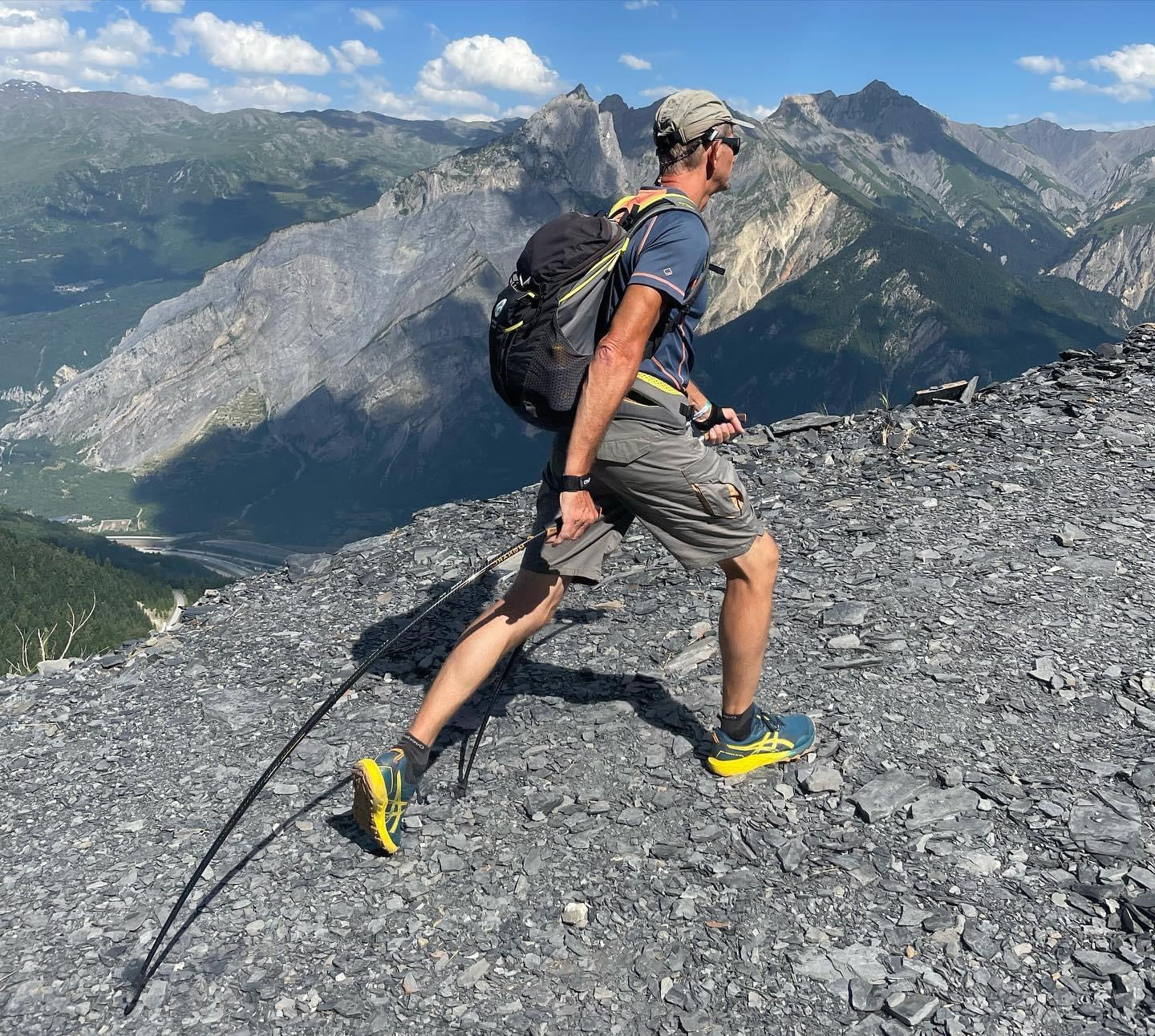
Preparing a Multi-Day Hike with Nordic Poles
A great crossing, a multi-day GR trail, an Alpine itinerary or a staged ultra-walk: these walking adventures demand rigorous preparation. And the walking poles, often chosen at the last moment, deserve very particular attention. On a multi-day trip, a poor pole choice is paid for in pain, blistered hands, tight shoulders. Good poles, on the other hand, vanish from your awareness: they simply become part of the movement.
How many kilometres per day and what elevation?
The first question to ask is not "which poles?" but "what is the nature of my project?" An itinerary in Alsace on rolling trails at 20 km/day does not have the same demands as an Alpine crossing at 30 km/day with 1,200 m of daily positive elevation. For intensive multi-day formats (staged ultra-walks, the 120-200 km over 5-7 days type), the demands come close to those of ultra-trail: maximum lightness, total stiffness, unbreakable solidity.
Physical preparation: 8 to 12 weeks before departure
For a demanding multi-day trip, preparation begins 2 to 3 months in advance. The essential points:
- Progressive weekly long outings: increase by 10% per week, with a recovery week every 3-4 weeks
- Back-to-back training (two consecutive long outings on Saturday and Sunday) to accustom the body to setting off again on already-worked legs, exactly what happens on a multi-day trip
- Specific work on climbs and descents if your project includes elevation
- Train with your poles from the start of the preparation: do not use them for the first time on the big day
Getting used to the poles before the big departure
It is a very frequent mistake: buying new poles the day before a multi-day trip. Nordic walking poles require learning the movement. A badly used pole tires the shoulders, does not propel, and can create wrist pain. Count at least 4 to 6 outings of actual practice before taking your poles on a serious project.
Equipment checklist for a multi-day trip with poles
- ✔ Poles: carbon, one-piece for long distances (maximum stiffness), detachable straps
- ✔ Spare tips: at least one spare pair of tungsten tips for long itineraries
- ✔ Rubber pads: indispensable for asphalt link sections and wooden-floored refuges
- ✔ Bag: for transport by car or train without risking injuring anyone with the tips
- ✔ Spare gloves: check that your straps are compatible with your cold-weather gloves if your itinerary goes through altitude
Managing your poles during the stages
On a long day, you will not necessarily want to hold your poles for 8 hours. Learn to stow them efficiently: an external attachment system on the pack, side elastics, or specific pole carriers. Non-folding one-piece poles (like the MØNARC®) require a pack with side attachments or a pole pocket.
On technical trail sections where the poles hinder more than they help (scrambling over blocks, crossing fences, reaching water points), being able to free them quickly from your hands, thanks to the detachable straps, is a real comfort.
Recovery between stages
The poles also help with recovery. After arriving at the refuge, some light stretching of the shoulders and triceps (the muscles most engaged by propulsion) prevents the next day's soreness. Some ultra-walkers use their poles as a support for hamstring and calf stretches at the end of the day.
The MØNARC® over time: telling accounts
Marie-Élisabeth Charre reports after 84 km in 10 days with her Arcs de Marche®: "a better push that lets you lengthen the step and go faster, the MØNARC® let you go further without waking the aches." Jean-Marie Saint-Omer describes poles that are "light, dynamic, beautiful: a sensation of power." Over several days, these qualities do not add up: they multiply.

The MØNARC® Arcs de Marche®
Curved 100% carbon Nordic walking poles, 140 g per pole, designed in France and assembled in France. Delivered ready to walk with straps, tungsten carbide tips and a made-to-measure bag.
Disclaimer. This article provides general information. It does not replace the advice of a doctor or health professional, nor supervision by a qualified instructor. Before starting or stepping up physical activity, especially if you have a health condition, pain or ongoing treatment, consult your doctor. Exercise according to your fitness, on suitable ground and with equipment in good condition. Each reader remains solely responsible for their own practice and for the decisions they make based on this information, and MONARC SAS cannot be held liable for their consequences.