Nordic Walking in the City: Advice, Terrain and Equipment
Nordic walking is often associated with forest trails and countryside landscapes. Yet millions of practitioners around the world do it in urban settings, in parks, along canal paths or greenways. With the right equipment and a few precautions, the city becomes an entirely compatible playground.
The main challenge: hard surfaces
Asphalt, concrete and cobblestones do not let you plant the pole's metal tip. Without adaptation, the tip slips, the noise disturbs those around you, and the tip wears out much faster: tungsten carbide tips are designed to bite into earth and gravel, but on tarmac the asphalt acts like sandpaper. The solution is simple: rubber pads.
Rubber pads: indispensable in town
The pad is a dense rubber cap that fits over the tip and creates a support surface without piercing the ground:
- It protects the tungsten tips from premature wear.
- It improves grip on tarmac and cobblestones, especially in wet weather.
- It reduces the noise characteristic of metal on the road.
Fit it so the base sits parallel to the ground to maximise grip, and put it on systematically whenever you leave the park or path to return to the pavement. On some very smooth cobbles or wet ground, one trick is to fit the pad upside down: the metal tip pricks slightly through the rubber and offers better grip.
The best urban terrains
- Public parks and gardens (semi-natural ground, quiet on weekdays)
- Greenways and towpaths
- River or lake banks
- Athletics stadiums (tartan tracks)
- Cemetery paths (often clear and calm ground)
Adapting your technique on hard ground
On asphalt with pads, the technique stays broadly the same: arm opposite the leg, plant slightly behind, hand opening at the end of the push. Two adjustments make the difference: a softer plant, to avoid slipping if the ground is wet, and more supple footwork, rolling well from heel to forefoot to limit impacts. Cushioning is reduced, which can tire the arms and shoulders more over time: limit your urban sessions to 45 minutes at first and include stretches on grass or earth whenever possible. Some walkers also prefer to shorten their stride a little on tarmac to keep control.
The unexpected advantages of the city
- Stairs, small climbs and bridges fit easily into your routes.
- Street lighting lets you practise safely early in the morning or late in the evening.
- The commute can become a Nordic walking session with a light backpack.
For many, the winning solution is a mix: leave from home, a few kilometres in town, then a park or green corridor for the central part of the session, and back through town.
Safety and courtesy
In urban settings, stay alert to other path users (cyclists, joggers, strollers). Announce your presence verbally and do not walk side by side in a group on narrow paths. Avoid pointing your poles towards other people when turning around.
Which poles for regular urban practice?
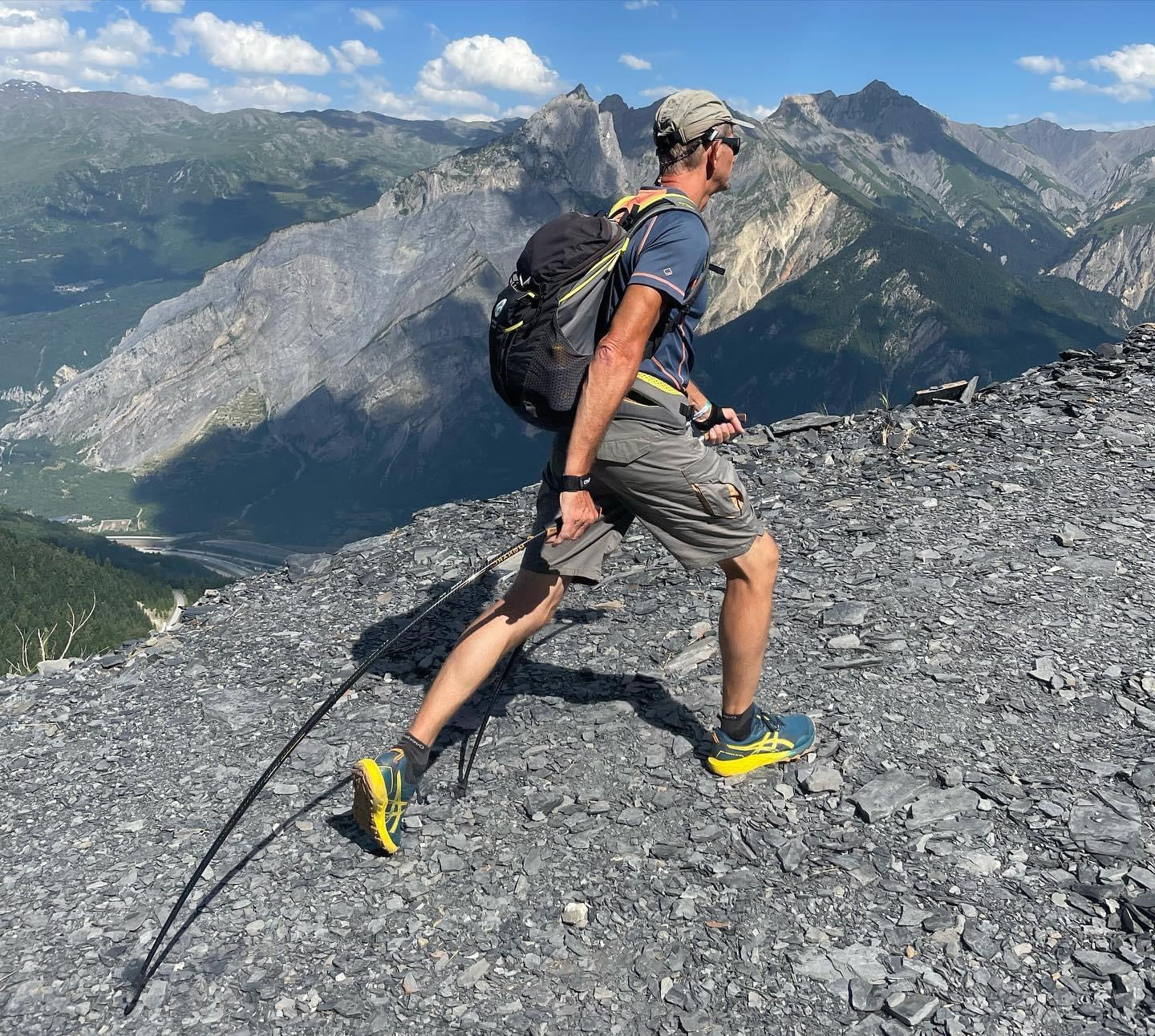
If most of your outings are in town, the requirements are the same as for the countryside, with two extra points: robust rubber pads, easy to fit and remove, and quiet poles (carbon and pads filter noise better than raw aluminium). The MØNARC® Arcs de Marche® come with tungsten carbide tips, and pads are available among the MØNARC® spare parts: think of ordering them together with your poles. Their lightness and curve also make them very pleasant for "home, park, home" sessions where tarmac is hard to avoid.

The MØNARC® Arcs de Marche®
Curved 100% carbon Nordic walking poles, 140 g per pole, designed in France and assembled in France. Delivered ready to walk with straps, tungsten carbide tips and a made-to-measure bag.
Key takeaway: Nordic walking in town is entirely possible with suitable rubber pads. Favour parks, greenways and riversides to alternate hard ground and natural terrain.
Going further
- The different types of Nordic walking pole tips: how to choose?
- The basic Nordic walking technique: the beginner's guide
- Choosing your shoes for Nordic walking
Disclaimer. This article provides general information. It does not replace the advice of a doctor or health professional, nor supervision by a qualified instructor. Before starting or stepping up physical activity, especially if you have a health condition, pain or ongoing treatment, consult your doctor. Exercise according to your fitness, on suitable ground and with equipment in good condition. Each reader remains solely responsible for their own practice and for the decisions they make based on this information, and MONARC SAS cannot be held liable for their consequences.