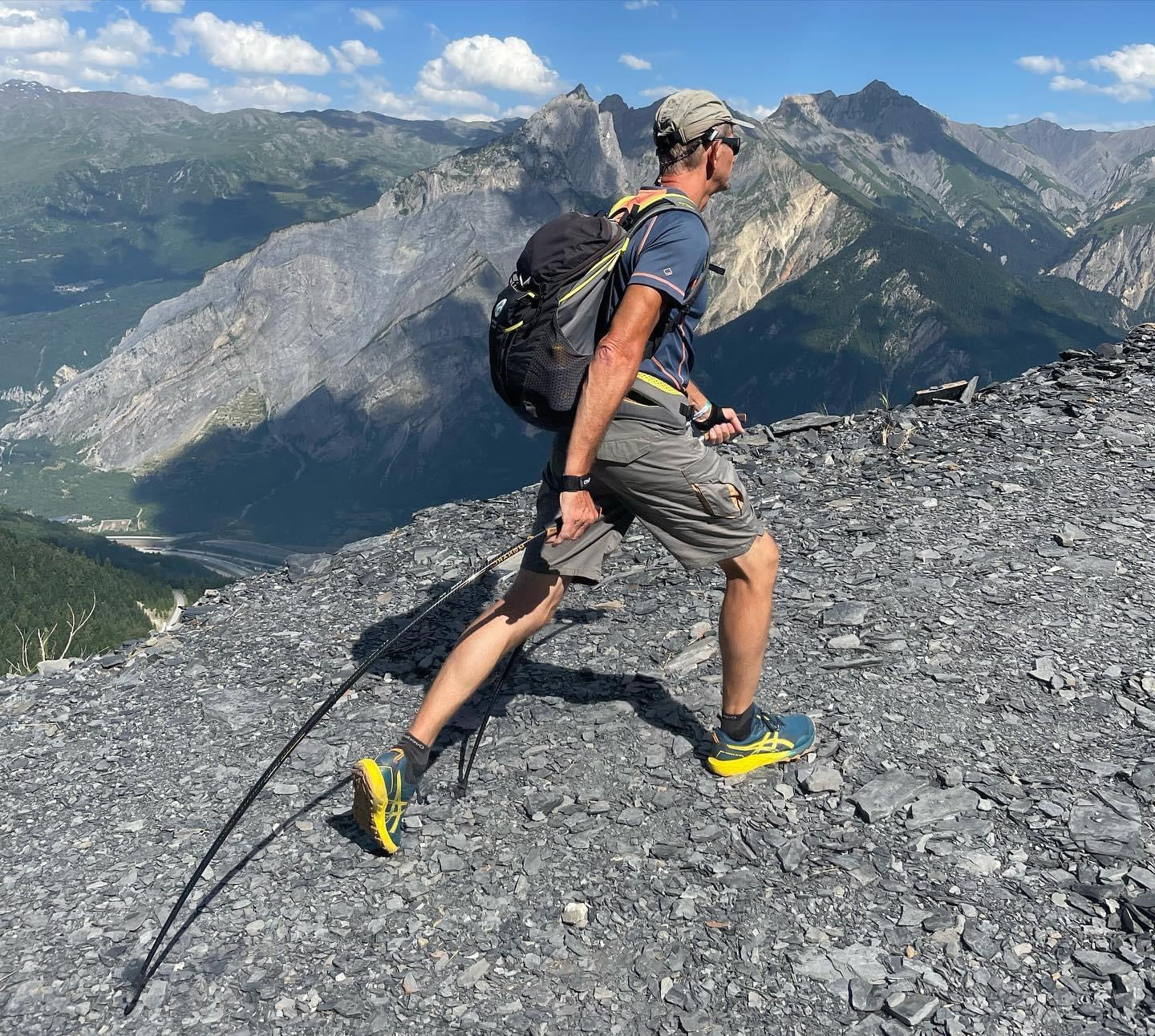
Choosing Your Shoes for Nordic Walking
For Nordic walking, choose a low-cut shoe with a flexible forefoot, a well-cushioned heel and a sole suited to your terrain. A trail shoe suits paths, and a road running or fitness walking shoe suits tarmac. You do not need to hunt for a “Nordic walking” model, which has become rare. What matters is that the shoe follows the roll of your foot and fits you perfectly. Below you will find the criteria, the right type for each terrain and how to try your shoes on properly.
In short
- The right type: choose a low trail shoe for earth and mud, a road running or fitness walking shoe for tarmac and dry paths, and a low hiking shoe for rocky ground.
- Key criteria: the shoe should be light, with a flexible forefoot, a cushioned and stable heel and grip suited to the ground.
- The heel: in Nordic walking, your stride lengthens and the heel takes more pressure than in ordinary walking.
- Trying on: try shoes on late in the day, with your sports socks, leaving about a thumb’s width (1.5 cm) beyond your longest toe.
- In the rain: a waterproof membrane keeps your feet dry. Wet socks cause blisters more than the sock material does.
- Poles: they are the second key piece of kit, and the only one that works your upper body.
What Nordic walking asks of your feet
Nordic walking is not just a stroll with poles. A review of 42 studies found that, compared with walking, steps are about 10% longer and cadence about 6% lower (Roy et al., 2020). The foot strikes the ground with the heel, rolls through to the toes, then pushes off while the opposite arm pushes on the pole. Our guide to the basic technique describes this movement in detail.
Measurements under the foot confirm this:
- The heel works harder. In experienced walkers, pressure under the heel is about 23% higher in Nordic walking than in walking, and pressure under the middle of the forefoot is about half (Pérez et al., 2010). Another study also found less pressure under the forefoot in Nordic walking, whatever the technique (Encarnación-Martínez et al., 2017).
- Footfalls are more dynamic. In 24 instructors, Nordic walking produced faster loading, higher horizontal forces and more pronation (the foot rolling inwards) than walking (Hagen et al., 2006).
These differences are nothing to worry about, as the same researchers conclude that the loads on the legs remain moderate. They do, however, explain why a Nordic walking shoe needs a cushioned, stable heel, a flexible forefoot so the foot can roll through, and a sole that grips as you push off.

7 criteria for a good Nordic walking shoe

1. A flexible forefoot
The shoe should bend where your toes bend, at their base, not in the middle. This lets you roll through the step to the push-off. In the shop, hold the shoe by the heel and the toe, then push them together. It should give easily at the front (Australian Podiatry Association).
2. A cushioned, stable heel
Since the heel takes more load, it needs cushioning. It also needs to be held firmly. The heel counter, the stiff part around the back of the heel, should not collapse when you press it. The middle of the shoe should not twist when you wring it like a cloth. A shoe that passes these two tests limits the foot rolling over on uneven ground.
3. A sensible drop
The drop is the difference in height between the heel and the forefoot. It ranges from zero to about twelve millimetres depending on the model. No study has established an ideal drop for Nordic walking. The simplest approach is to stay close to your usual shoes. If you switch to a much lower drop, do it gradually, as it works the calves and Achilles tendon harder.
4. Grip suited to the terrain
On earth paths and grass, short lugs are enough. In mud and on slippery trails, you need deeper, widely spaced lugs that do not clog with soil. On tarmac, very pronounced lugs wear quickly without adding anything, and a road running sole is more comfortable.
5. Waterproof or airy
A waterproof membrane keeps your feet dry in rain, dew or puddles. It is, however, less airy than a mesh upper, so in summer your feet get hotter and sweat more. Many walkers own two pairs, a waterproof one for autumn and winter and an airy one for fine weather. Our tips for wet outings are in the article Nordic walking in the rain.
6. Weight
Weight on your feet costs more than weight on your back. Each kilo added to the feet increases energy expenditure by 7 to 10% (Knapik et al., 2004). On a one-hour outing, you lift each foot several thousand times. For equal comfort, choose the lighter shoe.
7. Support
A low cut suits the vast majority of outings, as it lets the ankle flex freely with every step. A mid cut can make sense on very stony ground or if you easily twist your ankle. In every case, support comes first from the heel counter and the lacing.
Which shoe for which terrain?
The right type of shoe depends first on where you walk most often.

| Type of shoe | Strengths | Limits | Best for |
|---|---|---|---|
| Low trail shoe | Grip, protection from stones, lightness | Lugs wear quickly on tarmac | Earth paths, forests, mud, mixed terrain |
| Road running shoe | Cushioning, lightness, flexibility | Little grip on mud and wet grass | Tarmac, greenways, dry paths |
| Fitness walking shoe | Easy roll-through, comfort | Limited grip off the beaten track | Tarmac and easy paths, getting back into sport |
| Low hiking shoe | Sturdiness, protection, firm sole | Heavier and stiffer, so the foot rolls through less well | Rocky ground, mountains, very rough terrain |
| Nordic walking shoe | Designed for the heel-to-toe roll | Now rare in shops | Regular walking on varied paths |
Do dedicated Nordic walking shoes still exist?
Yes, but they have become rare. In October 2026, Decathlon still lists them under its Newfeel brand (NW range), in an airy and a waterproof version. You do not have to look for one, because a low, flexible, light trail shoe meets the same criteria.
Shoes to avoid
- Town shoes: they have neither suitable cushioning nor grip.
- High, stiff hiking boots: they hinder the roll of the foot.
- Worn-out shoes: their sole is smooth, their cushioning flattened and their heel counter misshapen.
- Shoes that are too tight: your feet swell during exercise and slide forwards on descents.
In town and on tarmac
On tarmac, the shoe provides most of the cushioning, so choose one with plenty of padding. As for poles, a metal tip slips and wears on tarmac. That is why you fit rubber caps, called pads. Everything is explained in our articles Nordic walking in town and The different types of pole tips. For the mountains, see also Nordic walking in the mountains.
How to try on shoes properly
Between 63 and 72% of people wear shoes that do not match the length or width of their feet, according to a review of 18 studies (Buldt and Menz, 2018). A few simple rules avoid the mistake:
- Try them on late in the day or after an outing, as feet swell as the hours go by (American Academy of Orthopaedic Surgeons).
- Wear your sports socks, the ones you will walk in.
- Leave a thumb’s width. Allow about 1.5 cm between the tip of your longest toe, which is not always the big toe, and the front of the shoe. When you walk, the foot slides forwards in the shoe, especially downhill.
- Check the width. Your toes should be able to move without the foot floating.
- Do the three tests. The heel counter should stay firm when you press it, the shoe should give at the front when you bend it, and the middle should resist when you twist it.
- Walk in them, on a small slope if possible. The heel should not lift and nothing should rub. Lace firmly over the instep so that the foot does not slide forwards.
If you buy online, measure the length of your foot and follow the brand’s size guide. Then try the shoes at home on a clean floor before any outing, so that you can return them if they do not suit you.
For socks, moisture matters more than material
It is often said that synthetic or merino socks prevent blisters, unlike cotton. The evidence is less clear-cut. Among 203 hikers on the Camino de Santiago, who had covered 254 km on average, sock material was not linked to blisters. Walking in wet socks, on the other hand, almost doubled the risk (Chicharro-Luna et al., 2022).
- Choose socks in your size, without prominent seams, that dry quickly.
- In the rain, pair them with a waterproof shoe, and take a spare pair on long outings.
- Always try on shoes with the socks you will wear.
Budget and lifespan
Price does not tell you whether a shoe fits. An entry-level trail or running shoe that fits well and suits your terrain is better than a badly chosen top-of-the-range model. Last season’s models are often cheaper and do the job just as well. If you walk in all weathers, two pairs (one waterproof, one airy) last longer than one.
Cushioning wears out before the sole. For running shoes, the American Academy of Orthopaedic Surgeons states that an EVA midsole, the most common foam, has lost about 45% of its initial shock absorption after 800 km. Nordic walking is less punishing than running, but the signs of wear are the same:
- smooth lugs or a sole worn unevenly;
- flattened foam, creased along the sides;
- a heel counter that sags;
- new pain in your feet or knees after your usual outings. If it persists, talk to a doctor or a podiatrist.
Poles matter as much as shoes
Shoes carry the lower body. Poles make the difference between walking and Nordic walking, because they are what work your arms, shoulders and back. Choose them with the same care as your shoes.

The MØNARC® Arcs de Marche® were designed for the Nordic walking movement, and their full-length curve follows the natural path of the arm. The Université Grenoble Alpes compared them with straight poles in 8 regular walkers. With the Arcs, the push angle goes from 46° to 33° and propulsion is 22% more efficient, for the same oxygen consumption and the same heart rate. The vibration transmitted to the arms drops by about 25%. They are the first poles whose shape has been scientifically compared with straight poles. Discover the study.
Their tip meets the ground more vertically, for consistent grip, and they are accepted in competition. To compare poles, read our 7 criteria for choosing your poles. If you walk with a club, a MØNARC® Partner Club gives its members €30 off per pair.
We are often asked whether you should measure your poles with your shoes on. The sizing rule (your height × 0.68) is enough, because the thickness of the sole changes the position of your arms very little. Simply check the elbow angle wearing your walking shoes. The details are in our size guide.
Frequently asked questions
Can you go Nordic walking in running shoes?
Yes, a road running shoe works very well on tarmac, greenways and dry paths, because it is cushioned, light and flexible. On mud or wet grass, its grip becomes insufficient and a trail shoe is a better choice.
Do you need high-top shoes for Nordic walking?
A low cut is generally enough, as it lets the ankle flex freely with every step. A mid cut makes sense on very stony ground, in the mountains or if you easily twist your ankle.
Do you need waterproof shoes?
A waterproof shoe suits autumn, winter and wet grass. In summer, an airy shoe is more comfortable, because the membrane makes you sweat more. If you only have one pair and walk all year round, the waterproof version covers the most situations.
Are there special Nordic walking shoes?
Yes, but they are rare. In October 2026, Decathlon still lists them under its Newfeel brand. A low, flexible, light trail shoe works just as well if it meets the criteria in this article.
When should you replace your Nordic walking shoes?
Replace them when the lugs are smooth, the foam is flattened or the heel counter sags. For running shoes, EVA foam has lost about 45% of its shock absorption after 800 km.
Should you measure your poles with your shoes on?
There is no need, because the height × 0.68 formula is enough and the thickness of the sole changes the position of your arms very little. Just check the elbow angle wearing your walking shoes.
Sources
- Roy M. et al., European Journal of Physical and Rehabilitation Medicine, 2020, 56(5): 607-615.
- Pérez P., Llana S., Encarnación A., Fuster M.A., “Nordic walking as alternative physical activity for population with neuropathy on foot”, European Journal of Human Movement, 2010, 22.
- Encarnación-Martínez A. et al., “Plantar Pressure Differences between Nordic Walking Techniques”, Journal of Human Kinetics, 2017, 57: 221-231.
- Hagen M., Hennig E.M., Stieldorf P., “Ground reaction forces, rearfoot motion and wrist acceleration in Nordic walking”, International Society of Biomechanics in Sports (ISBS) conference, 2006.
- Knapik J.J., Reynolds K.L., Harman E., “Soldier load carriage: historical, physiological, biomechanical, and medical aspects”, Military Medicine, 2004, 169(1): 45-56.
- Buldt A.K., Menz H.B., “Incorrectly fitted footwear, foot pain and foot disorders”, Journal of Foot and Ankle Research, 2018, 11: 43.
- Chicharro-Luna E. et al., “The influence of sock composition on the appearance of foot blisters in hikers”, Journal of Tissue Viability, 2022, 31(2): 315-318.
- American Academy of Orthopaedic Surgeons, OrthoInfo, “Athletic Shoes”, accessed October 2026.
- Australian Podiatry Association, fact sheet “Footwear health check”.
- Termoz, Depery, Lorenzi, Université Grenoble Alpes: study of MØNARC® curved poles compared with straight poles.

The MØNARC® Arcs de Marche®
These curved 100% carbon Nordic walking poles weigh 140 g each and are designed and assembled in France. They are delivered ready to walk with straps, tungsten carbide tips and a made-to-measure bag.
Disclaimer. This article provides general information. It does not replace the advice of a doctor or health professional, nor supervision by a qualified instructor. Before starting or stepping up physical activity, especially if you have a health condition, pain or ongoing treatment, consult your doctor. Exercise according to your fitness, on suitable ground and with equipment in good condition. Each reader remains solely responsible for their own practice and for the decisions they make based on this information, and MONARC SAS cannot be held liable for their consequences.