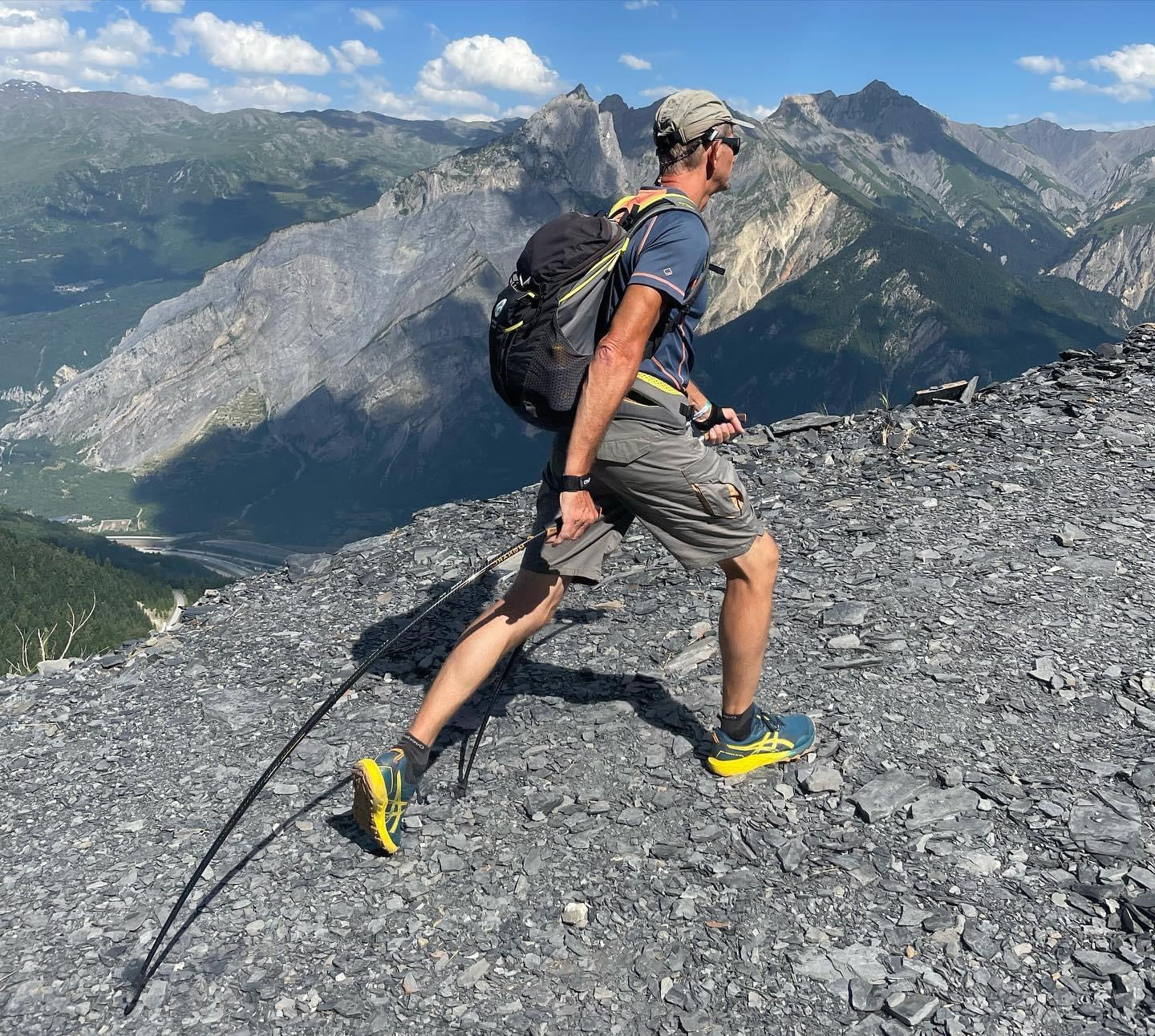
Nordic Walking in the Mountains: Technique, Safety and Pleasure at Altitude
Nordic walking developed on flat, regular terrain, where it is at the centre of the outdoors. But it long ago left the urban parks to take on mountain trails. And it is there, precisely there, that it reveals its full potential. Elevation, varied terrain, technical footing: so many situations where the poles make the difference between an exhausting outing and a mastered one.
What changes in the mountains compared to the flat
In the mountains, the poles' role evolves with the phases of the route. Where on the flat they propel, uphill they push vertically and relieve the legs. Downhill, they stabilise, brake and absorb shocks. On sidehill traverses, they ensure lateral balance. On technical sections (scree, wet grass, undergrowth), they multiply the points of contact and secure every step.
The technique adapts to each situation. Here are the essential principles.
Uphill technique
The climb is the phase where poles are most useful in terms of muscular economy. A few key rules:
- Plant the pole just in front of the uphill foot, without going beyond the ground projection of the centre of gravity, for an upward push force, not a downward one
- Shorten the step and increase the frequency when the slope steepens: better 120 small regular steps than 80 exhausting big ones
- Spin the arms on a sporty climb: fully use the triceps and shoulders as extra engines
- On gradients > 40%: switch to simultaneous double-push, both poles together, to maximise vertical propulsion
Downhill technique
The descent is often the most traumatic phase for the joints, especially on long days. The poles let you control speed and reduce impacts:
- Detach the straps as soon as the descent becomes technical: in a fall, a free pole is less dangerous than one moored to the wrist
- Plant the poles alternately on steep descents to keep permanent ground contact (foot + opposite pole)
- Knees bent, torso slightly inclined forward, weight on the front of the foot, as in skiing
- Do not lean back: it is the most frequent and most dangerous mistake downhill
- On slippery ground (wet grass, stones): plant the poles firmly before moving the feet
Safety at altitude: the non-negotiable rules
The mountains are an environment where conditions can change in minutes. A few fundamental principles:
- Check the weather before every outing and always carry an extra warm layer: temperatures drop fast at altitude even in summer
- Tell someone your route and your planned return time
- Hydrate more than you think: altitude and effort combined sharply increase water needs
- Do not ignore the warning signs: dizziness, intense headaches, palpitations at altitude can signal a serious problem
- With poles: never carry them slung horizontally on busy trails: a pole horizontal across your back injures the people you pass
Choosing the right size for the mountains
The MØNARC® arcs de marche are fixed-length one-piece poles: the size is chosen once and for all at purchase, using the formula height × 0.68. In the mountains, it is therefore the technique that adapts to the relief, not the equipment: shorter steps and higher cadence uphill, weight further forward and knees bent downhill. Walkers who practise mostly on mountainous terrain can choose the size immediately below their theoretical calculation, more comfortable on sustained slopes.
The Vercors, MØNARC®'s historic playground
It is no coincidence that Christian Pelèse, inventor of the MØNARC® Arcs de Marche, spent decades roaming the trails of the Alps and the surrounding glaciers. The Vercors, a limestone plateau with marked elevation, varied trails and striking panoramas, is MØNARC®'s natural terrain.
Jean-Pierre Guilloteau, official MØNARC® ambassador and state-qualified mid-mountain guide based in Méaudre (Vercors), regularly organises stays and courses there featuring the Arcs de Marche. His mountain expertise, combined with the curved poles, opens the way to a more committed, safer and more fulfilling practice than on any flat terrain.
To go further
- What size of Nordic walking poles to choose? The complete guide
- The different types of Nordic walking pole tips: how to choose?
- Nordic walking and knee pain: answers to the most frequent questions
- Choosing your shoes for Nordic walking

The MØNARC® Arcs de Marche®
Curved 100% carbon Nordic walking poles, 140 g per pole, designed in France and assembled in France. Delivered ready to walk with straps, tungsten carbide tips and a made-to-measure bag.
Disclaimer. This article provides general information. It does not replace the advice of a doctor or health professional, nor supervision by a qualified instructor. Before starting or stepping up physical activity, especially if you have a health condition, pain or ongoing treatment, consult your doctor. Exercise according to your fitness, on suitable ground and with equipment in good condition. Each reader remains solely responsible for their own practice and for the decisions they make based on this information, and MONARC SAS cannot be held liable for their consequences.