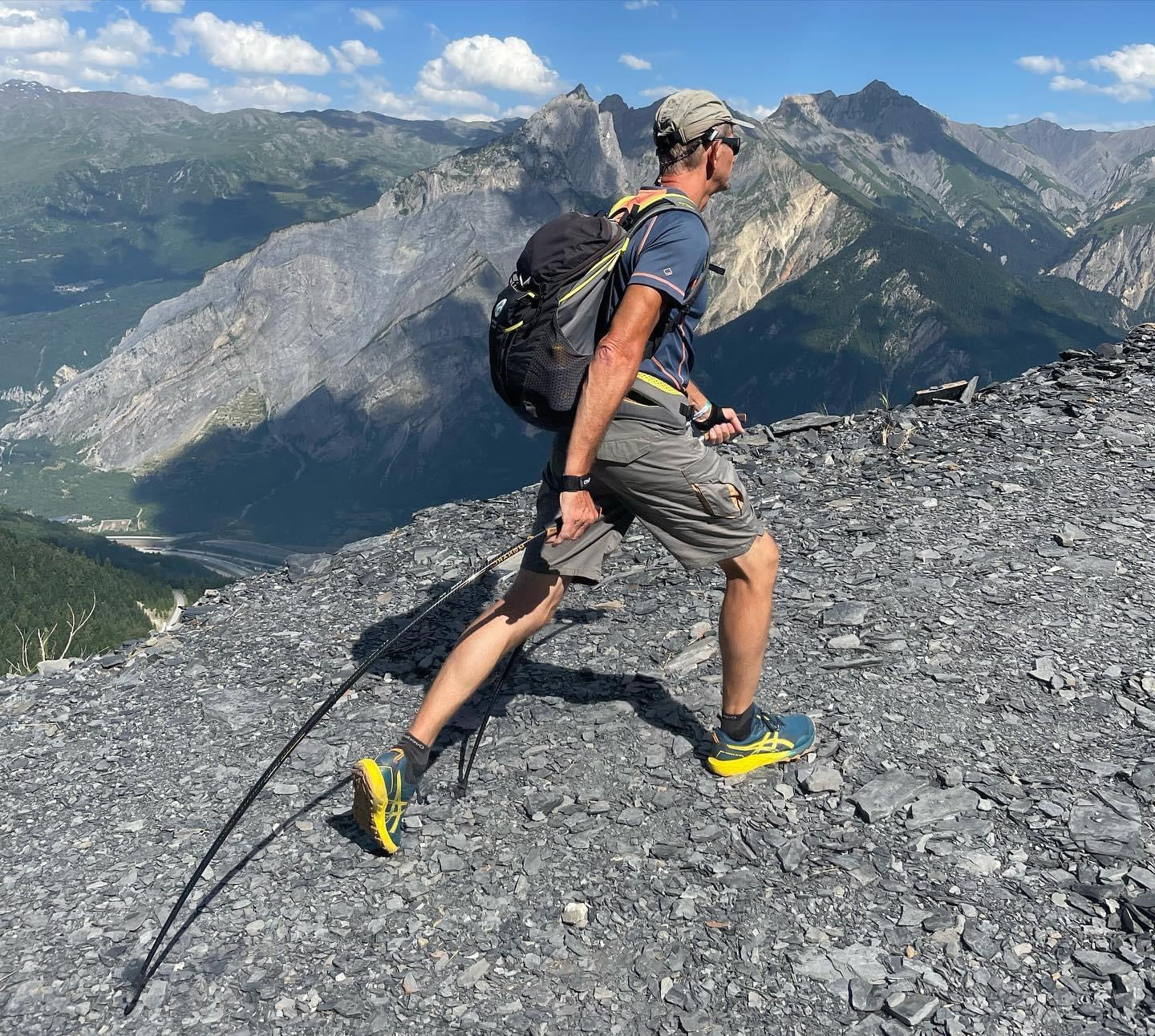
Nordic Walking and Knee Pain: Answers to the Most Frequent Questions
Yes, Nordic walking suits most painful knees, osteoarthritis included, as long as you pace the effort and get the technique right. On the other hand, the idea that poles “take 30% of your weight off” your knees does not stand up to measurement. On the flat, the relief is small or nil, and it is downhill that poles clearly ease the knee. Here is what the studies and guidelines say, question by question.
In short
- Knee osteoarthritis: adapted physical activity is the first-line treatment (HAS, 2022; OARSI, 2019). Nordic walking is a simple, sociable form of it.
- On the flat: poles take little load off the knee in most studies. The often-quoted 30% figure is not confirmed.
- Downhill: the effect is clear, with 12 to 25% less force in the knee (Schwameder et al., 1999).
- Stop signals: if your knee is warm or swollen, or if pain wakes you at night, rest it and see a doctor.
- Knee replacement, meniscus: Nordic walking is often possible, with your surgeon's or physiotherapist's agreement and a gradual return.
- Technique and pole length: a pole of the right length, planted well, drives you forwards instead of braking you.
Is Nordic walking good for the knees?
For the vast majority of people, the answer is yes. Knee cartilage has no blood vessels. It is nourished by the cycles of pressure and release that movement creates. In its factsheet on osteoarthritis, the French National Authority for Health (HAS) points out that moderate, regular mechanical stress is essential to maintain cartilage and muscle, whereas a sedentary lifestyle increases the risk of osteoarthritis (HAS, 2022).
Nordic walking ticks the boxes of a knee-friendly activity. It has none of the impact of running, it is done at moderate intensity, it works the thigh muscles that stabilise the joint, and it adapts to every level. The poles add two points of support. You feel more stable, you dare to walk for longer, and the upper body takes its share of the effort.
Nordic walking does not repair damaged cartilage or cure osteoarthritis, and no activity can. In knee osteoarthritis, however, trials show that exercise reduces pain and improves function, in the short and the long term (HAS, 2022).

Do poles really take load off the knee?
You read everywhere that poles “take 30% of the weight off the knees”. We found no study that measures such a figure when walking on the flat. Here is what laboratories have actually measured.

Downhill, the effect is clear
The knee works much harder downhill, because the quadriceps has to brake the body at every step. Calculated knee forces rise from about 3.9 times body weight on the flat to 8 times downhill (Kuster et al., 1997). Measured directly in knee implants fitted with sensors, they average 2.6 times body weight when walking and 3.5 times when going down stairs (Kutzner et al., 2010).
Downhill is where poles help most. On a ramp inclined at 25°, eight walkers reduced the forces in their knees by 12 to 25% thanks to their poles. Part of the weight goes through the arms, and the upper body, leaning slightly further forward, shortens the lever on the knee (Schwameder et al., 1999).
On the flat, the effect is small, sometimes nil
- In 13 healthy adults, walking with poles reduced the vertical force in the knee, and the work of the muscles that straighten the knee by 7 to 10%, depending on how the poles were planted (Willson et al., 2001).
- In seven experienced Nordic walking instructors, knee compression was the same with and without poles (Hansen et al., 2008).
- When ten people pushed 2.4 times harder on their poles, knee compression still did not fall (Jensen et al., 2011).
- In 34 patients with knee osteoarthritis and varus (“bow”) legs, poles did not reduce the load indicator on the inner side of the knee; it even rose slightly (Bechard et al., 2012).
- Conversely, in one person whose knee implant measures forces, walking with two poles reduced the total force in the knee by 21% (Fregly et al., 2009). It is only one case, but the measurement is direct.
In short, poles take little load off the knee on the flat. Their real benefit is to let you walk for longer, faster and more often, with more stability. Downhill, on the other hand, they clearly relieve the knee.
Can you do Nordic walking with knee osteoarthritis?
Yes, you can, outside flare-ups. All national and international guidelines make adapted physical activity the first-line treatment for osteoarthritis, and the HAS stresses that its benefit/risk ratio is better than that of medication (HAS, 2022). The international OARSI guidelines put structured exercise, with education and weight management, at the heart of treating knee osteoarthritis (Bannuru et al., 2019). In the reviews of trials cited by the HAS, no serious adverse effects were reported.
The HAS also lists walking poles among the useful technical aids around exercise, and the American College of Rheumatology strongly recommends a cane when osteoarthritis makes walking difficult (Kolasinski et al., 2020). Trials specifically on Nordic walking in knee osteoarthritis are still few and small. In hip osteoarthritis, however, a trial in 152 people over 60 showed that four months of supervised Nordic walking improved physical performance more than gym-based strength training or home exercises (Bieler et al., 2017).
Signs that call for a break
An osteoarthritis flare-up (also called an inflammatory or congestive flare) is a temporary contraindication to activity for the knee concerned. The HAS describes the following signs:
- pain that rises sharply over a few days, for no obvious reason;
- pain that wakes you at night;
- stiffness on waking that lasts more than 15 minutes;
- a swollen, warm or red knee.
If so, rest the knee and see your doctor promptly. As soon as the flare-up is over, even if some pain remains, the HAS recommends resuming activity, because movement maintains the cartilage.
How to get started with an arthritic knee
- Start short. Walk for 20 to 30 minutes on flat, soft ground (paths, grass), two or three times a week.
- Keep to a moderate intensity. You should be able to talk while walking.
- Build up gradually, first the duration, then the climbing, aiming eventually for the 150 minutes of moderate activity a week recommended by the WHO.
- Listen to the pain. Slight discomfort that settles after the session is common. If the pain grows from one outing to the next or lasts until the following day, cut back and talk to your doctor or physiotherapist.
- Limit long descents at first, and do them with your poles planted in front of you.
- Add thigh strengthening. The HAS combines endurance with muscle strengthening.
In France, your doctor can prescribe adapted physical activity; in 2022 the HAS published a factsheet on osteoarthritis to guide this prescription. To start without injury, also read our guide Starting Nordic walking at 50, 60 or 70.
Where should you plant your poles uphill, on the flat and downhill?
The knee suffers most when technique is not adapted to the terrain. The most common mistake is to plant the pole far in front of you on the flat. The pole then brakes your momentum instead of propelling you, and your legs make up the difference.

Uphill
Shorten your stride, lean your upper body slightly forward and push far behind you, so that your arms do part of the work. On mountain paths, walkers with poles walked faster than without, for the same perceived effort (Grainer et al., 2017).
On the flat
Plant the pole between your feet, angled backwards, and push right through the movement, opening your hand. Roll your foot from heel to toe, without slapping the ground. The full technique is in our article Basic Nordic walking technique.
Downhill
Take small steps, knees slightly bent, and plant your poles in front of you to hold yourself back. Slow down, because downhill is where the knee takes the most, and also where poles relieve it the most. On steep paths, use our advice on Nordic walking in the mountains.
Shoes that cushion well and hold the heel firmly also matter. Our guide explains how to choose Nordic walking shoes.
What pole length if your knees hurt?
The right length avoids two faults that affect the legs. Poles that are too long land in front of you and brake; poles that are too short make you lean forward. To find the right length, multiply your height by 0.68. Between two lengths, choose the shorter; a very sporty walker can take the one above. For a height of 1.70 m, the calculation gives 1.70 × 0.68 = 115.6 cm, so 115 cm poles.
The Arcs de Marche® are fixed-length one-piece poles, from 100 to 130 cm. You choose the length once and for all, and nothing moves afterwards. Downhill, there is no need to lengthen them, because you simply plant them a little further in front of you. It is all detailed in our size guide and in the article What size Nordic walking poles should you choose?
What did the Grenoble study measure on the Arcs de Marche®?
The Arcs de Marche® are not a medical device, and no study has measured their effect on forces in the knee. The Université Grenoble Alpes study looked at what their shape changes. It compared straight poles and Arcs in eight regular walkers with an average age of 64.5, on a track, at 5 and 6 km/h (Termoz, Depery, Lorenzi). They are the first poles whose geometry has been scientifically compared with that of straight poles.

- A push directed forwards: the push angle goes from 46° to 33°, and propulsion becomes 22% more efficient with no extra oxygen uptake or heart rate. This is the “booster effect” our walkers describe.
- Less vibration in the arms: transmitted vibration falls by 22% at 5 km/h and by 26% at 6 km/h.
- Effort better shared: the upper body tends to work a little more, and some leg muscles a little less. This trend is not always significant with eight participants.
- More comfort: perceived effort is lower at 5 km/h, and comfort and enjoyment are significantly greater at 6 km/h.
These results matter when you are looking after your knees. Arms that propel you better, fewer shocks in the upper limbs and a more pleasant walk make you want to go out more often, and it is regular activity that does the knee good. The full protocol is on the Université Grenoble Alpes study page, and our article on curved Nordic walking poles explains the principle.
Learn the right technique in a club
Good technique is learned in a few sessions with an instructor, who corrects the pole angle, stride length and push. MØNARC® Partner Clubs coach walkers using Arcs, and their members get €30 off per pair. If you run a club, discover our certified training courses for clubs and coaches, on preferential terms for labelled clubs, and the Partner Club label.
Frequently asked questions
Can Nordic walking damage the knee?
Nothing suggests so. In osteoarthritis, the HAS asks doctors to reassure patients that exercise carries no risk of making it worse, and reviews of trials report no serious adverse effects. The risk comes mainly from returning too abruptly or from long descents without preparation.
What should I do if my knee hurts going downhill?
Shorten your stride, keep your knees slightly bent, slow down and plant your poles in front of you to shift part of the effort onto your arms. Downhill is where poles relieve the knee most, with up to 25% less force (Schwameder et al., 1999). If the pain comes back on every outing, have your knee examined by a doctor or physiotherapist.
Can you do Nordic walking with a knee replacement?
It is generally possible, because Nordic walking is a low-impact activity. According to a review of 45 studies, 85% of people who have had a knee replacement return to physical activity or sport, after a median of four months, mostly low-impact activities (Braz et al., 2026). Wait for your surgeon's agreement, start again on flat ground and limit long descents at first, where the load on the knee is highest (Kuster, 2002).
And with a meniscus tear?
For a degenerative meniscus tear (due to wear), exercise has proven its worth. In a trial of 140 patients, twelve weeks of supervised exercise gave results comparable to surgery (partial meniscectomy) on knee pain and function ten years later (Berg et al., 2025). Nordic walking can complement this work once the painful phase has passed. After a meniscus repair or a tear caused by an injury, follow the schedule set by your surgeon.
Do you need special poles if your knees hurt?
Above all, you need poles of the right length and good technique. Light, stiff poles that do not move help you keep a steady action throughout the outing. The Arcs de Marche® add a forward-directed push and about 25% less vibration in the arms. They are not medical poles, and they replace neither medical advice nor rehabilitation.
How much should I walk each week?
The WHO recommends at least 150 minutes of moderate activity a week, spread over several outings, and that is the goal to aim for in time. With a painful knee, start shorter and build up gradually, as the HAS advises.
This article is for information and does not replace medical advice. If you have persistent pain, a swollen knee or have recently had surgery, ask your doctor or physiotherapist for advice.
Sources
- Schwameder H. et al., Journal of Sports Sciences, 1999, 17(12): 969-978.
- Willson J. et al., Medicine & Science in Sports & Exercise, 2001, 33(1): 142-147.
- Hansen L. et al., Scandinavian Journal of Medicine & Science in Sports, 2008, 18(4): 436-441.
- Jensen S.B. et al., Scandinavian Journal of Medicine & Science in Sports, 2011, 21(6): e195-e200.
- Bechard D.J. et al., Osteoarthritis and Cartilage, 2012, 20(12): 1500-1506.
- Fregly B.J., D'Lima D.D., Colwell C.W., Journal of Orthopaedic Research, 2009, 27(8): 1016-1021.
- Kuster M.S. et al., Journal of Bone and Joint Surgery (British volume), 1997, 79(1): 109-113.
- Kutzner I. et al., Journal of Biomechanics, 2010, 43(11): 2164-2173.
- Bannuru R.R. et al. (OARSI guidelines), Osteoarthritis and Cartilage, 2019, 27(11): 1578-1589.
- Kolasinski S.L. et al. (ACR/Arthritis Foundation guideline), Arthritis Care & Research, 2020, 72(2): 149-162.
- Bieler T. et al., Scandinavian Journal of Medicine & Science in Sports, 2017, 27(8): 873-886.
- Grainer A. et al., International Journal of Environmental Research and Public Health, 2017, 14(10): 1235.
- Braz R. et al., Knee Surgery, Sports Traumatology, Arthroscopy, 2026, 34(9): 3415-3428.
- Kuster M.S., Sports Medicine, 2002, 32(7): 433-445.
- Berg B. et al., British Journal of Sports Medicine, 2025, 59(2): 91-98.
- Haute Autorité de santé (French National Authority for Health), “Prescription of physical activity: peripheral osteoarthritis”, factsheet approved on 13 July 2022.
- World Health Organization, guidelines on physical activity and sedentary behaviour, 2020.
- Termoz N., Depery E., Lorenzi G., Université Grenoble Alpes: straight poles versus MØNARC® curved poles, 8 regular walkers.

The MØNARC® Arcs de Marche®
These curved 100% carbon Nordic walking poles weigh 140 g each and are designed and assembled in France. They are delivered ready to walk with straps, tungsten carbide tips and a made-to-measure bag.
Disclaimer. This article provides general information. It does not replace the advice of a doctor or health professional, nor supervision by a qualified instructor. Before starting or stepping up physical activity, especially if you have a health condition, pain or ongoing treatment, consult your doctor. Exercise according to your fitness, on suitable ground and with equipment in good condition. Each reader remains solely responsible for their own practice and for the decisions they make based on this information, and MONARC SAS cannot be held liable for their consequences.