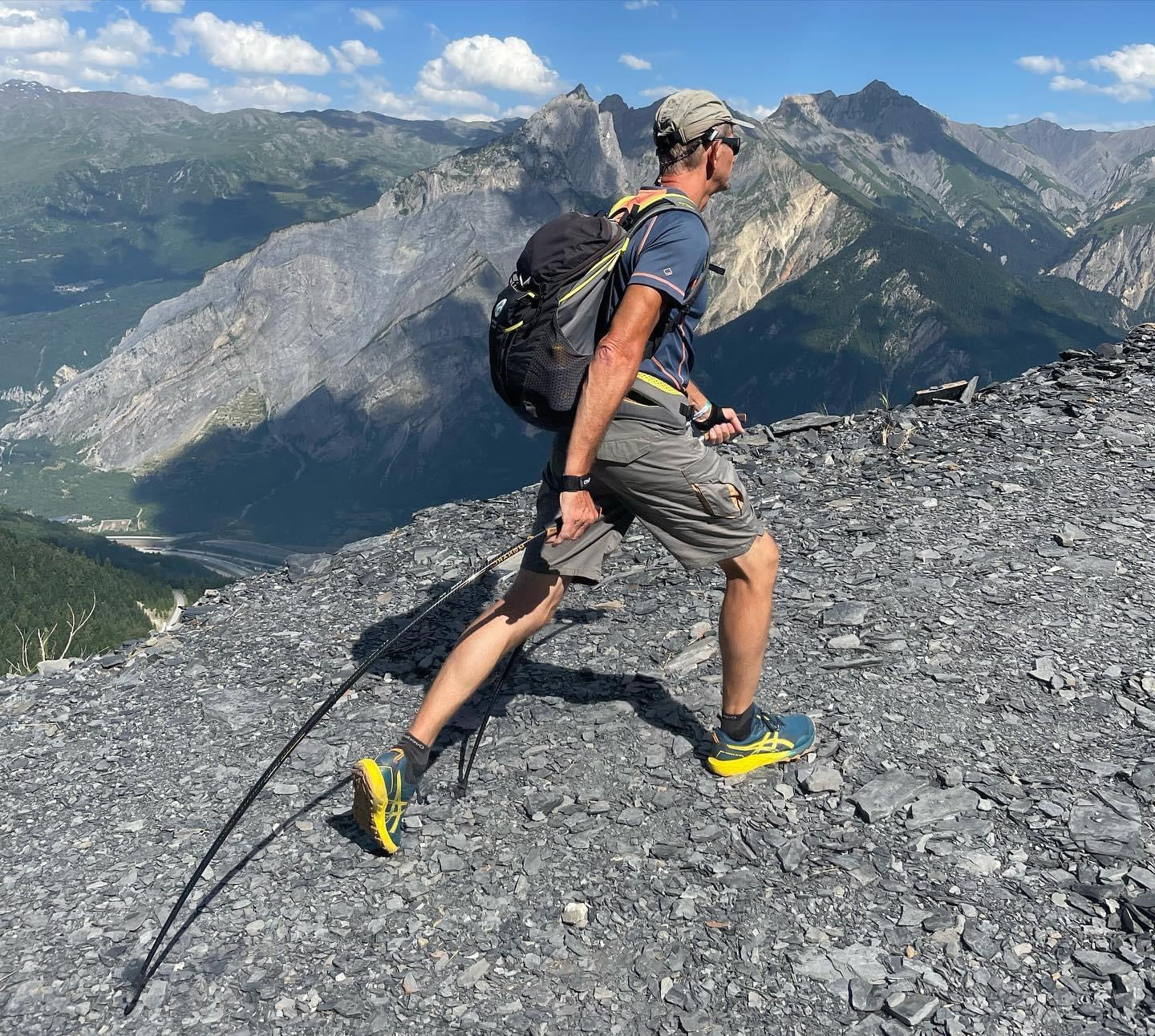
Starting Nordic Walking at 50, 60 or 70: How to Begin Without Injury
Yes, you can start Nordic walking at 50, 60 or 70, even with no sporting background. It is in fact one of the best-studied endurance activities after 60, with measured gains in breathing, strength and balance. To start without injury, four rules are enough: medical advice when your situation calls for it, short and progressive sessions, a technique learned from an instructor, and poles of the right length from your very first outing.
In short
- It is never too late. The studies involve walkers aged 60 to 92, often inactive at the start.
- The benefits have been measured for aerobic capacity, arm and leg strength, balance, quality of life and blood pressure (meta-analyses from 2018 and 2025).
- Ask a doctor first if you have heart disease, diabetes or kidney disease, or symptoms during exertion.
- The first 4 weeks involve 2 to 3 sessions of 20 to 45 minutes a week, at a pace at which you can talk, with a rest day between sessions.
- The most common injury is a sprained thumb in a fall. If you fall, open your hands.
- Get the right kit from the start. Choose poles of your length (height × 0.68) and straps that fit your hand, then learn the technique in a club.
Is it too late to start? What the studies show
Nordic walking has been tested in many trials with people over 60, often inactive at the start. The results point the same way and show that the body improves, whatever the age at which you begin.
- Breathing, strength and balance. A meta-analysis of 15 studies in people aged 60 to 92 shows that Nordic walking clearly improves aerobic capacity, as well as arm and leg strength and balance, compared with people who stayed inactive. Against ordinary walking, it does better for balance, lower-body flexibility and quality of life; ordinary walking does slightly better for pure endurance (Bullo et al., 2018).
- Heart and waistline. Across 22 trials and 1,271 participants with an average age of 62, Nordic walking lowers systolic blood pressure by about 3 mmHg, weight by 1.8 kg and waist circumference by 2.2 cm, and improves maximal oxygen uptake. After 65, diastolic blood pressure falls by about 5 mmHg (Liu and Kim, 2025).
- Everyday independence. In a trial published in 2026, people aged 65 to 80 followed 12 weeks of Nordic walking or ordinary walking, three times a week. The Nordic walking group covered 51 metres more in the 6-minute walk test, got up from a chair more easily and was less afraid of falling (Öziri et al., 2026).
- Brain. In walkers with an average age of 71, Nordic walking improves executive functions, the ones we use to plan and to switch from one task to another. No effect on memory has been shown so far (Li et al., 2025).

Two caveats are needed to give the full picture. For bones, the evidence is thinner. In people over 50 at risk of fracture, Nordic walking improves mobility, but its effect on bone density has not been shown, and it is best combined with strength training (Rodrigues et al., 2021). Our article on Nordic walking and osteoporosis looks at this in detail. In addition, the World Health Organization recommends that people over 65 do balance and strength exercises at least three days a week, on top of 150 minutes of moderate activity a week (Bull et al., 2020), and Nordic walking covers part of this. For the benefits in detail, read our article on the benefits of Nordic walking for seniors.

Should you see a doctor before starting?
It is not always necessary. Nordic walking is a moderate-intensity activity, and most people can take it up without a check-up. The American College of Sports Medicine (ACSM) bases its recommendations on three criteria: your current activity level, the presence of a disease or symptoms, and the intensity you are aiming for (Riebe et al., 2015).
| Your situation | What the ACSM recommends |
|---|---|
| No known disease, no symptoms | You can start at light to moderate intensity and build up gradually. |
| Known heart disease, diabetes or kidney disease, no symptoms, and you do not exercise | Ask for medical advice before starting. |
| Already active, with one of these diseases, no symptoms | Carry on at moderate intensity, and ask for medical advice before moving up to vigorous effort. |
| Chest pain or discomfort, unusual breathlessness, faintness or dizziness, palpitations, swollen ankles, calf pain when walking | Ask for medical advice before starting, whatever your level. |
Also talk to your doctor if you have a recent hip or knee replacement, painful osteoarthritis, osteoporosis with a previous fracture, or if you have had a fall in the past year. They will tell you which precautions to take.
In France, if you join a club, the rules depend on the federation. At the FFRandonnée, for example, a first licence requires a medical certificate less than six months old (rules of September 2025). And if you live with a chronic disease, risk factors or a loss of independence, a French doctor can prescribe adapted physical activity (law of 2 March 2022). This is known as “sport on prescription”, and the Maisons Sport-Santé can point you to a supervised group.
Your first 4 weeks, session by session
At first, count in minutes rather than kilometres. To set the intensity, rely on the talk test. You should be able to talk while walking, but not sing. On a scale from 0 (rest) to 10 (maximum effort), aim for 5 or 6, which matches the moderate intensity of the WHO recommendations.

| Week | Sessions | Duration | Goal |
|---|---|---|---|
| 1 | 2 | 20 to 30 min, flat ground | Discover the movement by letting the poles drag at first, then planting them to push |
| 2 | 2 to 3 | 30 min | Coordinate arms and legs, push backwards |
| 3 | 3 | 30 to 40 min | Walk without stopping, add a gentle slope |
| 4 | 3 | 40 to 45 min | Hold your pace, lengthen your stride a little |
- Start each session with 5 to 10 minutes of slow walking and shoulder movements, and finish with a few minutes of easy walking.
- Keep a rest day between two sessions.
- Increase only one thing at a time: duration first, then pace, then climbing.
- Muscle soreness for one or two days is normal. Joint pain lasting more than 48 hours is a signal to ease off.
- Stop and see a doctor if you have chest pain, unusual breathlessness, dizziness or palpitations.
Do not aim for a set speed. At their own pace, walkers in studies move at just under 5 km/h; in a 12-minute all-out test, recreational walkers with an average age of 64 reach 5.4 km/h (Fujita et al., 2018). After four weeks, you are walking three times 40 minutes a week, and you are ready for our 8-week Nordic walking training programme. The WHO target of 150 minutes a week then means three outings of 50 minutes.
The most common injuries, and how to avoid them
Nordic walking is a safe sport. In a German study of 137 walkers with an average age of 53, over more than 29,000 hours of practice, there was less than one injury per 1,000 hours. Only 5% of injuries interrupted training, and all the walkers were back at the same level within four weeks. No knee ligament injuries were recorded (Knobloch and Vogt, 2006).
| Injury | How it happens | How to avoid it |
|---|---|---|
| Sprained thumb, known as “skier's thumb”, the most common | A fall while still gripping the handle, which then levers the thumb | If you fall, open your hands. With straps, the pole stays attached to your hand. |
| Shoulder pain or dislocation in a fall | Falling on an outstretched arm, poles too long, arms rising too high | Poles of your length, arms swinging close to the body, eyes ahead |
| Calf strain | Lengthening the stride too fast, no warm-up | Warm up, lengthen your stride gradually |
| Wrist or elbow pain | Gripping the handle all the time, repeated shocks on hard ground | Relaxed hand, well-adjusted straps, rubber pads on tarmac |
| Sprained ankle, fall | Roots, wet leaves, loose stones | Grippy shoes, easy paths at first |
What about the knees? On the flat, poles unload the legs by only a few per cent, about 3% of peak ground reaction force in young and older beginners (Di Bacco et al., 2022). On a steep descent, the effect becomes clear, with 12 to 25% less force on the knee (Schwameder et al., 1999). If your knees hurt, read our article on Nordic walking and knee pain.
Your starter checklist for equipment and settings
Starting well also means getting the right kit from your first outing. A pole that is too long tires the shoulders, and a badly fitted strap makes you grip the handle. Session after session, these small equipment mistakes end up causing aches.

- Choose Nordic walking poles, not hiking poles. A hiking pole is planted in front of you for support; a Nordic walking pole is planted behind you to push, with a strap that transmits the push.
- The right length is your height in centimetres × 0.68, rounded down to the nearest 5 cm. For 1.65 m, the calculation gives 165 × 0.68 = 112 cm, so 110 cm poles. To check, plant the pole upright in front of you; your elbow should then form an angle slightly greater than 90°. Our size guide gives the length for every height.
- For the straps, measure around your palm, thumb excluded. Take size S for under 18 cm, M for 18 to 20 cm and L for over 20 cm.
- Prefer light, stiff poles. A one-piece carbon pole is light, stiff and has no mechanism to work loose as you walk.
- Match the tips to the ground. Carbide tips suit paths and grass, and rubber pads suit tarmac and pavements.
- Wear shoes that hold your foot, with a grippy sole that is flexible at the front and a well-held heel. Trail shoes or sporty walking shoes are fine.
- Also bring layered clothing, a water bottle and your phone.
That is why our Arcs de Marche® arrive ready to walk, with the length chosen at purchase for your height, S, M or L straps, tungsten carbide tips and a made-to-measure bag. There is nothing to adjust before your first outing, and no mechanism to work loose as you walk.
Learning the technique in a club for a good start
The Nordic walking movement looks simple, but it has to be learned: plant the pole behind you, push through to the hip, open the hand at the end of the push, coordinate arms and legs. A few sessions with an instructor correct faults before they become habits, and the group makes you want to come back every week. With the Arcs, the movement stays that of Nordic walking and fits every teaching method. Simply allow a few outings to find your rhythm. The basics are covered in our guide to the basic technique of Nordic walking.
To find a club, look for a Nordic walking section in the hiking, athletics or health-sport clubs near you, and read our article on Nordic walking in a group. MØNARC® Partner Clubs know the Arcs de Marche® and can explain them; their members get €30 off per pair. Your club is not a partner yet? It can become a Partner Club and benefit from preferential terms on our certified courses.
Frequently asked questions
Can you start Nordic walking at 70 or older?
You can certainly start at 70 or older, since the studies include walkers up to 92. Start with 20-minute sessions on flat ground, ideally supervised, and ask for medical advice if you have a chronic disease or symptoms during exertion.
Do you need a medical certificate for Nordic walking?
You do not need one to walk on your own. For a club licence, it depends on the federation, and in France the FFRandonnée requires a certificate less than six months old for a first licence. Medical advice is still recommended before starting if you have heart disease, diabetes, kidney disease or symptoms during exertion.
How many sessions a week to start with?
Plan two to three sessions a week, with a rest day between sessions. Start with 20 to 30 minutes and add 5 to 10 minutes a week. In time, aim for 150 minutes a week, or three 50-minute outings.
Is Nordic walking good for the knees?
It is well tolerated, and no knee ligament injuries were recorded among the 137 walkers followed by Knobloch and Vogt. On the flat, poles unload the legs only a little; downhill, they clearly reduce the forces on the knee. If you have osteoarthritis or pain, ask your doctor for advice.
What pole length should a beginner choose?
Multiply your height in centimetres by 0.68, then round down to the nearest 5 cm. Between two lengths, take the shorter one; a very sporty walker can take the one above.
Sources
- Bullo V. et al., “Nordic Walking Can Be Incorporated in the Exercise Prescription to Increase Aerobic Capacity, Strength, and Quality of Life for Elderly: A Systematic Review and Meta-Analysis”, Rejuvenation Research, 2018, 21(2): 141-161.
- Liu J., Kim J.H., “The effects of nordic walking on the cardiovascular risk factors in older adults: A systematic review and meta-analysis”, Archives of Gerontology and Geriatrics, 2025, 129: 105663.
- Öziri N., Baskan E., Balkisli B.C., “Investigation of the effectiveness of Nordic Walking training on geriatric individuals: a randomized comparative study”, European Geriatric Medicine, 2026, 17(4): 1901-1909.
- Li H. et al., “The effects of Nordic walking on cognitive function in older adults: a systematic review and meta-analysis”, Frontiers in Aging Neuroscience, 2025, 17: 1666449.
- Rodrigues I.B. et al., “The Effects of Walking or Nordic Walking in Adults 50 Years and Older at Elevated Risk of Fractures: A Systematic Review and Meta-Analysis”, Journal of Aging and Physical Activity, 2021, 29(5): 886-899.
- Riebe D. et al., “Updating ACSM's Recommendations for Exercise Preparticipation Health Screening”, Medicine & Science in Sports & Exercise, 2015, 47(11): 2473-2479.
- Bull F.C. et al., “World Health Organization 2020 guidelines on physical activity and sedentary behaviour”, British Journal of Sports Medicine, 2020, 54(24): 1451-1462.
- Fujita E. et al., PLoS One, 2018, 13(11): e0208070.
- Knobloch K., Vogt P.M., “Nordic pole walking injuries: Nordic walking thumb as novel injury entity”, Sportverletzung Sportschaden, 2006, 20(3): 137-142.
- Di Bacco V.E., Kiriella J.B., Gage W.H., “The Influence of the Relative Timing between Pole and Heel Strike on Lower Limb Loading among Young and Older Naïve Pole Walkers”, Translational Sports Medicine, 2022: 3938075.
- Schwameder H. et al., “Knee joint forces during downhill walking with hiking poles”, Journal of Sports Sciences, 1999, 17(12): 969-978.
- Termoz N., Depery E., Lorenzi G., Université Grenoble Alpes, study on the geometry of Nordic walking poles: about the study (in French).
- FFRandonnée, “Le certificat médical pour la randonnée pédestre et autres activités de marche”, rules of September 2025; French law no. 2022-296 of 2 March 2022 on making sport more accessible.

The MØNARC® Arcs de Marche®
These curved 100% carbon Nordic walking poles weigh 140 g each. Designed and assembled in France, they arrive ready to walk with straps, tungsten carbide tips and a made-to-measure bag.
Disclaimer. This article provides general information. It does not replace the advice of a doctor or health professional, nor supervision by a qualified instructor. Before starting or stepping up physical activity, especially if you have a health condition, pain or ongoing treatment, consult your doctor. Exercise according to your fitness, on suitable ground and with equipment in good condition. Each reader remains solely responsible for their own practice and for the decisions they make based on this information, and MONARC SAS cannot be held liable for their consequences.