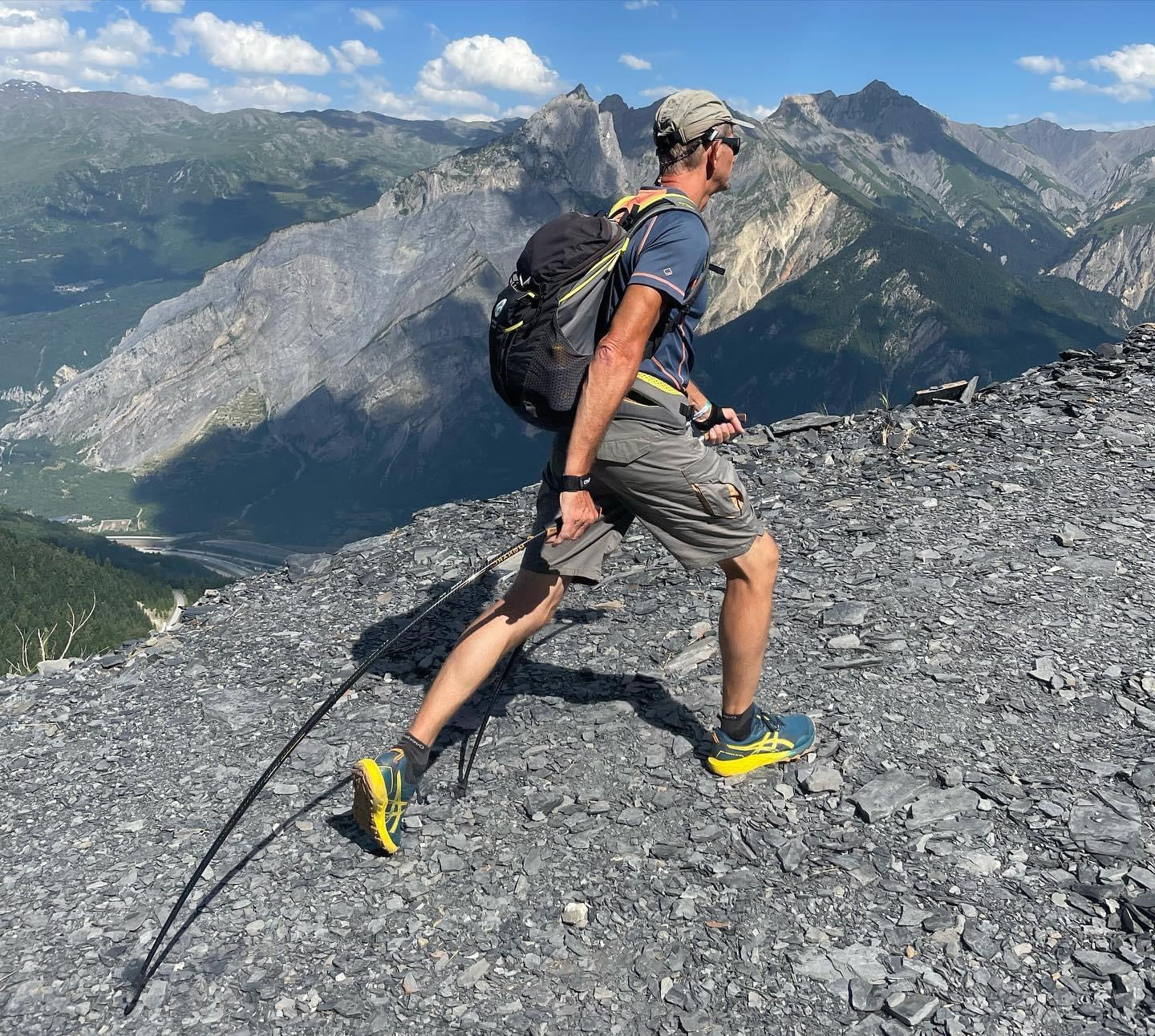
Nordic Walking: The Best Apps and GPS Watches for Making Progress
Technology has made its way onto the trails. GPS watches, tracking apps and audio coaching can turn a Nordic walking outing into a structured, measured session. You still need to know which ones to choose, and what their limits are when you walk with poles.
In short
- To get started with a free guided programme, choose Decathlon Coach.
- To find routes, use Cartes IGN and Visorando, both free (France), or Wikiloc and its thousands of Nordic walking routes.
- To record and share your outings, Strava remains the reference.
- Polar and Suunto offer a Nordic walking mode. On other watches, choose “Walk” or “Hike”.
- With poles, your watch miscounts your steps and measures your heart rate less accurately at the wrist. Rely on GPS, and on a chest strap if you track your heart rate.

Apps for Nordic walking
No major app was designed for Nordic walking. Each one excels in one area: training, finding a route, recording your outings or sharing them. Here are the ones that really help, with what is free and what is paid (prices checked in October 2026).

| App | Free and paid | Best for |
|---|---|---|
 Decathlon Coach Decathlon CoachNordic walking: yes |
Completely free, with several Nordic walking programmes | Getting started and progressing with a voice coach |
 Strava StravaNordic walking: no |
Free: recording, clubs, watches. Subscription at €59.99/year: routes, offline maps, plans | Tracking and sharing your outings |
 Komoot KomootNordic walking: no |
Free: planning, one region. Paid: other regions, World Pack at €29.99 one-off, Premium | Planning a route and following it offline |
 Visorando VisorandoNordic walking: no |
Free: search and offline guidance. Premium at €25/year: offline IGN 1:25,000 maps | Finding described routes in France |
 Cartes IGN Cartes IGNNordic walking: no |
Completely free: IGN maps, route drawing, GPX tracks | Planning a route on France's official maps |
 Wikiloc WikilocNordic walking: yes |
Free: search, publish. Premium at €19.99/year: follow other members' routes, send to your watch | Finding Nordic walking routes |
 MaRando (FFRandonnée) MaRando (FFRandonnée)Nordic walking: yes, as a filter |
Free; paid options, including IGN TOP 25 maps | Clubs and members of the French hiking federation |
Decathlon Coach, the best free app to get started
It is the most complete free app for Nordic walking. It offers several dedicated programmes, from a 4-week discovery programme (one session a week) to an 8-week beginner plan and progression plans. A voice coach guides you during the session, and the app records distance, duration and, with a chest strap, heart rate. It has no club features.
Strava for recording and sharing your outings
Strava has become the reference for outdoor sports tracking. The free version records your routes by GPS (distance, speed, elevation gain), automatically imports the outings from your watch and lets you join or create a club. The subscription, at €59.99 a year, adds route creation, offline maps, full segment leaderboards and training plans. Strava has no “Nordic walking” sport. Choose “Walk” or “Hike”, and always the same one, so you can compare your outings.
Komoot for planning a route
Komoot is one of the most precise planning tools in Europe: elevation profile, surface type, points of interest. Planning is free everywhere. To navigate or record, you need to unlock the region: one region is free when you sign up, others are bought individually, or all at once with the World Pack, at €29.99 as a one-off payment. You plan in “Hiking” mode; “Nordic walking” only exists as a label for a completed outing.
Visorando and Cartes IGN for routes and maps in France
Visorando gathers thousands of described hikes in France, with route guidance that works even without a signal, for free. The Premium subscription, at €25 a year, adds offline IGN 1:25,000 maps.
The Cartes IGN app, from France's national mapping institute, is completely free: draw a route with its distance and elevation, record it, and import or export GPX tracks. It offers more than 6,000 hiking ideas. The former IGNrando' app became WeTrek at the end of 2025.
Wikiloc and its ready-made Nordic walking routes
Wikiloc is the only major app with a real “Nordic walking” activity. It lists more than 20,000 Nordic walking routes in France, shared by walkers. Searching and publishing are free. Following another member's route or sending it to your watch requires Premium, at €19.99 a year.
The Garmin, Polar and Suunto watch apps
Garmin Connect, Polar Flow and the Suunto app accompany those brands' watches. Free of charge, they analyse your data in depth: training load, recovery, sleep, estimated VO2 max. They can also send your outings automatically to Strava or Komoot.
Which smartwatch for Nordic walking?
Any GPS sports watch will do. However, few brands offer a true “Nordic walking” mode. Here is where the main ones stand in October 2026.

- Polar (Pacer, Vantage, Grit X2…) offers a “Nordic walking” profile.
- Suunto (Run, Race, Vertical…) lists Nordic walking among its sports. If it is missing on your model, create a custom mode in the Suunto app.
- On a Garmin (Forerunner, Venu, fenix, Instinct…), choose Walk or Hike. Models that allow it let you duplicate and rename this profile.
- On an Apple Watch, choose Outdoor Walk rather than “Other”, which does not record distance.
- On a COROS or a Samsung Galaxy Watch, choose Walk or Hike.
How to choose?
- For regular practice and long outings, choose a sports watch (Polar, Suunto, Garmin, COROS). Depending on the model, it lasts from 20 to more than 40 hours in GPS mode and analyses your training in detail.
- For an everyday watch, an Apple Watch or a Samsung Galaxy Watch will do. They are versatile, but their battery life during activity is counted in hours. The Apple Watch SE 3, for example, lasts up to 7 hours with GPS.
- If you mostly walk in a club, with an instructor, an entry-level watch is enough, as long as it has GPS and heart rate.
Budget-wise, the first serious GPS watches from the major brands start at around €200 to €300 (list prices checked in October 2026).
What poles distort in your watch's measurements
Watches derive much of their data from wrist movement. In Nordic walking, however, your arms do not swing freely as in walking, because they push on the poles. Studies show the consequences.

- Steps are undercounted. In a 2024 study on hiking with poles, the watch worn on the pole side counted about half as many steps as the one on the free wrist (Gines et al., 2024). In Nordic walking, both hands hold a pole.
- Wrist heart rate is less accurate. One study found a mean error of 6.6 beats per minute in Nordic walking, versus 3.7 in normal walking, with a wrist sensor. The chest strap remained accurate (Baek et al., 2021).
- Take estimated VO2 max with caution. Watches calculate it from walking or running without poles. Yet at the same speed, Nordic walking requires about 20% more energy (Church et al., 2002). Read it as a trend rather than as a measurement.
Our tips for reliable data
- Judge your outings on the distance and pace measured by GPS, not on step count.
- If you track your heart rate, wear a chest strap. It connects to most sports watches and to Decathlon Coach.
- Always use the same activity profile, so you can compare your outings.
- Wear the watch snugly, just above the wrist bone, to limit sensor movement.
Useful metrics in Nordic walking
- Heart rate. Do most of your outings in zone 2, between 60 and 70% of your maximum heart rate, where you can still talk. The zones are detailed in our article on Nordic walking speed, heart-rate zones and progress.
- Pace. It is the best marker of progress. At a self-selected pace, studies report just under 5 km/h. In a 12-minute all-out test, recreational walkers aged 64 on average reach 5.4 km/h, and instructors 6.6 km/h (Fujita et al., 2018).
- Cadence. It is around 100 to 120 steps per minute at a moderate pace. With poles, strides lengthen and cadence drops slightly. A review of 42 studies associates Nordic walking with strides about 10% longer and a cadence about 6% lower (Roy et al., 2020). Measured at the wrist, cadence is unreliable.
- Elevation gain. It is essential for comparing mountain outings. Uphill, poles let you walk faster for the same perceived effort (Grainer et al., 2017).
- Moving time. It separates active walking from breaks, especially in a group.
- Calories. Treat them as an order of magnitude only. The study figures are in our article How many calories does Nordic walking burn?
To structure your sessions, follow our 8-week Nordic walking training plan.
Apps for running a Nordic walking club
For a club, the challenge is not individual data but organisation: announcing outings, sharing routes, keeping in touch between sessions.
- MaRando and MaTribu (FFRandonnée). Leaders create the club's “tribe”, invite members by link, set meeting points and share routes. It is free for members of the French hiking federation.
- Strava. Creating a club is free, with club messaging. Group events, however, are designed first for running and cycling.
- Komoot. Community events are free, on foot or by bike, for up to 400 participants. They are public.
- Visorando. A Premium member can share hike folders with the whole club, and a free widget displays the routes on the club's website.
Does your club already support walkers using curved poles? It can become a MØNARC® Partner Club. Its members then get €30 off per pair and preferential terms on training courses. To find a club near you, read our article Nordic walking in a group: find a club near you.
Combining technology and pleasure
Finally, do not let technology take over from the pleasure of walking. Data are tools for progress, not orders. Some of the finest Nordic walking outings happen without a watch, listening to your sensations, as recommended by Jean-Pierre Guilloteau, MØNARC® ambassador and hiking guide in the Vercors for many years.
Your watch will not measure the sensation of propulsion that the MØNARC® Arcs de Marche® give from the very first kilometres. A Université Grenoble Alpes study has nevertheless quantified it, showing that their curve directs the push 13° more horizontally. Read the study.
Frequently asked questions
What is the best free app for Nordic walking?
For training, Decathlon Coach is free and offers several Nordic walking programmes with a voice coach. For finding routes in France, Cartes IGN and Visorando are free, and Wikiloc lists routes tagged Nordic walking. For recording and sharing your outings, the free version of Strava is enough.
Which watch has a Nordic walking mode?
Polar offers a “Nordic walking” profile on its current watches, and Suunto lists Nordic walking among its sports. Garmin, COROS, Apple and Samsung do not. Choose the Walk profile (Outdoor Walk on Apple Watch) or Hike.
Does my watch count my steps correctly in Nordic walking?
Often it counts too few, because your wrists follow the poles instead of swinging freely. Rely on the distance measured by GPS instead.
Do I need a chest strap for Nordic walking?
It is recommended if you track your heart-rate zones, because the wrist sensor errs more in Nordic walking than in normal walking, whereas the chest strap stays accurate.
Which app for a Nordic walking club?
FFRandonnée clubs use MaRando and its MaTribu feature. Strava lets you create a club and chat, and Komoot lets you publish outings open to all.
Sources
- Gines J. et al., “The impact of trekking poles on smart-watch step counts during outdoor hiking in healthy adults”, International Journal of Exercise Science: Conference Proceedings, 2024.
- Baek S., Ha Y., Park H.W., PM&R, 2021, 13(4): 379-386.
- Church T.S. et al., Research Quarterly for Exercise and Sport, 2002, 73(3): 296-300.
- Roy M. et al., European Journal of Physical and Rehabilitation Medicine, 2020, 56(5): 607-615.
- Fujita E. et al., PLoS One, 2018, 13(11): e0208070.
- Grainer A. et al., International Journal of Environmental Research and Public Health, 2017, 14(10): 1235.
- Official websites of Polar, Suunto, Garmin, COROS, Apple, Samsung, Strava, Komoot, Visorando, IGN, Wikiloc, Decathlon Coach and FFRandonnée, consulted in October 2026.

The MØNARC® Arcs de Marche®
These curved 100% carbon Nordic walking poles weigh 140 g each and are designed and assembled in France. They are delivered ready to walk with straps, tungsten carbide tips and a made-to-measure bag.
Disclaimer. This article provides general information. It does not replace the advice of a doctor or health professional, nor supervision by a qualified instructor. Before starting or stepping up physical activity, especially if you have a health condition, pain or ongoing treatment, consult your doctor. Exercise according to your fitness, on suitable ground and with equipment in good condition. Each reader remains solely responsible for their own practice and for the decisions they make based on this information, and MONARC SAS cannot be held liable for their consequences.