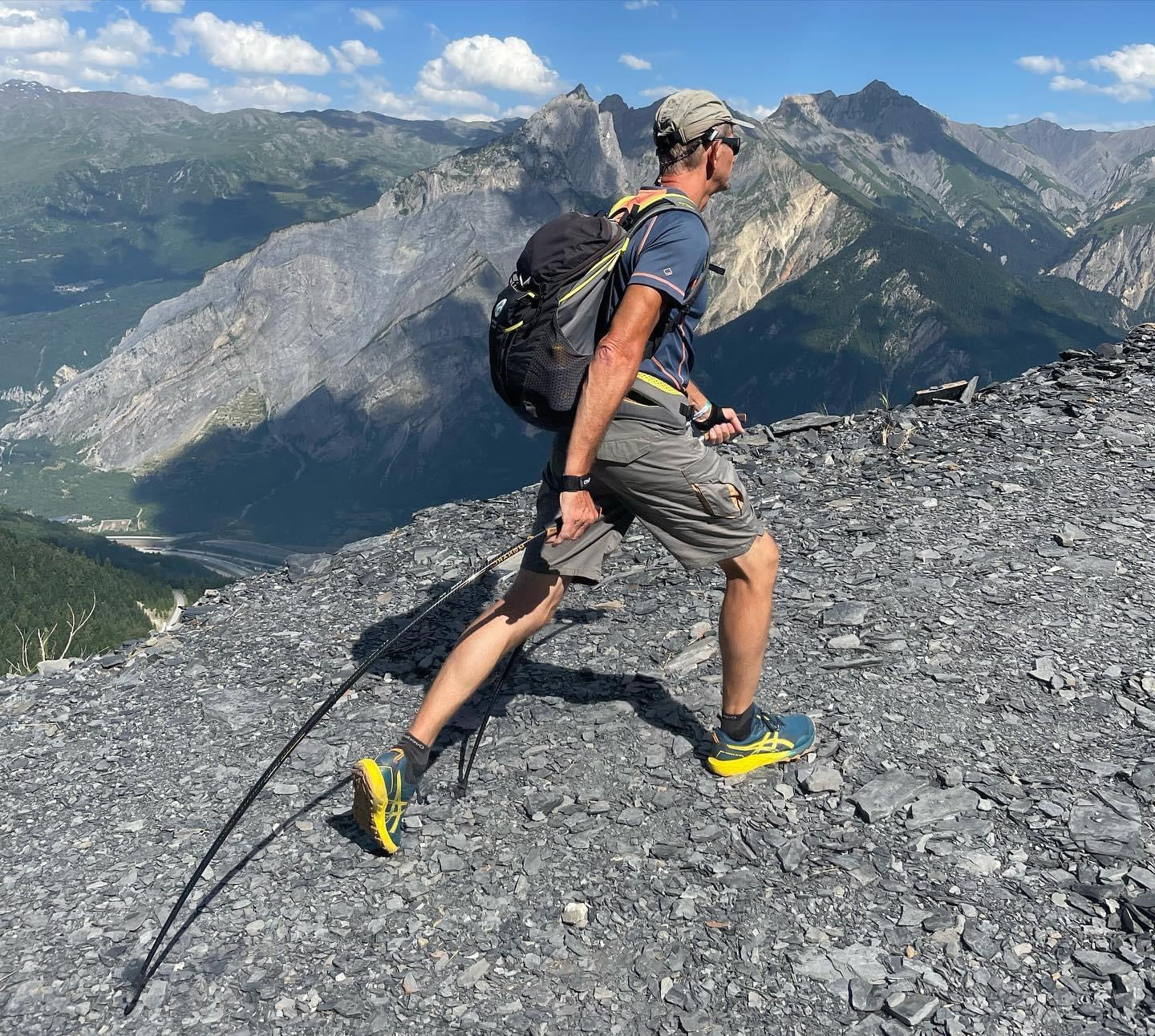
What Speed in Nordic Walking? Pace, Heart-Rate Zones and Progression
In Nordic walking, a leisure walker moves at around 5 km/h on the flat, a trained walker at 5.5 to 7 km/h, and the best French competitors exceed 9 km/h. But the right speed is first and foremost the one that keeps you in the right heart-rate zone. Most of your outings should therefore be at a pace where you can still talk. This article gives you benchmarks, shows you how to work out your zones, and offers a field test and a plan to progress.
In short
- Leisure pace: a leisure walker moves at around 5 km/h on the flat, or 12 minutes per kilometre. A trained walker holds 5.5 to 7 km/h, and the 2026 French champion went faster than 9 km/h.
- Zone 2: it corresponds to 60 to 70% of your maximum heart rate, a pace at which you can still talk. Most of your outings should take place in this zone.
- Max HR: estimate it with 208 − 0.7 × age (Tanaka et al., 2001), more accurate than 220 − age, or have it measured in an exercise stress test.
- 12-minute test: walk as fast as you can, then divide the distance in metres by 200 to get your speed in km/h.
- Progressing: do most of your outings in zone 2, add one pace session a week and push firmly on the poles. The strength of that push is what separates walkers (Fujita et al., 2018).
What speed for your level?
On flat ground, speed depends mainly on your fitness and your technique. The figures below are benchmarks rather than targets, because everyone slows down uphill, on a stony trail or in hot weather.

| Level | Usual pace | Time per kilometre | Measured benchmark |
|---|---|---|---|
| Discovery, returning | 4 to 4.5 km/h | 13 to 15 min | You learn the technique; speed comes later |
| Regular leisure | 4.5 to 5.5 km/h | 11 to 13 min | 5.4 km/h flat out over 12 minutes (leisure walkers, average age 64) |
| Experienced, sporty | 5.5 to 7 km/h | 8 min 30 to 11 min | 6.6 km/h flat out over 12 minutes (instructors, average age 57) |
| Competition | 8 to 9.5 km/h | 6 min 20 to 7 min 30 | Over 9 km/h for the 2026 French champion over 18 km |
The two middle benchmarks come from a Japanese study. Flat out over 12 minutes, leisure walkers covered 1,081 m on average, or 5.4 km/h, and instructors 1,316 m, or 6.6 km/h (Fujita et al., 2018). On an ordinary outing, at a pace you can hold for an hour while talking, you walk more slowly, and a leisure walker then moves at a little under 5 km/h.
Converting speed into time per kilometre
Watches and apps often display pace in minutes per kilometre. The table below shows how they match up.
| Speed | Time per kilometre | 10 km in |
|---|---|---|
| 4 km/h | 15 min | 2 h 30 |
| 5 km/h | 12 min | 2 h |
| 6 km/h | 10 min | 1 h 40 |
| 7 km/h | 8 min 34 s | 1 h 26 |
| 8 km/h | 7 min 30 s | 1 h 15 |
| 9 km/h | 6 min 40 s | 1 h 07 |
Do poles make you faster?
In general, poles make you walk a little faster. A review of 42 studies found that with poles, stride length increases by about 10% and cadence falls by about 6% (Roy et al., 2020). The gain in speed depends mainly on technique. In Fujita's study, leisure walkers gained only 6.5% in speed with their poles, against 15% for instructors, who pushed much harder. The stronger the push on the pole, the bigger the gain in speed.
Nordic walking takes a little more effort, but you barely feel it. Over the same distance, at a comparable pace, it uses about 20% more oxygen than walking, and the heart beats 5 to 8 beats per minute faster, yet the effort does not feel harder (Church et al., 2002).

Heart-rate zones in Nordic walking
Speed varies with the terrain; your heart measures the real effort. That is why intensity is set by heart rate, expressed as a percentage of maximum heart rate (max HR). Polar and Garmin use the five zones shown below by default.

| Zone | % of max HR | How it feels | What it is for | At age 60* |
|---|---|---|---|---|
| Zone 1 | 50 to 60% | Very easy, you talk effortlessly | Warm-up, cool-down, recovery | 83 to 100 bpm |
| Zone 2 | 60 to 70% | Easy, you can hold a conversation | Base endurance, for most of your outings | 100 to 116 bpm |
| Zone 3 | 70 to 80% | Steady, you speak in short sentences | Building pace (“tempo” sessions) | 116 to 133 bpm |
| Zone 4 | 80 to 90% | Hard, only a few words | Intervals, racing | 133 to 149 bpm |
| Zone 5 | 90 to 100% | Maximal, you can no longer talk | Very short efforts, rarely useful for leisure | 149 to 166 bpm |
*Max HR is estimated at 166 beats per minute (bpm) with the Tanaka formula, explained below.
For health, guidelines aim for moderate intensity. The American College of Sports Medicine places it between 64 and 76% of max HR (Garber et al., 2011). This range covers the top of zone 2 and the bottom of zone 3, which matches the pace of a good Nordic walking outing. The WHO recommends 150 to 300 minutes of moderate activity a week (Bull et al., 2020), in other words three outings of 50 minutes to an hour.
Working out your max HR
The best-known formula, 220 minus age, is simple but imprecise, because it overestimates max HR in young people and underestimates it from around 40 onwards. A meta-analysis of 351 studies (18,712 people) offers a more accurate formula, 208 − 0.7 × age (Tanaka et al., 2001). It gives the following values:
- At 50: 208 − 35 = 173 bpm (versus 170 with 220 − age).
- At 60: 208 − 42 = 166 bpm (versus 160).
- At 70: 208 − 49 = 159 bpm (versus 150).
These formulas only give an average. From one person to another, a gap of around ten beats either way is common. Some medicines, such as beta blockers, also lower heart rate. The only reliable measurement is an exercise stress test with a cardiologist or a sports doctor. The French Club of Sports Cardiologists recommends a check-up before taking up intense activity again after 35 for men and 45 for women.
The Karvonen method, more personalised
The Karvonen method takes your resting heart rate into account, which is lower when you are fit (Karvonen et al., 1957). You calculate your heart-rate reserve, then apply the percentage you want with the following formula.
Target HR = resting HR + % × (max HR − resting HR)
Measure your resting HR in the morning, lying down, before getting up, over three or four days. Take a 60-year-old whose resting HR is 65 bpm. Their reserve is 166 − 65 = 101 beats. For moderate intensity, the ACSM recommends 40 to 59% of the reserve, from 65 + 40 = 105 bpm to 65 + 60 = 125 bpm. This roughly matches the range of 64 to 76% of max HR (106 to 126 bpm).
These percentages apply to the heart-rate reserve, not to max HR. Take care not to mix the two methods.
Without a heart-rate monitor, use the talk test
If you have no chest strap, your breathing is enough to guide you. As long as you can talk comfortably, you stay below the ventilatory threshold, in other words in endurance (Reed and Pipe, 2014). When you can say a whole sentence without catching your breath, you are in zone 1 or 2. When you can only speak in short sentences, you are in zone 3, and when you can only say a few words, in zone 4. If you track your zones with a watch, prefer a chest strap, because in Nordic walking the wrist sensor gets it wrong more often, as explained in our article on apps and smartwatches.
A field test to measure your speed in 12 minutes
To track your progress, nothing beats a simple, repeatable test. This one follows the protocol of Fujita's study, which consists of walking for 12 minutes as fast as possible on flat ground.
- Choose a flat, measured route, such as an athletics track (400 m per lap) or a loop measured by GPS.
- Warm up for 10 to 15 minutes in zones 1 and 2, with two or three gradual accelerations.
- Walk for 12 minutes as fast as you can, without running, keeping the Nordic walking technique.
- Note the distance covered and, if you wear a chest strap, your heart rate over the last few minutes.
- Calculate your speed in km/h by dividing the distance in metres by 200.
So 1,000 m corresponds to 5 km/h. With 1,080 m, you walk at 5.4 km/h like the leisure walkers in the study, and with 1,320 m, at 6.6 km/h like the instructors. Repeat the test every six to eight weeks, in the same place and under the same conditions.
Before an all-out test
This test is a maximal effort. Only do it if you already walk regularly and are in good health; after 35 for men and 45 for women, ask your doctor first. Stop immediately if you feel chest pain, palpitations, faintness or unusual breathlessness.
Technique, the first lever for speed
To go faster, the temptation is to take quicker steps. Yet the opposite works, because in Nordic walking you gain speed by lengthening your stride and pushing further back.
- Plant the pole angled backwards, never in front of your front foot.
- Push all the way through: the arm extends behind the hip and the hand opens at the end of the push; the strap brings the pole back.
- Engage your upper body: keep your shoulders relaxed, lean your torso slightly forward and let your trunk rotate naturally.
- Roll your foot from heel to toes, and let your stride lengthen by itself.
Our 7 exercises to improve your technique help you work on each of these points. In a club, a coach spots within minutes what is holding back your push.
The pole itself matters too. With a straight pole, part of the push goes downwards and lifts you. The curve of the MØNARC® Arcs de Marche® directs the push further forward, in the direction of travel. That is what the Université Grenoble Alpes measured, in the first study to compare the shape of a pole with straight poles.

Eight regular walkers, aged 64.5 on average, walked on a track at 5 then 6 km/h, with straight poles and Arcs de Marche® in random order. Their heart rate and oxygen uptake stayed the same, but their push angle fell from 46° to 33° and their propulsion was 22% more efficient. The study is small, and its authors call for larger trials. Read the full study.
An 8-week plan to pick up the pace
This plan is for walkers who have already been going out at least twice a week for a few months. If you are a beginner, start with our 8-week Nordic walking training programme.
The plan relies on plenty of easy endurance and only one faster session a week. Endurance athletes spend about 80% of their training time at low intensity (Seiler, 2010). This volume in zone 2 builds the base, and the pace session raises your speed.
| Weeks | Session 1 (endurance) | Session 2 (pace) | Session 3 (long outing) |
|---|---|---|---|
| 1 and 2 | 45 min in zone 2 | 45 min, including 6 × 1 min a little faster (zone 3), 2 min recovery | 60 min in zone 2 |
| 3 and 4 | 50 min in zone 2 | 50 min, including 5 × 3 min in zone 3, 2 min recovery | 70 min in zone 2 |
| 5 and 6 | 50 min in zone 2 | 50 min, including 4 × 4 min at the top of zone 3 or in zone 4, 3 min recovery | 80 min in zone 2, hilly route |
| 7 and 8 | 45 min in zone 2 | 50 min, including 2 × 10 min in zone 3 (“tempo” pace), 3 min recovery | 90 min in zone 2 in week 7, then the 12-minute test in week 8 |
- Each session starts with a 10-minute warm-up and ends with a 5-minute cool-down, in zone 1.
- Only increase one thing at a time, duration or pace, and never both in the same week.
- If you feel unusually tired, sleep badly or have pain, replace the pace session with an easy outing.
- Keep at least one rest day between the pace session and the long outing.
At the end of the 8 weeks, repeat the 12-minute test. Your zone 2 outing pace should have gone up too, and that is the most reliable sign of progress.
Progressing in a group helps a lot, because an interval session is easier to stick to with others. In a MØNARC® Partner Club, members get €30 off each pair of Arcs de Marche®, and coaches get preferential terms on our certified training courses.
Speeds in competition
In France, competitive Nordic walking is run by the French Athletics Federation (FFA). At the 2026 French championships in Neuf-Brisach, the winner of the long race (just over 18 km) finished in 1 h 57 min 30 s, an average of more than 9 km/h, and the women's winner in 2 h 03 min 43 s, about 8.7 km/h. In the short race, just over 11 km, the winner went faster than 9.4 km/h (FFA, 2026).
At these speeds, the heart works hard. In a small Spanish study, adult walkers monitored during a regional championship spent the race at 84 to 94% of their max HR on average, that is in zone 4 or even zone 5 (Serna-Martínez et al., 2024).
Speed is not everything, because judges also check the technique. The rules require a foot and a pole to be on the ground at all times, and arms and legs to alternate; the double push and the running step are excluded. At MØNARC®, we believe a full push should stay at the heart of the movement, even at full speed. Our investigation into the double push looks at these rules. To get started, read our article on Nordic walking races and events.
The Arcs de Marche® are accepted in competition on all circuits in Europe, so you can train and race with the same poles.
Frequently asked questions
What is the average speed in Nordic walking?
A leisure walker moves at around 5 km/h on the flat, or 12 minutes per kilometre. A trained walker holds 5.5 to 7 km/h, and the best competitors exceed 9 km/h.
How many kilometres do you cover in an hour of Nordic walking?
Most leisure walkers cover 4 to 5.5 km in an hour, and a trained walker 5.5 to 7 km. You cover less in the mountains or on technical trails.
What heart rate should you aim for in Nordic walking?
For most outings, aim for zone 2, or 60 to 70% of your max HR, which gives about 100 to 116 beats per minute at 60. One session a week can go up into zone 3, or even zone 4 if you are trained and in good health.
Do you need to walk fast to burn more calories?
Walking faster increases the energy used per hour, but duration and regularity matter more. At a comparable pace, poles already increase energy use by about 20% compared with walking (Church et al., 2002). The detailed figures are in our article How many calories do you burn Nordic walking?
Do curved poles make you walk faster?
The Université Grenoble Alpes study compared the Arcs de Marche® with straight poles at set speeds, 5 and 6 km/h, without measuring top speed. At the same pace, with the same heart rate and the same oxygen uptake, the push was 22% more efficient, and the effort felt lighter at 5 km/h. The Arcs therefore mainly help you walk more easily at your usual pace.
Sources
- Fujita E. et al., “Proficiency in pole handling during Nordic walking influences exercise effectiveness in middle-aged and older adults”, PLoS One, 2018, 13(11): e0208070.
- Roy M. et al., “Nordic walking influence on biomechanical parameters: a systematic review”, European Journal of Physical and Rehabilitation Medicine, 2020, 56(5): 607-615.
- Church T.S., Earnest C.P., Morss G.M., “Field testing of physiological responses associated with Nordic Walking”, Research Quarterly for Exercise and Sport, 2002, 73(3): 296-300.
- Tanaka H., Monahan K.D., Seals D.R., “Age-predicted maximal heart rate revisited”, Journal of the American College of Cardiology, 2001, 37(1): 153-156.
- Karvonen M.J., Kentala E., Mustala O., “The effects of training on heart rate; a longitudinal study”, Annales Medicinae Experimentalis et Biologiae Fenniae, 1957, 35(3): 307-315.
- Garber C.E. et al., American College of Sports Medicine position stand, Medicine & Science in Sports & Exercise, 2011, 43(7): 1334-1359.
- Bull F.C. et al., “World Health Organization 2020 guidelines on physical activity and sedentary behaviour”, British Journal of Sports Medicine, 2020, 54(24): 1451-1462.
- Reed J.L., Pipe A.L., “The talk test: a useful tool for prescribing and monitoring exercise intensity”, Current Opinion in Cardiology, 2014, 29(5): 475-480.
- Seiler S., “What is best practice for training intensity and duration distribution in endurance athletes?”, International Journal of Sports Physiology and Performance, 2010, 5(3): 276-291.
- Serna-Martínez M., Ribes-Hernández S., Martínez-González-Moro I., “Oxygen Consumption, Ventilatory Thresholds, and Work Zones in Nordic Walking Competitors”, Journal of Functional Morphology and Kinesiology, 2024, 9(3): 171.
- Termoz N., Depery E., Lorenzi G., Université Grenoble Alpes, study on the geometry of Nordic walking poles (MØNARC® curved poles and straight poles).
- French Athletics Federation (FFA), report on the 2026 French Nordic walking championships (Neuf-Brisach), athle.fr, May 2026.
- Club des cardiologues du sport, “10 golden rules”; Polar, heart-rate zones guide; consulted in October 2026.

The MØNARC® Arcs de Marche®
These curved 100% carbon Nordic walking poles weigh 140 g each and are designed and assembled in France. They are delivered ready to walk with straps, tungsten carbide tips and a made-to-measure bag.
Disclaimer. This article provides general information. It does not replace the advice of a doctor or health professional, nor supervision by a qualified instructor. Before starting or stepping up physical activity, especially if you have a health condition, pain or ongoing treatment, consult your doctor. Exercise according to your fitness, on suitable ground and with equipment in good condition. Each reader remains solely responsible for their own practice and for the decisions they make based on this information, and MONARC SAS cannot be held liable for their consequences.