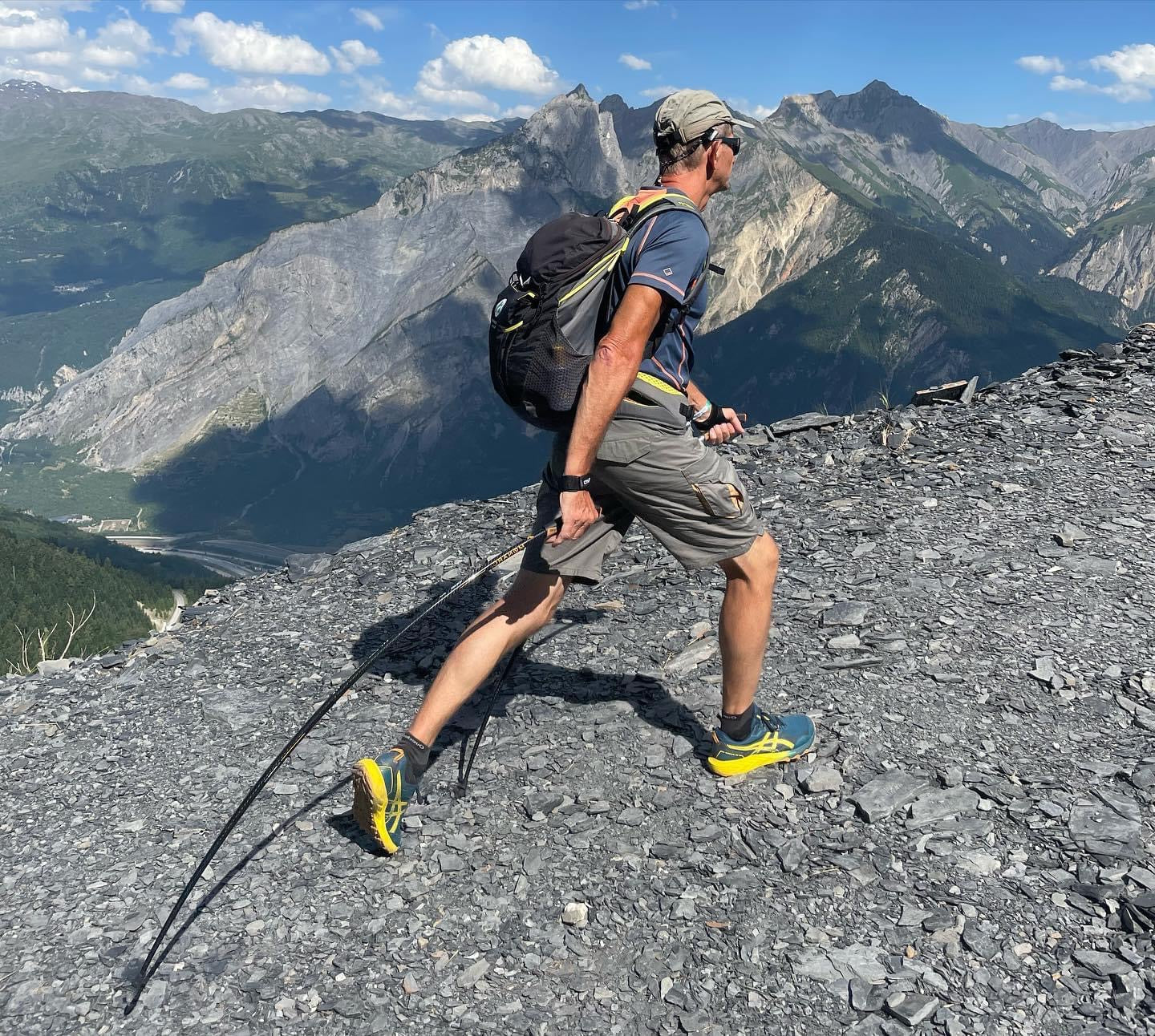
The Different Types of Nordic Walking Pole Tips: How to Choose?
For Nordic walking, two tips cover most situations: a tungsten carbide tip, ideally bevelled, for paths, grass and snow, and a rubber pad for tarmac. The rest depends on the ground you walk on, on compatibility with your pole and on wear. Here is how to choose them and when to replace them.
In short
- Trails, grass, gravel, snow: use a tungsten carbide tip, without a pad. A bevelled tip bites better when the pole is at an angle.
- Tarmac, concrete, pavements: fit a rubber pad, the right way round. It grips, protects the tip and makes less noise.
- Ice: never use a pad. The carbide tip bites into ice, but it is your feet that need traction devices.
- Mixed routes: choose a pad with carbide studs, or a plain pad that you take off as soon as the tarmac ends.
- Replacement tips: there is no universal tip. Buy the ones designed for your pole.
- When to replace: change the tip when it becomes rounded and no longer bites, and the pad when it is split or worn on one side.

Steel or tungsten carbide, which material should you choose?
The tip is the hardest-working part of the pole, since it strikes the ground thousands of times per outing, on earth, stones and sometimes tarmac. Its material decides how long it lasts.
- Steel is still found on some entry-level hiking poles. It blunts quickly on stones and tarmac.
- Tungsten carbide, often called “widia”, has become the standard in Nordic walking. LEKI, Gabel and Decathlon fit it to their poles and replacement tips. Depending on the grade, its hardness reaches up to 2,200 on the Vickers scale (HV), against around 700 to 900 HV for hardened steel. It is therefore two to three times harder (Hyperion Materials & Technologies).
Carbide is not indestructible, though. On tarmac, it wears with every plant and ends up rounded. LEKI even presents its rubber pads as a way to protect carbide tips from unnecessary wear. We therefore advise you to choose carbide and to protect it on tarmac.
Round or bevelled tip, which shape should you choose?
In Nordic walking, the pole is never planted vertically. It lands at an angle, tip pointing backwards, and pushes until the hand passes behind the hip. The French Athletics Federation's competition rules state that “the tip must stay on the ground until the end of the push” (our translation). If the tip skids on the ground, part of your push is lost.
- The round tip, cone-shaped, grips the same way whatever angle it lands at. It is mostly found on entry-level poles. Decathlon fits it, for example, to its NW P100 and P120 models.
- The bevelled tip, also called a claw tip, is cut at an angle, and its edge bites into the ground when the pole is inclined. Decathlon fits it to its NW P500 and P700 poles, LEKI sells a bevelled replacement tip described as giving the most grip on gravel and compacted ground, and it is the shape of the Gabel tips on the Arcs de Marche®.
A bevelled tip has a fitting direction. When you replace it, keep the original orientation.

Rubber pads are essential on tarmac
On tarmac, concrete or pavements, a metal tip cannot dig in. It clicks, slips and wears. The pad, also called a paw or boot, is a rubber shoe that slides over the tip. It does three jobs:
- grip on hard ground, thanks to a flat, angled sole;
- protect the carbide tip from wear;
- reduce noise, which other pavement users appreciate.
Fitting it the right way round
A pad's sole is angled, and it should sit flat during the push. Follow the direction given by the maker of the pad or of your pole. A pad that only touches the ground on one edge slips and wears on one side. Angled wear therefore points to a badly oriented pad or a pole angle that needs correcting (Stewart, 2011).
The Arcs de Marche® are delivered without pads. If you walk in town, add a pair. Jean-Pierre Guilloteau, Nordic walking instructor and the first tester of the Arcs, has approved the Newfeel pads for them. He advises fitting them “upside down”, with the “FRONT” marking facing the back of the pole.
What a pad cannot do
According to LEKI's guidance, pads are designed for tarmac. Their grip drops on dirt tracks, stones, roots, gravel, grass and sand, and ice, snow, mud or moisture also reduce it. The manufacturer advises against using them off-road or on uneven surfaces. So take your pad off as soon as you leave the tarmac, and mind your fingers, because carbide tips have sharp edges.
Spiked pads for mixed routes
If you alternate between pavement and path, note that some pads have carbide studs set into the rubber, such as LEKI's Silent Spike Pad. They save you taking the pad off at every change of surface, but they cost more. At LEKI, allow around €10 a pair for a plain pad and €22 for a studded one (prices checked in October 2026). For urban outings, see also Nordic walking in town: tips, terrain and equipment.
The special cases of snow, ice and sand
- Packed snow: the bare carbide tip grips well, whereas a pad loses its grip.
- Powder snow: a snow basket stops the pole from sinking. Most Nordic walking poles do not have one, and only some models accept one.
- Ice and black ice: the carbide tip bites into ice where rubber slips. But the grip of your poles does not replace the grip of your feet. Wear traction devices on your shoes, or postpone your outing.
- Sand: keep the tip bare, because a pad does not grip there.
For winter and hilly ground, read Nordic walking in the mountains: technique, safety and enjoyment at altitude, and for waterlogged ground, Nordic walking in the rain: advice and the right equipment.
Which tip for which terrain?
The illustration and table below sum up our advice, terrain by terrain.

| Terrain | Recommended tip | Why, precautions |
|---|---|---|
| Trail, dirt path | Carbide tip, ideally bevelled | Plant firmly so that the tip bites |
| Grass, meadow | Carbide tip | Pads slip, especially on wet grass |
| Gravel, compacted path | Bevelled carbide tip | The bevel grips between stones |
| Rocks, slabs | Carbide tip | Aim for rough spots, because smooth wet rock stays slippery |
| Tarmac, concrete, pavement | Rubber pad | The pad grips, makes less noise and protects the tip |
| Cobbles, wet urban ground | Rubber pad | Plant the pole gently, because moisture reduces grip |
| Packed snow, ice | Carbide tip, never a pad | On black ice, wear traction devices on your shoes |
| Powder snow | Carbide tip and snow basket | If your pole accepts a basket |
| Town and trails | Spiked pad, or removable plain pad | Take the plain pad off when the tarmac ends |
What the curve of the Arcs changes where they meet the ground
A straight pole forces a compromise. To push forwards you have to incline it, and the more it is inclined, the more its tip lands at a slant. The integral curve of the MØNARC® Arcs de Marche® gets round this compromise. The lower part of the pole presents the tip more vertically to the ground, for consistent grip, while the pole as a whole works at a lower angle.

The study carried out at Université Grenoble Alpes by Nicolas Termoz, Elyott Depery and Gabriel Lorenzi compared the two shapes with 8 regular walkers, at 5 and 6 km/h:
- Push angle: it is 33° to the ground with the Arcs, against 46° with straight poles. The push becomes more horizontal, so you are driven forwards more and lifted upwards less.
- Efficiency: propulsion is 22% more efficient, with unchanged oxygen consumption and heart rate.
- Vibration: vibration transmitted to the arms drops by 22% at 5 km/h and by 26% at 6 km/h.
- Perception: perceived effort is lower at 5 km/h, and both comfort and enjoyment increase at 6 km/h.
With 8 participants, the researchers themselves call for larger studies. The Arcs remain the first poles whose shape has been scientifically compared with straight poles, and they are accepted in competition on all circuits in Europe. To find out more, read the full study, as well as our articles The curve of Nordic walking poles: what does it really change? and Nordic walking in competition: let's talk about the push on the poles again.
Before changing tips, check compatibility
On a good pole, the tip is a wear part that you replace without changing the pole. Decathlon sums it up on its product sheets with the phrase “change your tips rather than your poles” (our translation). Yet there is no universal tip, as these examples show:
- Decathlon's bevelled replacement tip is designed for a 9.5 mm tube and does not fit the NW P100 and P120 poles;
- LEKI's Nordic walking replacement tips are 10 mm in diameter;
- at LEKI, Smart Tip 2.0 pads are not compatible with the Smart Tip 1.0 generation;
- Gabel sells its Vario Fit carbide tips as spare parts, under its own part numbers.
Before buying, note the brand and model of your pole, and choose the tips designed for it. Depending on the model, the tip is push-fitted, clipped or glued. Follow the instructions and, on a carbon pole, ask the manufacturer before applying heat or force.
For the Arcs de Marche®, original Gabel tungsten carbide replacement tips are sold in pairs. Like the grips and straps, they are easy to replace, and the Arcs are therefore built to last for years.
Do you run a club? Keep a stock of pads and tips for town sessions and for members who are buying equipment. If your walkers use the Arcs, your club can become a MØNARC® Partner Club. Its members then get €30 off per pair, and the club gets preferential terms on certified training courses.
When should you replace tips and pads, and how do you look after them?
No manufacturer publishes a lifespan in figures, because it all depends on your mileage and above all on the time spent on tarmac without a pad. Look out for these signs instead:
- The tip is rounded or blunt and no longer bites, especially uphill or on wet ground.
- The carbide is cracked, chipped or loose in its housing.
- The pad is split, holed or worn down to the metal.
- The pad is worn on one side, a sign that you should check its fitting direction and your pole angle.
For care, simply rinse the tips after a muddy outing, brush them, dry the pole before storing it and check that the tip is firmly attached. For transport, a protective cap stops the tip from piercing the bag. All the details are in our article How to clean and maintain your Nordic walking pole tips.
Frequently asked questions
Which tip should I choose for Nordic walking?
Choose a tungsten carbide tip, ideally bevelled, for paths, grass, gravel and snow. Add a pair of rubber pads for tarmac. Steel, being softer, wears quickly.
Do I need rubber pads?
Rubber pads are useful on tarmac, concrete and pavements, where they grip, protect the tip and reduce noise. On paths, grass, snow or ice, however, they slip, and you should take them off as soon as you leave the tarmac.
Which way round do pads go?
Fit them in the direction set by the manufacturer, so that the angled sole sits flat during the push. A pad worn on one side is badly oriented or planted at the wrong angle. For the Arcs de Marche® with Newfeel pads, Jean-Pierre Guilloteau advises fitting them upside down, with the “FRONT” marking facing the back of the pole.
Are pole tips universal?
They are not. The diameter and fitting system vary from one brand and model to another, so buy the replacement tips designed for your pole.
Can you go Nordic walking on ice?
It is possible, with caution. The carbide tip without a pad bites into ice, but your feet remain the weak point. Wear traction devices on your shoes, or postpone the outing if there is black ice.
When should tips be replaced?
Replace them when the tip becomes rounded and no longer bites, especially uphill or on wet ground, or when the carbide is chipped or loose. There is no fixed lifespan, because it depends on your mileage and the time spent on tarmac without a pad.
Sources
- Termoz N., Depery E., Lorenzi G., Université Grenoble Alpes, study of the effect of Nordic walking pole geometry (straight poles against MØNARC® curved poles): presentation of the study.
- French Athletics Federation (FFA), definition of competitive Nordic walking (extracts from the FFA specifications), reproduced in race regulations, for example La Nordique Essonnienne.
- LEKI, product sheets and instructions for the Rubber Pad, Power Grip Pad, Smart Tip 2.0 Pad and Silent Spike Pad (leki.com), and Nordic Walking Speed replacement tip sheet (i-Run), consulted in October 2026.
- Decathlon (Newfeel), product sheets for round and bevelled replacement tips for Nordic walking poles, consulted in October 2026.
- Gabel, spare parts catalogue (Vario Fit Carbide tips, Walking Pad), gabelsport.com, consulted in October 2026.
- Hyperion Materials & Technologies, “Cemented carbide hardness”.
- Stewart G., “Paws for thought”, WALX, 2011.

The MØNARC® Arcs de Marche®
These curved 100% carbon Nordic walking poles weigh 140 g each. Designed and assembled in France, they are delivered ready to walk with straps, tungsten carbide tips and a made-to-measure bag.
Disclaimer. This article provides general information. It does not replace the advice of a doctor or health professional, nor supervision by a qualified instructor. Before starting or stepping up physical activity, especially if you have a health condition, pain or ongoing treatment, consult your doctor. Exercise according to your fitness, on suitable ground and with equipment in good condition. Each reader remains solely responsible for their own practice and for the decisions they make based on this information, and MONARC SAS cannot be held liable for their consequences.