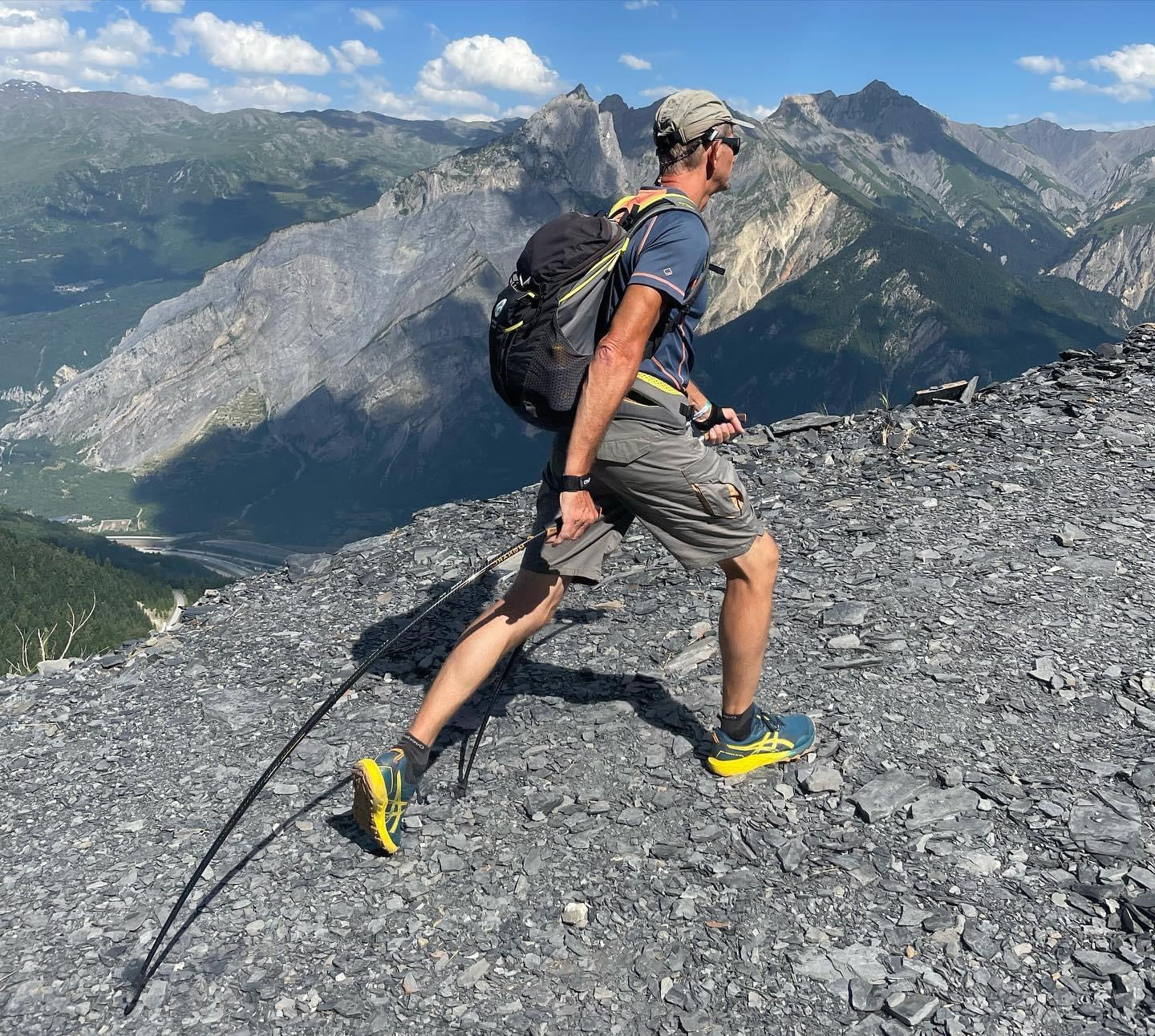
Nordic Walking vs Brisk Walking vs Jogging: Which Sport to Choose?
For your heart, these three sports are equal when the energy you burn is equal. Jogging gets there in less time. Nordic walking puts half as much impact on each step and works your upper body too. Brisk walking remains the simplest to do. So the right choice depends on your time, your joints and what you will actually want to do again every week. Here is the comparison, backed by study figures.
In short
- Energy: a 70 kg person burns about 340 kcal per hour brisk walking, 370 Nordic walking at 6–7 km/h and 525 jogging (Compendium 2024). At the same speed, poles raise the energy cost of walking by about 20%.
- Heart: for the same energy burned, walking and running lower the risk of high blood pressure, high cholesterol and diabetes just as much. Running simply gets there faster.
- Joints: each step transmits 1 to 1.5 times your body weight when walking, and 2 to 2.9 times when running.
- Injuries: the available studies report 8 to 18 injuries per 1,000 hours of running depending on level, against fewer than one in Nordic walking.
- Our view: for the cardio benefit of running without the impact, Nordic walking is the right compromise, provided you have real Nordic walking poles and the right technique.
The comparison at a glance
These three ways to move have very different profiles. The energy figures come from the Compendium of Physical Activities, the international reference updated in 2024 (Herrmann et al., 2024). The impact figures come from force-plate measurements (Nilsson and Thorstensson, 1989).

| Criterion | Brisk walking | Nordic walking | Jogging |
|---|---|---|---|
| Energy for 70 kg | ≈ 340 kcal/h (5.6 to 6.3 km/h) | ≈ 370 kcal/h (5.8 to 7.1 km/h), up to ≈ 600 kcal/h very fast | ≈ 525 kcal/h (self-selected pace) |
| Impact per step | 1 to 1.5 × body weight | 1 to 1.5 × body weight | 2 to 2.9 × body weight |
| Injuries | Low (few published figures) | ≈ 0.9 per 1,000 hours | 7.7 to 17.8 per 1,000 hours |
| Upper body | Little used | Arm, shoulder and back activity 2 to 15 times higher than walking | Little used |
| Intensity (WHO) | Moderate | Moderate, vigorous at a fast pace | Vigorous |
| Learning | None | A few sessions for the technique | Gradual build-up |
| Equipment | Shoes | Nordic walking poles and shoes | Running shoes |
| Best for | Easing back in, moving every day | Heart and whole body without the impact of running | Little time, joints in good shape |

Running burns more energy, and poles narrow the gap
To compare sports, researchers use the MET. One MET is your energy use at rest, and one hour of activity at 5 METs costs about 5 kilocalories per kilo of body weight. Here are the 2024 Compendium values for a 70 kg person.

- Brisk walking (5.6 to 6.3 km/h) is rated at 4.8 METs, or about 340 kcal per hour.
- Nordic walking (5.8 to 7.1 km/h) is rated at 5.3 METs, or about 370 kcal. More slowly (4 to 5.6 km/h), it drops to 4.3 METs, or about 300 kcal. At a very fast pace (7.2 to 8 km/h), it rises to 8.5 METs, or about 600 kcal.
- Jogging at a self-selected pace is rated at 7.5 METs, or about 525 kcal. At 9.7 km/h, it reaches 9.3 METs, or about 650 kcal.
These values come from different studies. The fairest comparison is within one study. In one such study, 22 adults walked 1,600 metres on a track, with and without poles. With poles, their oxygen uptake rose by about 20% and their energy use by 17% in women and 21% in men. Their heart rate was 5 to 8 beats per minute higher, without the effort feeling significantly harder to them (Church et al., 2002). On a treadmill at a set 4 km/h, an Italian team found the same order of magnitude, with 22% more oxygen (Pellegrini et al., 2015). So remember that with poles, walking takes about 20% more energy.
In practice, to burn as much as in 30 minutes of jogging, allow 40 to 55 minutes of brisk Nordic walking. The details by speed are in our article How many calories do you burn Nordic walking?, and how to turn this into a plan in Nordic walking and weight loss: a practical 12-week programme.
For your heart, walking matches running at equal energy use
This is the question that matters most, and the answer is clear. A study followed 33,060 runners and 15,945 walkers in the United States for six years. For the same energy burned, walking lowered the risk of high blood pressure, high cholesterol and diabetes as much as running, and possibly of coronary heart disease (Williams and Thompson, 2013). What counts, then, is how much energy you burn each week, whatever way you burn it.
Running keeps the advantage of time. The World Health Organization recommends 150 to 300 minutes of moderate activity per week, or 75 to 150 minutes of vigorous activity (Bull et al., 2020). One minute of running therefore counts roughly as two minutes of walking. Among 55,137 adults followed for 15 years, runners had a 45% lower risk of cardiovascular death, even with 5 to 10 minutes of slow running a day (Lee et al., 2014).
Nordic walking closes part of the gap, because poles make walking more intense. Study reviews confirm it:
- 16 randomised trials (1,062 patients): Nordic walking improves resting heart rate, blood pressure, exercise capacity, maximal oxygen uptake and quality of life. It does better than brisk walking without poles and, on some measures, than jogging (Tschentscher et al., 2013).
- 22 trials in adults aged 62 on average: Nordic walking increases maximal oxygen uptake and lowers systolic blood pressure by 2.9 mmHg, waist size by 2.2 cm and LDL cholesterol (Liu and Kim, 2025).
- 15 studies in people aged 60 to 92: Nordic walking clearly increases aerobic capacity compared with staying inactive. Compared with walking alone, it improves balance, flexibility and quality of life, but not aerobic capacity (Bullo et al., 2018).
In plain terms, Nordic walking works no miracles compared with walking, but it makes walking a fuller, more intense activity. For the heart, it comes close to running without the impact. To go further, read Nordic walking and heart health: what the studies confirm. If you have a heart condition, ask your doctor before you start.
What poles really add for your muscles
No study has established the share of muscles used in Nordic walking, and the percentages that circulate on the subject have never been measured. The available data are telling all the same. In Nordic walking, upper-body muscle activity is 2 to 15 times higher than in ordinary walking (Pellegrini et al., 2015). A review of 42 studies confirms greater arm activation and strength, with strides about 10% longer and a cadence about 6% lower (Roy et al., 2020). In people over 60, arm strength improves clearly compared with inactive people (Bullo et al., 2018).
Brisk walking and jogging mainly work the legs; the arms swing along without pushing. Nordic walking is the only one of the three that makes the upper body help you move forwards.
With the Arcs de Marche®, the Université Grenoble Alpes study observed that activation of the biceps, triceps, deltoids and back muscles tends to increase further compared with straight poles (see the study).
Walking puts half as much impact on your joints
Running has a flight phase, during which both feet leave the ground. Each landing then takes 2 to 2.9 times your body weight. When walking, one foot always stays on the ground, and the impact stays between 1 and 1.5 times body weight (Nilsson and Thorstensson, 1989). For a 70 kg person, that means 70 to 105 kg at each step when walking, against 140 to 200 kg when running, and this thousands of times per outing.
Two nuances apply, however:
- Poles do not offload the knee. You often read that they “carry” part of your weight. Yet in experienced instructors, a biomechanics study found no difference in knee load between walking with and without poles (Hansen et al., 2008). Nordic walking is easy on the joints because it is still walking.
- Running does not necessarily wear out your knees. Hip or knee osteoarthritis affects 3.5% of recreational runners, against 10.2% of inactive people; it is high-volume competitive running that is more strongly linked to it (13.3%) (Alentorn-Geli et al., 2017).
If your knees already hurt, Nordic walking lets you stay active with walking-level impact. Check with your doctor or physiotherapist, and read Nordic walking and knee pain: answers to the most common questions.
Running carries a higher risk of injury
This is jogging's weak point. A meta-analysis found 17.8 injuries per 1,000 hours of running in beginners, about one every 56 hours, and 7.7 in regular recreational runners (Videbæk et al., 2015).
In Nordic walking, a study of 137 walkers (aged 53 on average, 29,160 hours of walking in total) counted 0.9 injuries per 1,000 hours. The most common injury was a sprained thumb in a fall. Everyone injured was back within four weeks (Knobloch and Vogt, 2006). As these studies use different methods, compare orders of magnitude rather than decimals.
Whatever the sport, increase duration or intensity gradually, week after week. If you are starting after 50, our guide Starting Nordic walking at 50, 60 or 70 sets out an injury-free progression.
You need real Nordic walking poles
All the benefits of Nordic walking come from pushing on the poles. So you need poles made for pushing. Hiking poles are for leaning on in front of you. In Nordic walking, the pole is planted angled backwards, and the strap lets you push far behind your hip, then open your hand without losing the pole. Check three things:
- The strap must wrap your hand, because it transmits the push. A simple wrist loop is not enough.
- The right length equals your height × 0.68. Between two lengths, take the shorter one (a very sporty walker can take the one above). Our size guide gives you yours.
- The pole must be stiff and light. A fixed-length one-piece pole has no mechanism that could work loose.
The MØNARC® Arcs de Marche® go further. They are the first poles whose shape has been scientifically compared with straight poles, and their full-length curve follows the natural path of the arm. In 8 regular walkers, Université Grenoble Alpes measured a push angle of 33° instead of 46°. More of the push therefore goes forwards, propulsion is 22% more efficient and arm vibrations drop by about 25%, for the same oxygen uptake and the same heart rate. This is the “booster effect” our walkers describe.

The study is small (8 participants) and the researchers call for larger work, but it remains the first to compare pole shapes. The Arcs are accepted in competition, and the movement is still Nordic walking. Allow a few outings to find your rhythm, and read The basic Nordic walking technique to learn the technique.
Accessibility and cost
- Brisk walking: it needs no learning, a good pair of shoes is enough, and it fits into everyday journeys.
- Jogging: it needs running shoes and a gradual build-up. Many beginners start by alternating walking and running.
- Nordic walking: it needs Nordic walking poles and walking shoes. The technique takes a few sessions to learn, ideally with an instructor, and walking with a club helps you keep going.
On budget, Nordic walking means buying poles at the start. Over time the gap narrows, because good poles last for years. On the Arcs de Marche®, every wear part can be replaced, whether the tungsten carbide tips, the straps or the rubber pads for tarmac.
Does your Nordic walking club want to equip its members? With the MØNARC® Partner Club label, its members get €30 off per pair, and the club gets preferential terms on certified courses.
Which sport suits your profile?
Choose Nordic walking if…
- you want real cardio work without the impact of running;
- you are getting back into sport, are over 50 or have a few kilos to lose;
- you want to work your upper body at the same time;
- you enjoy walking with others, or progressing all the way to competition.
Choose jogging if…
- you have little time and like intense effort;
- your joints are fine and you are willing to progress in steps;
- you are aiming for a race or a time.
Choose brisk walking if…
- you are starting from scratch or coming back from a long break;
- you want to move every day, with no equipment or planning.
Nothing stops you combining all three, for example brisk walking on weekdays, Nordic walking at the weekend and a run when you feel like it. What matters most is choosing an activity you will still want to do in six months.
Frequently asked questions
How much Nordic walking equals 30 minutes of jogging?
In energy terms, allow 40 to 55 minutes of brisk Nordic walking (5.8 to 7.1 km/h), depending on the jogging pace. For health guidelines, the WHO counts one minute of vigorous activity as two minutes of moderate activity.
Does Nordic walking help you lose as much weight as running?
Per hour, running burns more. But what counts is your weekly energy use, together with your diet, and Nordic walking can be done for longer, more often and with fewer injuries. Our 12-week programme helps you organise it.
Is Nordic walking better than running for the knees?
It means half the impact at each step, or 1 to 1.5 times body weight against 2 to 2.9 times when running. Poles do not offload the knee, though, because it is walking itself that spares it. If you have pain, ask your doctor for advice.
Can you Nordic walk with hiking poles?
You can try it with hiking poles. Without a strap, however, you will be able neither to push far behind you nor to open your hand, and you will lose most of the upper-body work. To get the full benefit, choose Nordic walking poles at the right length (height × 0.68).
Should you start with Nordic walking or brisk walking?
Both work. Brisk walking needs no learning. Nordic walking takes a few sessions to learn the technique, but it works your heart and upper body harder. If you are unsure, start with a taster session at a club.
Sources
- Herrmann S.D. et al., “2024 Adult Compendium of Physical Activities: A third update of the energy costs of human activities”, Journal of Sport and Health Science, 2024, 13(1): 6-12.
- Church T.S., Earnest C.P., Morss G.M., “Field testing of physiological responses associated with Nordic Walking”, Research Quarterly for Exercise and Sport, 2002, 73(3): 296-300.
- Pellegrini B. et al., “Exploring muscle activation during Nordic walking: a comparison between conventional and uphill walking”, PLoS One, 2015, 10(9): e0138906.
- Williams P.T., Thompson P.D., “Walking versus running for hypertension, cholesterol, and diabetes mellitus risk reduction”, Arteriosclerosis, Thrombosis, and Vascular Biology, 2013, 33(5): 1085-1091.
- Bull F.C. et al., “World Health Organization 2020 guidelines on physical activity and sedentary behaviour”, British Journal of Sports Medicine, 2020, 54(24): 1451-1462.
- Lee D.C. et al., “Leisure-time running reduces all-cause and cardiovascular mortality risk”, Journal of the American College of Cardiology, 2014, 64(5): 472-481.
- Tschentscher M., Niederseer D., Niebauer J., “Health benefits of Nordic walking: a systematic review”, American Journal of Preventive Medicine, 2013, 44(1): 76-84.
- Liu J., Kim J.H., “The effects of Nordic walking on the cardiovascular risk factors in older adults: a systematic review and meta-analysis”, Archives of Gerontology and Geriatrics, 2025, 129: 105663.
- Bullo V. et al., “Nordic walking can be incorporated in the exercise prescription to increase aerobic capacity, strength, and quality of life for elderly”, Rejuvenation Research, 2018, 21(2): 141-161.
- Roy M. et al., “Nordic walking influence on biomechanical parameters: a systematic review”, European Journal of Physical and Rehabilitation Medicine, 2020, 56(5): 607-615.
- Nilsson J., Thorstensson A., “Ground reaction forces at different speeds of human walking and running”, Acta Physiologica Scandinavica, 1989, 136(2): 217-227.
- Hansen L. et al., “Nordic walking does not reduce the loading of the knee joint”, Scandinavian Journal of Medicine & Science in Sports, 2008, 18(4): 436-441.
- Alentorn-Geli E. et al., “The association of recreational and competitive running with hip and knee osteoarthritis”, Journal of Orthopaedic & Sports Physical Therapy, 2017, 47(6): 373-390.
- Videbæk S. et al., “Incidence of running-related injuries per 1000 h of running in different types of runners”, Sports Medicine, 2015, 45(7): 1017-1026.
- Knobloch K., Vogt P.M., “Nordic pole walking injuries: Nordic walking thumb as novel injury entity”, Sportverletzung Sportschaden, 2006, 20(3): 137-142.
- Termoz N., Depery E., Lorenzi G., Université Grenoble Alpes, study of MØNARC® curved poles versus straight poles: study summary (in French).

The MØNARC® Arcs de Marche®
These curved 100% carbon Nordic walking poles weigh 140 g each and are designed and assembled in France. They are delivered ready to walk with straps, tungsten carbide tips and a made-to-measure bag.
Disclaimer. This article provides general information. It does not replace the advice of a doctor or health professional, nor supervision by a qualified instructor. Before starting or stepping up physical activity, especially if you have a health condition, pain or ongoing treatment, consult your doctor. Exercise according to your fitness, on suitable ground and with equipment in good condition. Each reader remains solely responsible for their own practice and for the decisions they make based on this information, and MONARC SAS cannot be held liable for their consequences.