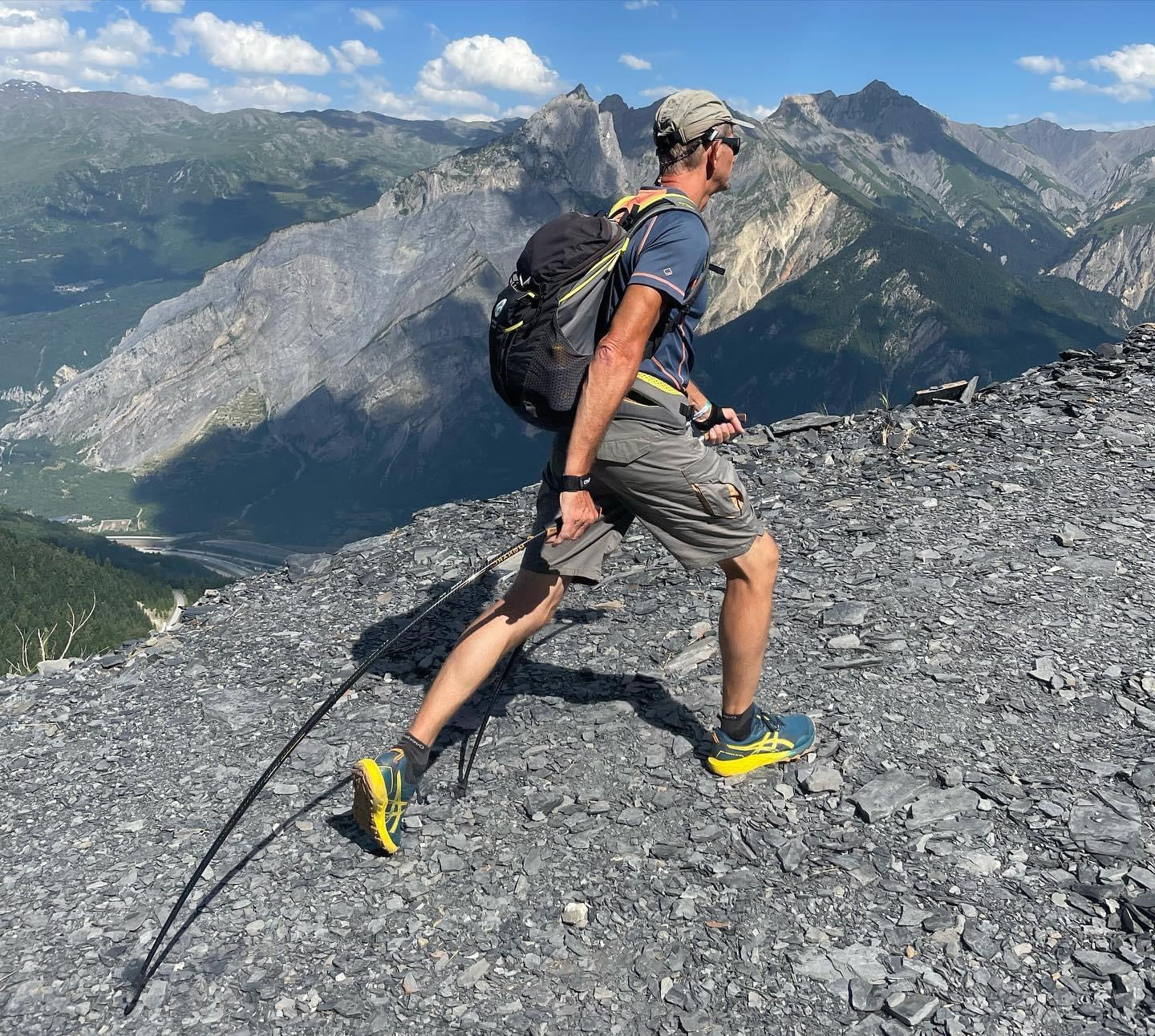
Nordic Walking and Trail: Can You Use the Same Poles?
In many cases, you can use the same poles. A good Nordic walking pole, light and stiff, makes a very good trail pole as long as you keep it in your hand, whether on climbs, on a vertical kilometre or on training runs. It becomes awkward when you have to stow it to run, and some races ban poles altogether. The reverse is less true, because most trail poles have neither the strap nor the tip that the Nordic walking push requires.
In short
- Two uses: in Nordic walking, you push on your poles at every step; in trail running, you use them mainly on climbs and stow them to run.
- Nordic walking poles for trail: they are very effective on climbs, on vertical kilometres and in training, but a one-piece pole does not fold.
- Trail poles for Nordic walking: they can serve as a stopgap, but without a proper strap the hand cannot open at the end of the push.
- Length: trail pole makers recommend roughly the same length as for Nordic walking, with the elbow at a right angle. For climbing, take the shorter of the two possible lengths.
- Race rules: poles are often allowed provided you keep them until the finish (UTMB World Series races), and sometimes banned (Grand Raid de La Réunion, Sierre-Zinal). Always read the race rules.

Two sports, two ways of using poles
In Nordic walking, the pole drives the movement. It is planted at a backward angle, roughly between the feet, then the arm pushes back past the hip. At the end of the push, the hand opens and the strap holds the pole. The movement is alternating and continuous from the start to the end of the session, on the flat as on climbs.
In trail running, poles are mainly used when the slope steepens. The runner switches to a fast hike and pushes on the poles, alternately or both together (double poling) when it is very steep. Downhill, they give support and braking on tricky sections. On the flat and on runnable sections they get in the way, so you carry them in your hand or stow them in your pack.
Both sports therefore ask the same things of a pole (lightness, stiffness, a tip that grips), but not at the same moments or in the same way, which explains their differences.
What sets a Nordic walking pole apart from a trail pole

| Feature | Nordic walking pole | Trail running pole |
|---|---|---|
| Construction | One-piece or telescopic | Folding in 3 or 4 sections (“Z-pole”), sometimes telescopic |
| Hold | Strap that wraps the hand, often quick-release | Wrist loop in most cases; clip-in half-glove from some brands |
| Grip | Short, cork or foam | Extended with a foam section, to hold the pole lower on climbs |
| Tip | Bevelled, with a rubber pad for asphalt | Carbide, often with a small basket |
| Weight of a carbon model | 140 g per pole for the Arcs de Marche® | About 135 to 150 g per pole at 120 cm (Leki, Black Diamond, Evadict) |
| Storage | In a bag, as a one-piece pole is 1 m to 1.30 m long | 35 to 43 cm folded, in the pack or a quiver |
The strap makes the real difference
In Nordic walking, the hand opens at the end of every push, and without a strap the pole would drop. The strap wraps the hand and transmits the push even with the hand open. Most trail poles have a simple wrist loop, designed for a hand closed on the grip. It is enough to push uphill, but not for the full Nordic walking movement. Some brands, such as Leki, do fit their trail poles with a clip-in half-glove close to a Nordic walking strap. To choose yours, read our article Nordic walking straps: role, sizes and how to choose.
The tip and the grip
A Nordic walking tip is bevelled so that it grips while the pole is angled backwards; on asphalt, it is covered with a rubber pad. A trail pole has a standard carbide tip, often with a small basket that stops it sinking into mud or between stones. As for the grip, a trail pole often has a foam extension below it. On steep climbs, the runner slides a hand down onto it to shorten the pole without adjusting it.
Folding or one-piece
This is the difference that matters most in a race. A folding trail pole collapses in a few seconds into three or four sections joined by a cord, and fits in the pack or a quiver. A one-piece pole does not fold, but it has no joint and no mechanism. It is therefore stiffer, nothing works loose, and the whole push goes into the ground. The details are in our article One-piece or telescopic Nordic walking poles: which to choose?
What poles bring in trail running
Studies on poles in trail running are few and involve small groups, but they point the same way.
- On steep climbs, a little energy saved. On a treadmill, 14 mountain runners used 2 to 3% less energy per metre of ascent with poles on the steepest slopes tested, from 25 to 35°, or roughly 47 to 71% gradient (Giovanelli et al., 2019).
- Legs spared, a little more speed. In 15 trained trail runners, poles reduced the force under the feet on climbs, without changing heart rate or oxygen uptake. At maximal effort, they climbed 2.5% faster with poles (Giovanelli et al., 2023).
- Less muscle damage. After climbing and descending Snowdon, in Wales, the group with poles had lost less strength, had less soreness 24 and 48 hours later, and found the climb less hard (Howatson et al., 2011).
- Less load on the knee downhill. On a 25° slope, poles reduced the forces measured in the knee joint by 12 to 25% (Schwameder et al., 1999).
These benefits come from poles in general. The choice of model depends rather on how you push, on the weight carried at the end of your arms for hours, and on what you do with the poles when you are not using them.
Trail running with your Nordic walking poles
On climbs, they are in their element
Climbing is where Nordic walking and trail running meet. In both, you lean your upper body forward, shorten your stride and push actively on your poles. A Nordic walking pole is perfectly at home here. The strap lets you push far back without squeezing the grip, which spares the forearms on a long climb. On the steepest slopes, double poling takes over, as on a vertical kilometre with poles.
This is also where the shape of the pole matters. With a straight pole, part of the push goes downwards and lifts you up. The curve of the MØNARC® Arcs de Marche® brings that push forwards. The Université Grenoble Alpes measured a push angle of 33° with the Arcs against 46° with straight poles, and 22% more efficient propulsion, for the same oxygen uptake and the same heart rate. These measurements were taken on a track, at 5 and 6 km/h, and this propulsion is what our walkers call the booster effect.

The limits of a one-piece pole in trail running
- Stowing: a one-piece pole does not fold. On runnable sections, you carry it in your hand, held in the middle, tips pointing back and down. A pole over a metre long is hard to attach to a running vest. If your race often alternates climbs and long runnable sections, a folding pole will be more practical.
- Descending: on technical descents, it is wise to free your hand so you can let go of the pole if it jams between two stones. With quick-release straps, like those of the Arcs, you unclip your hand in one move and clip back in at the bottom.
- Asphalt: on tarmac link sections, the tungsten carbide tip grips poorly and wears. Fit rubber pads; for the Arcs, they are sold separately.
Who a one-piece pole makes sense for in trail running
A one-piece pole makes sense if you keep your poles in hand from start to finish, as in the following situations:
- hill training sessions and climbing workouts, where the poles never leave your hands;
- vertical kilometres, which are one long climb;
- mountain trails where walking dominates, and races that require you to keep your poles until the finish;
- fast hiking, ultra-walking and Nordic walking in the mountains.
A folding pole remains more practical on runnable trails, where you run most of the time, and in races that require poles to be stowed on part of the course.

And trail poles for Nordic walking?
For a taster session, they will do. For regular practice, they have three drawbacks. The wrist loop does not let the hand open at the end of the push. The tip grips less well when the pole is angled backwards, and there is no rubber pad for asphalt. Finally, the joints of a folding pole add a little play where Nordic walking needs a stiff pole, pushed thousands of times per session. If you do both sports, the Nordic walking pole is the one that crosses over best.
What length for trail running?
You often read that a trail pole should be shorter than a Nordic walking pole. The makers' size charts do not bear this out. They arrive at similar lengths, around two thirds of your height, with the elbow at a right angle when the pole is held upright.
| Your height | Arcs de Marche® (height × 0.68) | Black Diamond, running poles | Evadict, trail poles |
|---|---|---|---|
| 1.62 m | 110 cm | 110 cm | 110 cm |
| 1.70 m | 115 cm | 115 cm | 110 cm |
| 1.78 m | 120 cm | 120 cm | 120 cm |
| 1.85 m | 125 cm | 125 cm | 130 cm |
The difference shows on climbs. Trail runners shorten the pole by sliding a hand down the grip extension, and Black Diamond advises taking the shorter of two lengths when in doubt, because in running it is the uphill push that counts. With a fixed-length one-piece pole, apply the same logic by keeping your Nordic walking length, that is height × 0.68 and the shorter of two lengths, without going up a size. Our size guide gives the length for each height, and our article on the vertical kilometre covers technique on the steepest slopes.
What race rules say
In trail running, each organiser sets its own rule, because World Athletics leaves the use of poles to the organiser's discretion, especially over long distances. There are three cases.
- Allowed, but to be kept until the finish. This is the rule in UTMB World Series races. Runners who start with poles must carry them for the whole race, picking them up along the way is forbidden, and they are not allowed in drop bags. Their use may also be banned in certain signposted areas.
- Banned. At the Grand Raid de La Réunion, including the Diagonale des Fous, any pole is forbidden, with a one-hour penalty. At Sierre-Zinal, in Switzerland, carrying poles on the course means disqualification.
- Compulsory. In Nordic walking competitions, poles are part of the discipline. The Arcs de Marche® are accepted on all circuits in Europe. Dates and formats are in our article Nordic walking competitions: are there races and events?
For a one-piece pole, the “keep them to the finish” rule changes nothing, since you had them in hand anyway. It is the areas where poles must be stowed, and the long runnable sections, that favour folding poles.
One pair for both?
If you run fast, runnable trails, keep a folding pole for racing and Nordic walking poles for your sessions. If you walk a lot, climb a lot and keep your poles in hand, a single pair of light one-piece poles is enough.
The Arcs de Marche® were designed for this use. Built for the Nordic walking movement, light and stiff enough for long climbs, they are as much at home in club sessions as on mountain outings. We explain what they change over very long distances in Poles in ultra-trail: why curved poles really make a difference.
Many clubs offer both Nordic walking and trail running. The MØNARC® Partner Club label gives their members €30 off each pair of Arcs de Marche®, and the club preferential terms on certified training courses.
Frequently asked questions
Can you use Nordic walking poles for trail running?
You can, especially on climbs, on vertical kilometres and in training, when you keep your poles in hand. Storage is their limit. A one-piece pole does not fold, which is a nuisance on trails where you run a lot.
Can you do Nordic walking with trail poles?
They will do for a first try. For regular practice, they usually lack a proper strap, which lets the hand open at the end of the push, as well as a rubber pad for asphalt.
Are trail poles shorter than Nordic walking poles?
They are not really shorter. The makers' size charts give similar lengths, with the elbow at a right angle. On climbs, trail runners shorten their hold on the extended grip or choose the shorter of the two possible lengths.
Are poles allowed in trail races?
It depends on the race. They are allowed in many long trail races, often with the obligation to keep them until the finish (UTMB World Series), and banned in others (Grand Raid de La Réunion, Sierre-Zinal). The race rules always prevail.
Should you keep the straps on downhill?
On a technical descent, it is better to free your hand so you can let go of the pole if it jams. Quick-release straps unclip and clip back in with one move.
Do the Arcs de Marche® fold?
They do not fold. They are fixed-length one-piece poles, from 100 to 130 cm, chosen when you buy them, and that is what makes them stiff and free of play. They travel in their made-to-measure bag.
Sources
- Giovanelli N. et al., “Do poles save energy during steep uphill walking?”, European Journal of Applied Physiology, 2019, 119: 1557-1563.
- Giovanelli N. et al., “Do poles really ‘save the legs’ during uphill pole walking at different intensities?”, European Journal of Applied Physiology, 2023, doi: 10.1007/s00421-023-05254-9.
- Howatson G. et al., “Trekking poles reduce exercise-induced muscle injury during mountain walking”, Medicine & Science in Sports & Exercise, 2011, 43(1): 140-145.
- Schwameder H. et al., “Knee joint forces during downhill walking with hiking poles”, Journal of Sports Sciences, 1999, 17(12): 969-978.
- Termoz N., Depery E., Lorenzi G., Université Grenoble Alpes: study of MØNARC® curved poles compared with straight poles.
- Race rules checked in October 2026: UTMB World Series (2025 race rules), Grand Raid de La Réunion, Sierre-Zinal; World Athletics, “Mountain and Trail Running” page.
- Size charts and specifications from Black Diamond (Distance Carbon Z), Leki (Ultratrail FX.One Superlite) and Evadict, checked in October 2026.

The MØNARC® Arcs de Marche®
These curved 100% carbon Nordic walking poles weigh 140 g each and are designed and assembled in France. They are delivered ready to walk with straps, tungsten carbide tips and a made-to-measure bag.
Disclaimer. This article provides general information. It does not replace the advice of a doctor or health professional, nor supervision by a qualified instructor. Before starting or stepping up physical activity, especially if you have a health condition, pain or ongoing treatment, consult your doctor. Exercise according to your fitness, on suitable ground and with equipment in good condition. Each reader remains solely responsible for their own practice and for the decisions they make based on this information, and MONARC SAS cannot be held liable for their consequences.