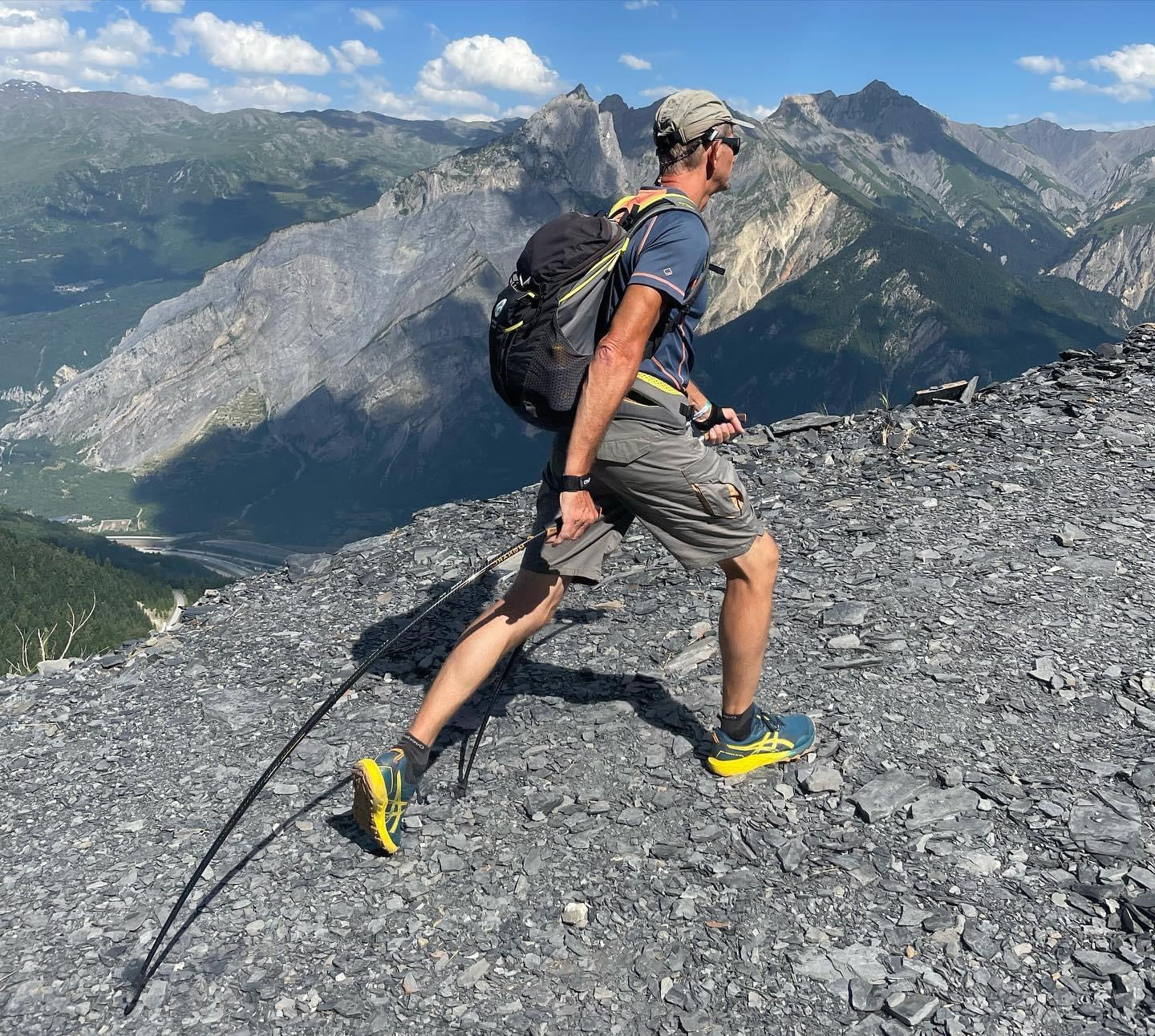
Vertical Kilometre (VK) with Poles: Technique, Equipment and Mistakes to Avoid
A vertical kilometre (VK) is 1,000 metres of elevation gain in under 5 km, on slopes that often exceed 30% and approach 60% in places. At these gradients almost everyone walks, and poles save about 2.5% of time at maximal effort while making the effort feel markedly easier, according to the studies of Nicola Giovanelli and his colleagues. Here is how to use them, what equipment to choose and the mistakes that cost minutes.
In short
- A VK: 1,000 m of climbing in under 5 km. The steepest, such as Fully in Switzerland, exceed a 50% average gradient.
- Walk rather than run: above a gradient of about 28%, walking costs less energy than running.
- What poles do: about 2.5% of time saved at full effort and 14 to 18% lower perceived exertion, but only 2 to 3% of energy saved.
- Technique: plant the pole near the front foot, push down and back, alternating or double poling depending on the slope.
- Equipment: stiff, light poles, carbide tips, straps that release quickly. Read the rules too, because some VKs, such as Chamonix, ban poles.
What is a vertical kilometre?
The vertical kilometre is an uphill-only race that gains 1,000 metres of elevation, within 5%, on a course of less than 5 km. This is the original definition of the International Skyrunning Federation (ISF), also used by the researchers who study the discipline. In its rules approved in December 2025, the ISF places the VK among “Vertical” races. These races go uphill only and climb at least 800 m, with an average gradient of at least 20% and at least 5% of the course steeper than 33%.
The fastest courses have a gradient close to 30°, or about 58% (Giovanelli et al., 2016). Most VKs are run as time trials with staggered starts, for example every 15 seconds at the Chamonix KM Vertical. Each organiser sets its own rules, notably on poles and helmets.

The best-known VKs and the records
| Race | Distance and average gradient | Poles | Good to know |
|---|---|---|---|
| Fully Vertical Kilometre (Valais, Switzerland) | 1.92 km, over 50% (up to 60%) | Strongly recommended | Helmet compulsory; follows the old funicular line; world records |
| Dolomites Vertical Kilometer (Canazei, Italy) | 2.6 km, about 38% | Depends on the year's rules | Finish on the summit of Crepa Neigra, at 2,465 m |
| Chamonix KM Vertical (Marathon du Mont-Blanc) | 3.8 km, about 26% | Banned (technical final section) | A start every 15 seconds, finish at Planpraz, at 2,000 m |
Fully is the world benchmark. It was there, in October 2025, that Switzerland's Rémi Bonnet set the world record of 27'21, nearly 2,200 m of climbing per hour, and France's Axelle Mollaret the women's record of 32'52. The previous record, 28'53, had stood since 2017. Kilian Jornet's 28'48 on the Vengetind, in Norway, in 2021 is not official, because he ran alone, outside a race.
To put these figures in context, the classic hikers' rule of thumb counts about 300 m of climbing per hour. In an Italian study, trained trail runners climbed at nearly 1,400 m per hour at full effort on a steep path (Giovanelli et al., 2022), which would mean a VK in about 45 minutes.
In France, the French Athletics Federation also holds a French vertical race championship every summer.

Walk or run on a VK?
On a VK, the question is not whether you will walk, but when. In 2016, Rodger Kram's team at the University of Colorado had 15 runners climb a treadmill tilted from 9° to 39°, walking then running, at a fixed vertical speed of 1,260 m per hour. Above about 16° (a 28% gradient), walking cost less energy than running, 8% less on average. And the energy spent per metre gained is lowest between 20° and 35°, i.e. between 37 and 70% (Giovanelli et al., 2016).
A second study, on a 30° slope (58%), pins down the threshold. Up to 0.7 m/s along the slope, walking remains cheaper than running (Ortiz et al., 2017). That corresponds to 1,260 m of climbing per hour, or a VK in about 48 minutes on this kind of slope. If you climb more slowly, walk. Beyond that, running can pay off, which mainly concerns the elite.
For most participants, then, the VK is a walking event with poles. Nordic walkers have every reason to take part, since they practise pushing on poles on every outing.
What poles really bring on a VK
Nicola Giovanelli and his colleagues at the University of Udine (Italy) have devoted a series of studies to poles on steep climbs. Their results are nuanced.
| Study | What was tested | With poles |
|---|---|---|
| Giovanelli et al., 2019 | 14 mountain runners, on a treadmill, 7 slopes from 10° to 39° (18 to 81%) | Energy: −2 to −2.8% at 25°, 30° and 35°. Perceived exertion: −14 to −18.5% on 5 of the 7 slopes. Fewer (−6.7%) and longer (+8.6%) steps |
| Giovanelli et al., 2022 | 15 athletes on a 1.3 km path with 433 m of climbing, at full effort and at 80% | Full effort: 18'51 versus 19'19 without poles, 12 of 15 athletes faster. At 80%: no difference |
| Giovanelli et al., 2023 | 15 trail runners, on a treadmill then on a path, at 80% and at full effort | Force under the feet: −2.4 to −5.2%. Energy cost unchanged. Full effort: 2.5% faster |
| Giovanelli et al., 2026 | 16 trail runners, before and after a simulated 31 km race with 2,086 m of climbing | After the race, walking without poles costs 2.5% more energy. Perceived exertion lower with poles, before and after |
Here is what to take away:
- Poles save time at full effort. The gain is about 2.5%, i.e. some thirty seconds over 20 minutes of effort, or more than a minute on a 45-minute VK.
- They make the effort more bearable. Perceived exertion falls far more than actual energy cost, and the legs are slightly relieved.
- They save little energy. The saving reaches 2 to 3% at best, but their value grows with fatigue.
- They change your stride. Steps become longer and less frequent, which you can practise in training.
Nordic walking shows the same thing. On a 15% climb, it costs only 6.9% more energy than walking without poles, against 22.3% on the flat, while the upper body works 2 to 15 times harder (Pellegrini et al., 2015).

All these studies were carried out with straight poles. The shape of the pole itself was studied for the first time by Université Grenoble Alpes, with the MØNARC® Arcs de Marche®. On a flat track, their curve directs the push 13° closer to the horizontal than a straight pole.
How to use your poles on steep slopes
Posture
Lean forward from the ankles, without bending at the waist. Keep your back long and your eyes a few metres ahead, and take short steps.
Where to plant, how to push
Plant the pole near your front foot, level with it or just ahead. Planted far ahead, it brakes before it pushes and forces you to pull with your shoulders. Then push down and back until your hand reaches your hip. On steep slopes, this movement is shorter than on the flat.
Alternating or double poling?
Two techniques coexist, and no study has yet compared them for uphill walking:
- Alternating: the opposite arm and leg work together, as in Nordic walking. This technique suits moderate slopes, restarts and moments when your arms tire.
- Double poling: both poles are planted together, usually every two steps, and the upper body leans on them. Many runners choose it on the steepest sections.
Switch from one to the other according to the slope and how you feel. Unlike competitive Nordic walking, where double poling is excluded, a VK does not judge your technique. For the story of this movement borrowed from cross-country skiing, read our investigation into double poling.

Cadence
With poles, your steps lengthen and their frequency drops slightly (Giovanelli et al., 2019). Let it happen, and find a rhythm you can hold all the way to the top.
Very steep or technical sections
On rocky steps, hold both poles in one hand and use the other to help yourself up. If the rules ban poles, as at Chamonix, also train without them, with your hands on your thighs.
What pole length for a VK?
Uphill, the pole is planted higher than your feet, so at the same length it feels longer than on the flat. With adjustable poles, the usual practice is to shorten them by 5 to 10 cm for climbs. But no study has established the ideal length for a VK, and longer poles lengthen the push phase (Saller et al., 2023). There is therefore no point shortening them too much.
With fixed-length poles such as the Arcs de Marche® (from 100 to 130 cm, in 5 cm steps), there is nothing to adjust during the race, since a VK is all uphill. Our size rule does not change. Length = height × 0.68; between two lengths, take the shorter one (a very sporty walker can take the one above). For mainly uphill use, stick to the shorter one. All the guidance is in our size guide.
Equipment for a VK
- Stiff poles. A pole that flexes or a telescopic section that slips loses part of your push. Our comparison one-piece or telescopic explains the differences.
- Light poles. Their weight has little effect on energy cost (Saller et al., 2023), but a light pole handles faster and more precisely.
- No need for folding poles. On a VK, you keep your poles in hand from start to finish.
- Tungsten carbide tips. They grip earth, roots and rock. Our article on the different types of tips helps you choose.
- Straps that transmit the push and release quickly. If you fall, you must be able to let go of your poles in a second.
- The rest: bring trail shoes with good grip, a helmet if the rules require it (as at Fully) and a watch with an altimeter to track your vertical speed in metres per hour. Our guide to apps and smartwatches helps you choose one.
The MØNARC® Arcs de Marche® meet this specification. Each pole weighs 140 g and is made of a single piece of T700 carbon, with no mechanism that could work loose. The tungsten carbide tips can be replaced and the straps unclip in one movement. These poles are designed for the Nordic walking movement, not adapted from a hiking pole. Do you also run trails? Read Nordic walking and trail running: can you use the same poles?, and for long distances, Poles in ultra-trail: why curved poles really make a difference.
Mistakes to avoid
- Not reading the rules. Each organiser decides whether poles are allowed everywhere, on part of the course or not at all (banned at Chamonix). At the start, keep your tips pointing down.
- Discovering your poles on race day. They change your stride and work your arms, shoulders and trunk. Do your hill sessions with them.
- Starting too fast. An over-ambitious start is paid for in the second half. Aim for a vertical speed you can sustain.
- Running where walking is better. Above a gradient of about 28%, walking costs less energy, except at very high speed.
- Planting the poles too far ahead. The pole brakes before it pushes, and your shoulders pull instead of pushing.
- Poles that flex or slip. A loosely locked telescopic pole can shorten under the push. Check the locks, or choose a one-piece pole.
- Staying strapped in on tricky sections. In a fall on a 50% slope, poles attached to your wrists can injure you. Quick-release straps unclip in one movement.
Preparing your first VK
- Train on hills, with your poles. Do repeated climbs of 5 to 10 minutes, then long climbs at your target pace.
- Measure your vertical speed on a familiar climb to estimate your time.
- Start with an accessible VK. A 3 to 4 km course is less steep than a route like Fully.
- Prepare it with your club. The instructor can correct your technique on climbs.
Does your Nordic walking club organise mountain outings? The MØNARC® Partner Club label gives its members €30 off each pair of Arcs de Marche® and preferential terms on our certified training courses.
Frequently asked questions
Do you need poles for a VK?
They are not compulsory, but they are recommended on steep slopes if the rules allow them. They save about 2.5% of time at full effort and make the effort more bearable (Giovanelli et al., 2022 and 2023).
How long does a VK take?
The world records, set at Fully in 2025, are 27'21 for men and 32'52 for women. Trained trail runners would complete a VK in about 45 minutes. It all depends on the gradient, the terrain and your level.
Double poling or alternating on a VK?
The two complement each other. Alternating suits moderate slopes, double poling the steepest sections. No study has settled the question for uphill walking.
Can you do a VK with Nordic walking poles?
Yes. A VK is walked almost entirely, and Nordic walking poles with straps transmit the push well. The MØNARC® Arcs de Marche®, 140 g one-piece poles in T700 carbon, have no mechanism that could work loose mid-climb.
What pole length for a VK?
With adjustable poles, shorten them by 5 to 10 cm compared with the flat. For Arcs de Marche®, apply our rule. Length = height × 0.68; between two lengths, take the shorter one (a very sporty walker can take the one above). Details are in our size guide.
Sources
- Giovanelli N., Ortiz A.L.R., Henninger K., Kram R., Journal of Applied Physiology, 2016, 120(3): 370-375.
- Ortiz A.L.R., Giovanelli N., Kram R., European Journal of Applied Physiology, 2017, 117(9): 1869-1876.
- Giovanelli N., Sulli M., Kram R., Lazzer S., “Do poles save energy during steep uphill walking?”, European Journal of Applied Physiology, 2019, 119(7): 1557-1563.
- Giovanelli N., Mari L., Patini A., Lazzer S., “Pole Walking Is Faster but Not Cheaper During Steep Uphill Walking”, International Journal of Sports Physiology and Performance, 2022, 17(7): 1037-1043.
- Giovanelli N., Pellegrini B. et al., European Journal of Applied Physiology, 2023, 123(12): 2803-2812.
- Giovanelli N., Mari L. et al., European Journal of Applied Physiology, 2026, 126(1): 249-258.
- Pellegrini B. et al., PLoS One, 2015, 10(9): e0138906.
- Saller M. et al., Bioengineering, 2023, 10(4): 497.
- Termoz N., Depery E., Lorenzi G., Université Grenoble Alpes, comparative study of straight poles and MØNARC® curved poles (study overview).
- International Skyrunning Federation (ISF), sport rules approved on 5 December 2025.
- Official websites of the Fully Vertical Kilometre, the Marathon du Mont-Blanc (KM Vertical) and the Vertical Kilometer® World Circuit; Fully 2025 results (Carreras de Montaña, Reference Trail); Outside, November 2021 (Kilian Jornet). Accessed in October 2026.

The MØNARC® Arcs de Marche®
These curved 100% carbon Nordic walking poles weigh 140 g each and are designed and assembled in France. They are delivered ready to walk with straps, tungsten carbide tips and a made-to-measure bag.
Disclaimer. This article provides general information. It does not replace the advice of a doctor or health professional, nor supervision by a qualified instructor. Before starting or stepping up physical activity, especially if you have a health condition, pain or ongoing treatment, consult your doctor. Exercise according to your fitness, on suitable ground and with equipment in good condition. Each reader remains solely responsible for their own practice and for the decisions they make based on this information, and MONARC SAS cannot be held liable for their consequences.